
Gaza Herald- In the corridors of Gaza’s Eye Hospital, dozens of Palestinians crowd into a suffocating space. Some lean against the walls, others collapse on the floor, and only a handful manage to sit on the few available chairs. Their faces reflect exhaustion, grief, and hunger. What unites them all is the urgent need for eye treatment, a need that Gaza’s collapsing medical system can no longer meet.
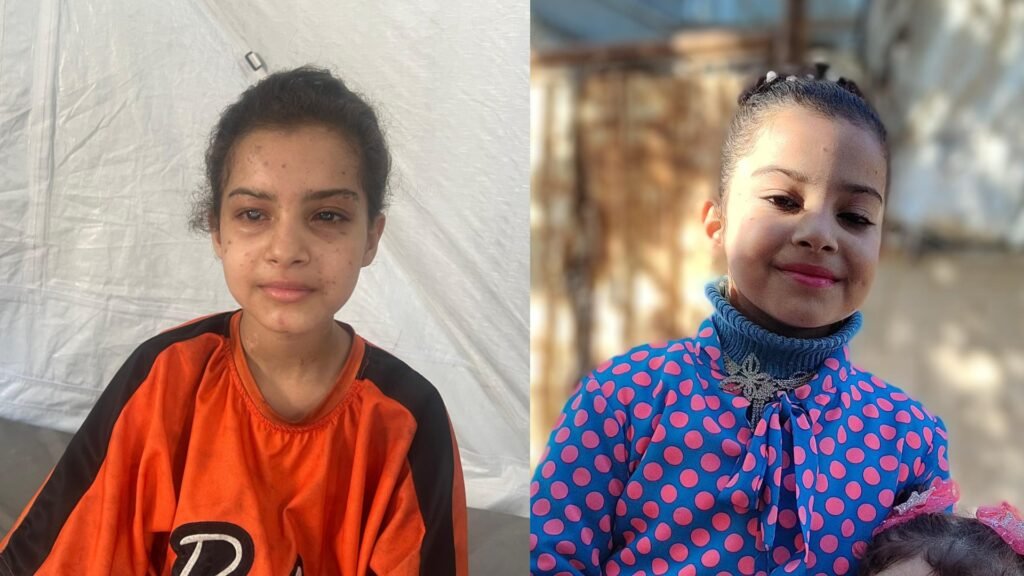
Among them is 11-year-old Maria Rihan, a child whose life was shattered on June 9 when an Israeli air strike leveled her family home in Jabalia refugee camp. The bombing killed her parents, brother, and sisters instantly, leaving her trapped under rubble with devastating eye injuries. Hours later, relatives managed to pull her out using primitive tools, as civil defense teams were blocked from reaching the area due to nearby Israeli assaults.
Transferred to Gaza’s already overwhelmed Shifa Hospital, doctors referred Maria to the Eye Hospital for emergency surgery. But with operating rooms overflowing and medical staff stretched beyond capacity, she waited two days before entering surgery, a delay that cost her nearly all her vision. One eye is completely blind, and the other has suffered near-total damage. Her surviving relatives now care for her in a tent in western Gaza after their displacement from Jabalia. Doctors have warned that her remaining sight could only be salvaged through procedures available abroad, but her evacuation has been stalled by Israel’s blockade.
Maria’s case reflects a growing tragedy in Gaza. Palestinian health officials estimate that at least 1,500 people have already lost their eyesight since the war began in October 2023. Many were blinded directly by shrapnel and gunfire; others lost their vision due to the destruction of hospitals, shortages of equipment, and Israel’s systematic targeting of Gaza’s medical infrastructure. Between 4,000 and 5,000 more are currently at risk of blindness, unable to receive the treatment they urgently need.
15,000 patients need urgent evacuation
The World Health Organization (WHO) has confirmed that while around 7,000 patients have been evacuated abroad for urgent care, at least 15,000 more are waiting in critical condition. At the current rate, it could take a decade to evacuate them all. For Maria, whose uncle submitted medical evacuation paperwork weeks after her injury, there has still been no response.
Inside Gaza’s Eye Hospital, the situation has reached catastrophic levels. Dr. Majed Kaheel, a senior ophthalmologist, describes a flood of patients arriving daily, from children with eye cancer and diabetic patients requiring routine laser treatment, to civilians suffering from severe trauma caused by Israeli strikes. But with key equipment destroyed, doctors have been left powerless. Laser machines and injections are gone, visual field tests and pressure monitors for glaucoma are unavailable, and surgical capacity has collapsed. Patients who might have been saved are instead left to deteriorate into blindness.
20 percent of war-related injuries are eye-related
The statistics are staggering. In June, hospital records showed that 20 percent of war-related injuries were eye-related, with 40 percent leading to total blindness. In July, the figure rose to 28 percent, particularly after Israeli forces opened fire on civilians at food distribution points. Many of the wounded lost their sight while waiting for basic aid.
Beyond the numbers lies a deeper humanitarian crisis. Visually impaired people are among Gaza’s most vulnerable. Living in tents on unpaved roads, dependent on others to navigate chaotic camps and makeshift toilets, they face daily risks of injury and humiliation. For children like Maria, the loss of sight compounds the trauma of losing parents, homes, and entire lives.
Gaza today is a place where preventable blindness has become permanent, not because of a lack of medical expertise, but because of deliberate destruction and systematic blockade. For the young, the elderly, and the thousands caught in between, the darkness they now endure is both literal and symbolic a human cost of war that continues to deepen in silence.

