
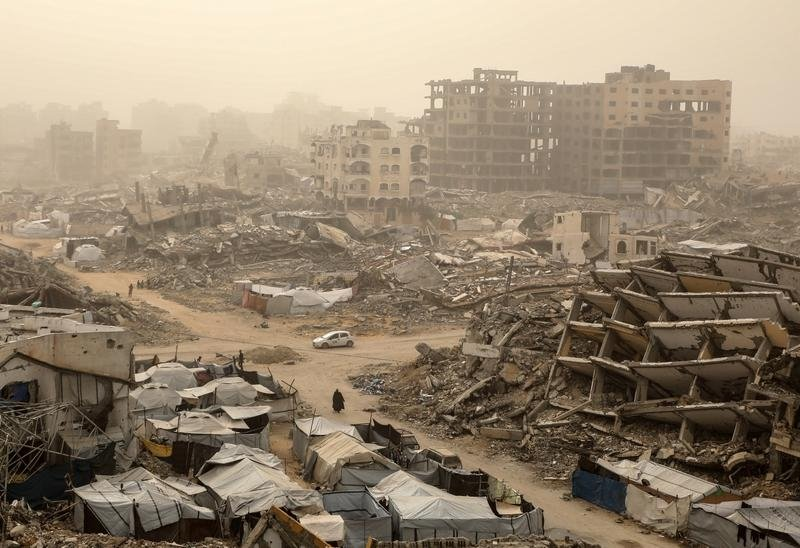
Gaza Herald – A United Nations official has revealed that approximately 8,000 bodies of Palestinians remain trapped beneath the rubble in the Gaza Strip, as debris removal efforts continue at an extremely slow pace following more than two years of devastating genocide.
The official, working with the United Nations Development Programme, told Haaretz that less than 1% of the debris has been cleared so far, warning that at the current rate, the process could take up to seven years to complete.
Thousands of bodies are believed to be still decomposing under collapsed buildings, while families continue to wait for the recovery of their loved ones to provide proper burials.
According to the report, these estimates are based on recent data from the Palestinian Civil Defense, which highlighted severe delays in rubble removal due to a lack of equipment and resources necessary to accelerate attacks.
A separate assessment published last month by the United Nations, the European Union, and the World Bank estimated that recovery and reconstruction in Gaza will require approximately $71.4 billion over the next decade.
The joint report indicated that around $26.3 billion will be needed within the first 18 months alone to restore essential services, rebuild critical infrastructure, and support economic recovery.
It also estimated physical damage to infrastructure at $35.2 billion, with broader economic and social losses reaching $22.7 billion.
The most heavily affected sectors include housing, healthcare, education, commerce, and agriculture. More than 371,000 housing units have been destroyed or damaged, over half of Gaza’s hospitals are no longer operational, and nearly all schools have been impacted.
The report further noted a dramatic contraction of Gaza’s economy by approximately 84%, alongside a severe decline in human development indicators, set back by an estimated 77 years.
Nearly 1.9 million Palestinians have been displaced, often multiple times, with over 60% of the population losing their homes in the Israeli attacks. Vulnerable groups, including women, children, and persons with disabilities, have borne the heaviest burden of the crisis.
The report stressed that recovery efforts must proceed alongside humanitarian operations to ensure a structured transition from emergency relief to large-scale reconstruction. It emphasized that rebuilding efforts should be led by Palestinians as part of a broader framework for sustainable recovery and governance.

