
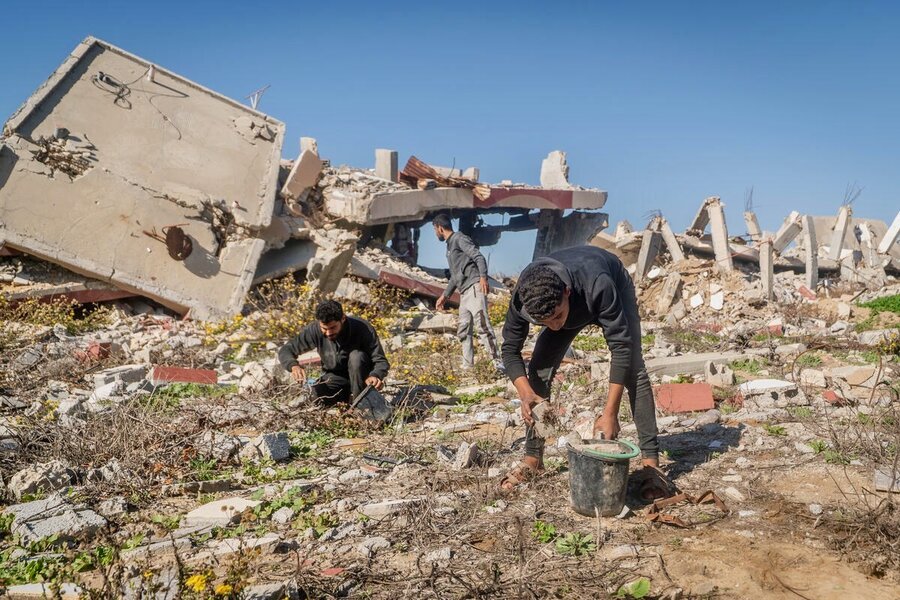
Gaza Herald – Palestinian farmers in eastern Gaza continue to face extreme daily danger while working near what is known as the “yellow line,” where Israeli occupation forces’ presence and frequent live fire make agricultural activity increasingly lethal.
According to field reports, only around 5% of Gaza’s agricultural land is currently cultivated, following the destruction and leveling of vast areas of farmland, particularly in the eastern regions that fall within proximity to the buffer zone, which accounts for a significant portion of Gaza’s remaining usable agricultural space.
Farmers describe an environment dominated by constant surveillance from Israeli drones, artillery positions, and military outposts, with sporadic gunfire and shelling making routine tasks such as irrigation, harvesting, and soil maintenance highly risky.
Many are forced to work in extremely short intervals, retreating whenever military vehicles approach or when firing begins, often abandoning tools and crops to save their lives. Despite these conditions, they continue attempting to maintain their livelihoods, as agriculture remains their only source of income.
In addition to security risks, farmers are also facing a severe economic burden. Production costs have risen dramatically, including irrigation systems, fuel for generators, and basic farming supplies, some of which have increased by more than ten times compared to pre-war prices. For example, irrigation materials that previously cost around 60 shekels (21$) now reach approximately 1,000 shekels (345$), while daily irrigation expenses for medium-sized farms can exceed 700 shekels (241$) due to fuel shortages and inflated energy costs.
The situation is further complicated by restricted access to land. Large portions of farmland near the eastern boundary are effectively inaccessible due to military restrictions, leaving farmers unable to cultivate entire sections of their property. Even when cultivation is possible, fields are often partially used, with the most exposed areas left fallow due to the high risk of Israeli gunfire and shelling.
In northern Gaza, some farmers are attempting to revive agriculture on cleared or previously destroyed land using minimal traditional tools, after most modern equipment was destroyed during the genocide. However, these efforts remain limited due to shortages of seeds, irrigation systems, and the ongoing restrictions on agricultural inputs.
Agricultural experts warn that Gaza has lost the vast majority of its productive capacity, leading to a severe decline in food production and a sharp rise in prices, contributing to deepening food insecurity across the territory. The continued instability along agricultural zones, combined with destruction and restricted access, has made farming increasingly unsustainable, with many describing the situation as a gradual collapse of the sector under ongoing war conditions.

