
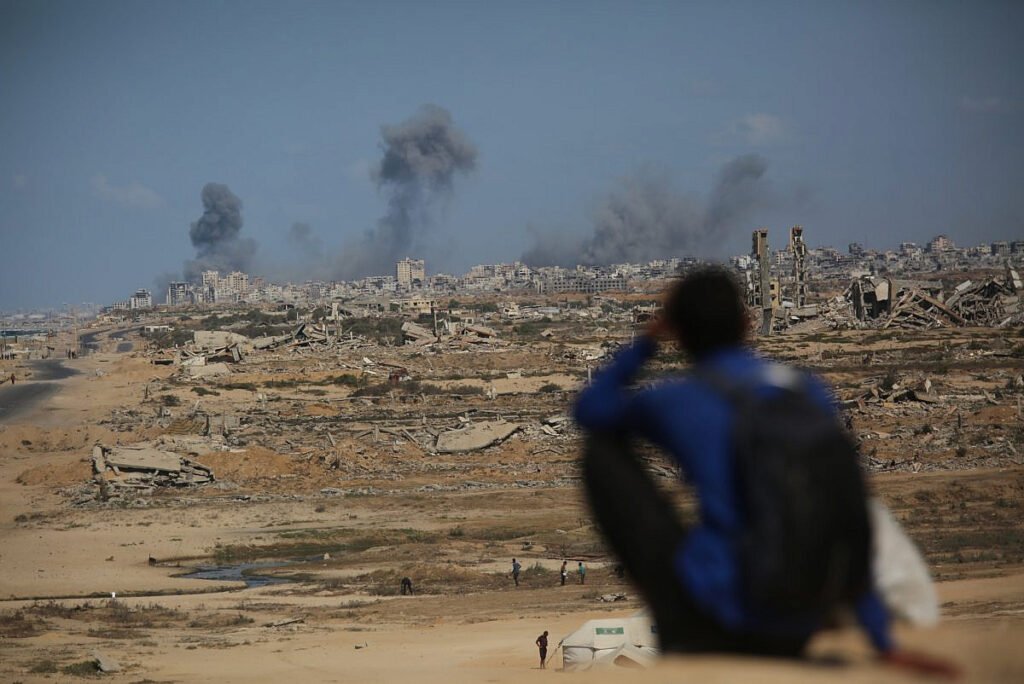
Gaza Herald – Hani Abu Issa went to the Deir el-Balah market Saturday morning expecting a simple errand: to buy a few ingredients for his family’s Ramadan iftar. Nothing more.
But when he arrived, he was stunned. Crowds had gathered in front of grocery shops, and the streets were buzzing with people carrying sacks of flour and emptying shelves. Confused, Hani asked a passerby what was happening, and learned that Israel had struck Iran, sparking fears of a wider conflict.
The panic spread quickly. Residents across Gaza rushed to purchase sugar, flour, cooking oil, and yeast, driving prices up as supplies dwindled.
“I don’t think this war between Israel, the U.S., and Iran will hit Gaza directly,” Hani, 51 and father of five, said. But he admitted that the population is no longer able to react to regional developments calmly.
“People are terrified of everything. Since early morning, everyone has rushed to the markets. That panic emptied shelves and caused prices to spike,” he said, standing amid the chaos.
Tensions only escalated when COGAT, the Israeli body controlling Palestinian crossings, announced on Facebook that the borders leading to Gaza and the West Bank would remain closed “until further notice,” citing security concerns related to the conflict with Iran.
Hani described the looming closure as deeply troubling.
“Flour, sugar, cooking oil, yeast… those are disappearing fast,” he said. “I lived through famine during Israel’s genocidal war on Gaza. There were days when a single sack of flour cost over 1,000 shekels [$319]. I can’t go through that again.”
He added that stockpiling while crossings remain sealed is not a viable solution.
“Goods run out too fast, and conditions here might spoil whatever we manage to store. All we need is someone to reassure us that the crossings will reopen, and that we will be safe.”
Confusion over the closures intensified because they coincided with the Jewish holiday of Purim. “We can’t trust Israel’s word, and no timeframe has been provided,” Hani said. “Gaza hasn’t recovered from two years of war and famine. I just want to leave with my two daughters and start over somewhere else.”
Memories of Famine Fuel Panic
Last year, during Ramadan, similar closures caused a severe shortage of goods in Gaza. Prolonged restrictions led to skyrocketing food prices and widespread hunger. International condemnation of Israel’s starvation policies was widespread, yet people continue to face the same threat.
In Nuseirat market, 28-year-old grocery seller Omar Al-Ghazali emphasized the deep psychological impact of past famines.
“People’s fear is completely justified,” he said. “They were shocked and frightened before and now they’re trying to protect themselves. Even though the war isn’t in Gaza, the fear of famine feels stronger than any rational analysis.”
“We can’t tell people not to buy,” he added. “What they went through was too painful. Fear has overtaken logic.”
Struggling to Survive
Not everyone can stock up. Asmaa Abu Al-Khair, a 38-year-old mother of eight, walked through Gaza City’s markets empty-handed, unable to afford even basic staples or store them in her small home.
“Where would I store anything? We need everything, but we can barely cover our daily needs during Ramadan,” she said. “I’m anxious. Everyone is talking about Iran and the crossings, and I can’t provide. I’m scared famine could come back. I have young children.”
Asmaa said displaced families living in nearby tents faced the same struggles: no money, no space, no relief.
“We survived the war barely, and the ceasefire just started,” she said. “So why close the crossings now? What more do we have to endure?”
When the border closure was announced, Asmaa described the moment as “a stab in my heart.”
Weariness and Desperation
Mohammed Daher, 46, now displaced in Deir el-Balah, said he had experienced the first peaceful Ramadan in two years, until news of the war with Iran arrived.
“I felt lost again,” he said. “But I decided not to stockpile. We are exhausted. Israel will use any excuse to starve Gaza and deepen the crisis.”
Daher explained that during the previous famine, he had spent nearly all his money on inflated prices for essential goods.
“Everything was like gold. Today, I have no energy to go through that again. Let whatever happens happen,” he said.
Gaza’s Humanitarian Crisis Worsens
Across social media, Palestinians voiced fears that Israel’s closure could intensify their suffering. Many warned that the blockade would disrupt aid distribution, pause charitable kitchens, and prevent critical medical travel for the sick and wounded.
Ali al-Hayek, a member of the Palestinian Businessmen Association in Gaza, described the economic devastation: more than 85% contraction due to Israel’s ongoing war, unemployment near 80%, poverty widespread, and 97% of industrial facilities shut down.
He urged the international community to pressure Israel to reopen crossings, restore normal operations, and ensure freedom of movement for goods and people.
“But traders must not exploit shortages to hike prices,” he said. “It’s Ramadan. Palestinians must show solidarity more than ever.”

