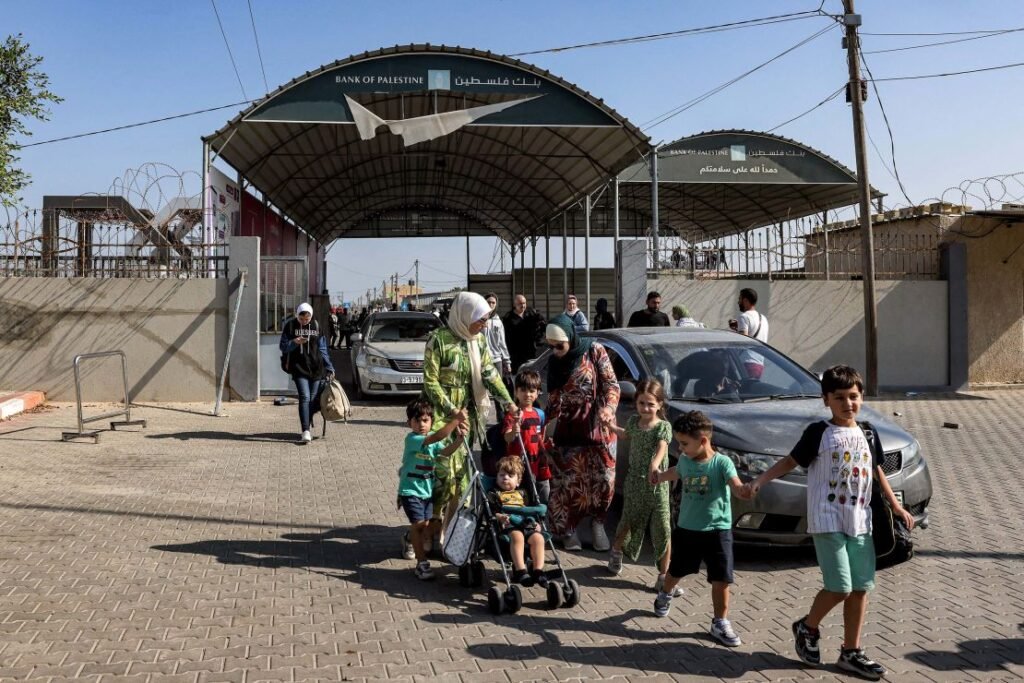
Gaza Herald — The Rafah land crossing was partially reopened on Sunday in both directions on a trial basis, under the supervision of representatives from Egypt and the European Union, with the participation of a representative from the Israeli army’s Coordination and Liaison Administration. The move comes as part of arrangements linked to the transition into the second phase of the ceasefire agreement and the US-backed plan for Gaza.
Egyptian sources said that members of the Palestinian security services arrived in the city of Al-Arish early Sunday morning, in preparation for assuming responsibilities related to managing the crossing during the coming phase, in line with ongoing understandings among the relevant parties.
In the same context, Israel’s public broadcaster reported that Israeli authorities will allow members of the so-called technocratic committee to enter the Gaza Strip through the Rafah crossing in the coming days, describing the step as a “gesture of goodwill” toward the US administration.
According to Israeli media, the crossing was opened for the first time since the outbreak of the war on Gaza under a limited operational framework. Egyptian authorities reportedly handed the Israeli side lists containing the names of the first travelers, who were subjected to Israeli security screening.
Sources explained that the first day of reopening was dedicated primarily to technical and logistical preparations. These included the arrival of a delegation from the Palestinian Authority and the experimental transfer of a limited number of wounded Palestinians through the crossing.
The number of Palestinians permitted to leave or return has not yet been finalized. Egyptian sources indicated that Cairo intends to allow the passage of individuals approved by Israeli authorities, as strict security restrictions remain in place.
For the first time since the beginning of the war, Gaza residents are expected to be able to travel through the Rafah crossing. However, at this stage, travel will be restricted to Gaza residents only, with foreign journalists barred from entry.
Actual travel is expected to begin on Monday, with approximately 150 departures per day, compared with the return of around 50 individuals. The initial operational capacity of the crossing is estimated at roughly 200 travelers per day, with expectations that the number of those leaving Gaza will exceed those returning.
The entry of the technocratic committee into Gaza via Rafah in the coming days is seen as a sign of the gradual implementation of the second phase of the US plan.
Under the current arrangements, Israel will be responsible for vetting the names of travelers, while the crossing itself will be managed on the ground by Palestinian staff under European supervision.
At the exit point of the crossing, a remotely controlled electronic revolving gate operated by Israeli security authorities allows the blocking of any individual who does not have prior approval, without the presence of Israeli forces at the site.
Entry into Gaza will be permitted only for approved residents. Arrivals will be transported by bus to an Israeli checkpoint, where identity verification and physical searches will be conducted.
Israeli media say these measures are intended to ensure that only authorized individuals enter Gaza and to prevent the smuggling of weapons or prohibited equipment through stringent security procedures imposed on travelers.
The Rafah crossing remains Gaza’s only land gateway to the outside world that does not pass directly through Israel. It is located in an area that has been under Israeli control since May 2024. The crossing was briefly reopened in early 2025 before being closed again, prior to the current trial operation.
The trial reopening of the Rafah crossing, while presented as a diplomatic breakthrough, falls far short of restoring genuine freedom of movement for Gaza’s population. What is being implemented is not a return to Palestinian sovereignty over a vital lifeline, but a tightly controlled system in which Israeli security approval remains the ultimate gatekeeper. By allowing more exits than returns, restricting access to residents only, and excluding international journalists, the process risks institutionalizing displacement rather than alleviating suffering. If Rafah is to serve as a true humanitarian passage, it must operate on principles of equality, transparency, and international law, not as a demographic filter or a political concession. Without these guarantees, the crossing’s reopening will remain a symbolic gesture, masking a deeper reality of continued control, exclusion, and enforced vulnerability for Gaza’s people.