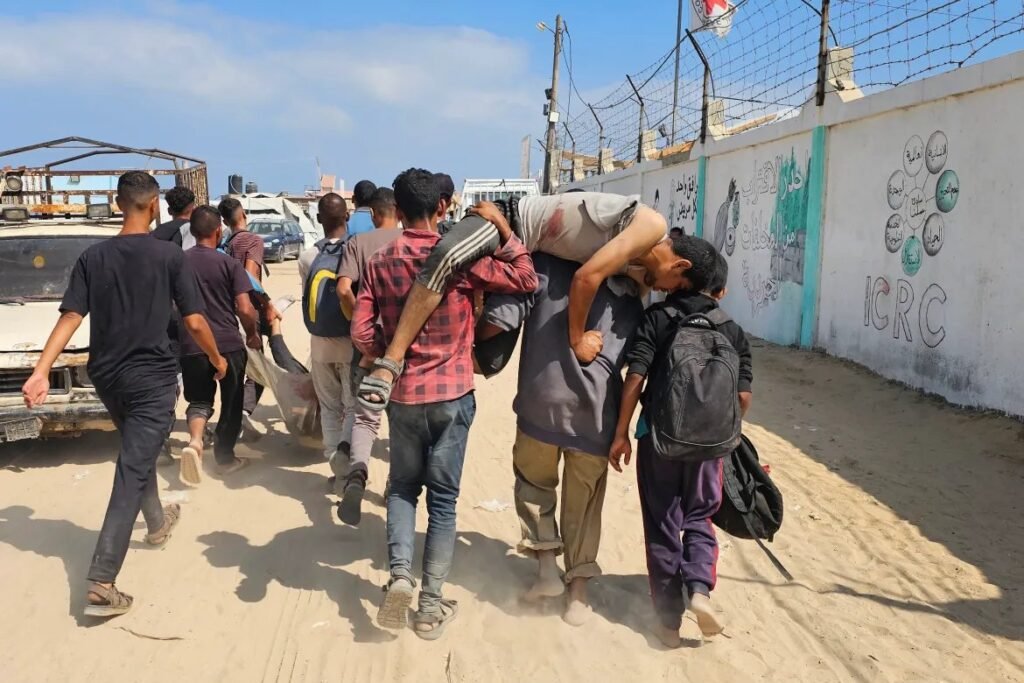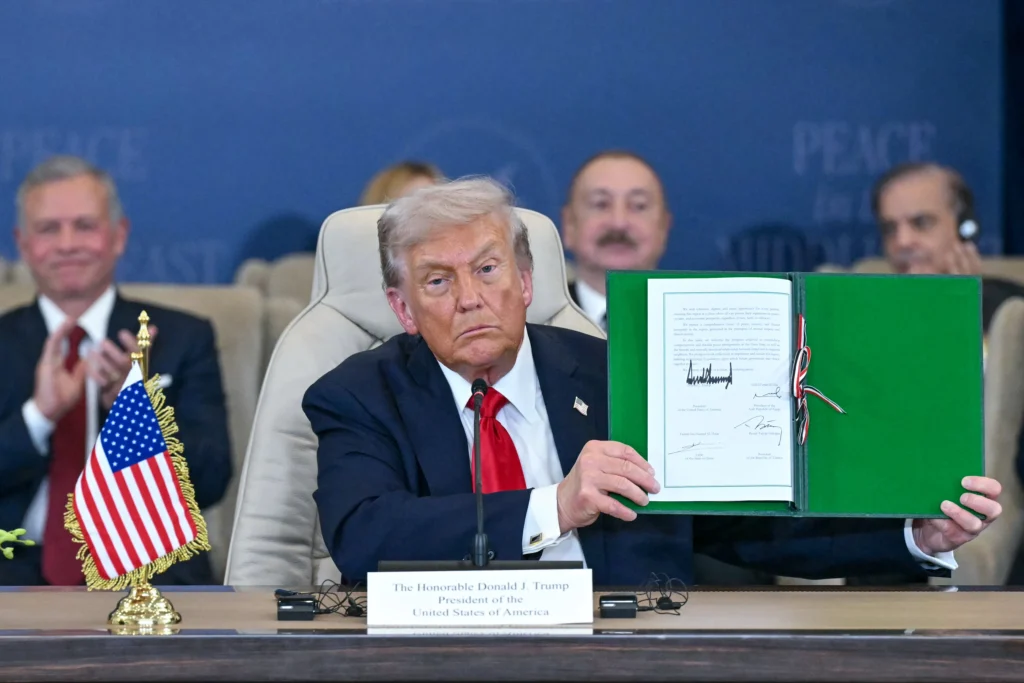
Gaza Herald _ The announcement of a new Global Peace Council by U.S. President Donald Trump at the World Economic Forum in Davos was initially framed as a bold diplomatic step toward stabilizing conflict zones, particularly Gaza. Yet the early optimism quickly gave way to deep concern and growing criticism from political analysts, researchers, and human rights advocates who warn that the initiative may serve as a vehicle for reshaping Gaza’s political, geographic, and demographic future rather than genuinely rebuilding it.
At the center of this controversy lies the reconstruction framework proposed for Gaza, which critics argue risks transforming the devastated enclave into a controlled economic zone stripped of sovereignty, political identity, and national continuity. Many see the project as an attempt to impose a new reality under the language of humanitarian relief, sidelining Palestinian voices and marginalizing established international legal frameworks.
Reconstruction That Redefines Gaza’s Purpose
Palestinian journalist and researcher Wissam Afifa has warned that the plan goes far beyond rebuilding homes and infrastructure. He describes it as a comprehensive redesign of Gaza’s identity, starting from its physical layout and extending to its political function. According to Afifa, the proposed model does not treat Gaza as a unified social and territorial entity, but instead fragments it into zones scheduled for sequential redevelopment, beginning in the southern cities of Rafah and Khan Younis before gradually expanding northward.
This phased approach, Afifa argues, is not merely logistical. It represents a calculated process aimed at reshaping Gaza step by step, erasing existing neighborhoods and social networks while laying the groundwork for an imposed political and economic order. Rather than restoring communities to their original spaces, the plan envisions transforming Gaza’s coastline into a luxury tourism corridor marked by dozens of high-rise towers, while the heart of the Strip is designated for industrial zones and data centers.
Such a transformation, critics say, risks converting Gaza from a living national community into an economic enclave governed by foreign capital and security interests. Afifa warns that this model substitutes political rights and sovereignty with promises of prosperity, effectively redefining Gaza’s role from a homeland under occupation into a market-driven development project disconnected from its people’s history and aspirations.
One of the most troubling elements, analysts emphasize, lies in the proposed infrastructure design. Circular road networks and ring highways surrounding residential zones could allow for systematic monitoring and movement control, enabling authorities to isolate neighborhoods or impose lockdowns with technical precision. Experts argue that this type of urban planning reflects security-driven logic rather than civilian necessity, transforming infrastructure into a mechanism of population management.
Although the plan includes ambitious proposals for a new seaport, airport, and railway system, fundamental questions remain unanswered, particularly regarding who would control these facilities. Critics caution that without Palestinian sovereignty over these gateways, such projects risk entrenching external dominance rather than fostering independence. In this context, reconstruction becomes a bargaining chip, offering material improvement in exchange for political compliance.
A Blueprint for Eliminating Palestinian Presence
Human rights advocate Rami Abdu, head of the Euro-Med Human Rights Monitor, describes the initiative as part of a broader strategy aimed at neutralizing Palestinian existence in Gaza. He points to the fragmentation of territory, the isolation of key access points, and the restructuring of internal geography as indicators of a long-term plan designed to dismantle Gaza’s social fabric and sever its connection to the broader Palestinian national project.
According to Abdu, the phased approach appears carefully designed to reshape identity, marginalize refugee rights, undermine the right of return, weaken the role of international humanitarian institutions, and remove core political issues from the agenda. The result, he warns, could be a pacified zone focused on labor and service provision, stripped of political agency and subjected to permanent security oversight.
Political writer and activist Hassan Bannajeh similarly argues that the most dangerous aspect of the initiative is its attempt to redefine Gaza not as a central front in a national liberation struggle, but as a humanitarian and security problem. By reframing the crisis in technical and economic terms, he says, the plan risks emptying the Palestinian cause of its political content and replacing it with externally imposed solutions that prioritize stability over justice.
From Bannajeh’s perspective, this so-called peace effort does not aim to end oppression, but rather to neutralize resistance, suppress collective memory, and remove Gaza from the equation of struggle altogether. In doing so, it risks transforming the victims of war into obstacles to diplomatic convenience.
Questions surrounding governance further deepen skepticism. Former U.S. national security adviser Michael Munroe revealed that the council’s authority is derived from a limited UN mandate set to expire in 2027, contradicting claims that it represents a permanent alternative to existing international institutions. Yet the structure grants sweeping power to the U.S. president, who would retain lifetime leadership and exclusive veto authority, raising concerns about transparency, accountability, and democratic legitimacy.
The financial requirements for permanent membership, reportedly set at no less than one billion dollars, have also sparked criticism, with observers warning that the council could evolve into a geopolitical forum dominated by wealthy states while excluding those most directly affected by its decisions.
Israeli affairs analyst Adel Shadid cautions that Israeli leadership, particularly Prime Minister Benjamin Netanyahu and his far-right allies, may exploit the council from within to legitimize aggressive policies and neutralize any meaningful steps toward justice or accountability. Meanwhile, Palestinian media expert Ibrahim al-Madhoun notes that excluding Palestinian political representation reflects a broader effort to sever Gaza from the West Bank, bypass international law, and undermine the foundation of a unified Palestinian state.
The absence of major European powers such as France and the United Kingdom from formal participation further underscores international unease, suggesting that key global actors remain unconvinced of the council’s credibility and intentions.
Kushner’s Four-Phase Plan for Gaza
At the operational level, Jared Kushner has outlined a multi-phase reconstruction plan centered on large-scale infrastructure development and massive financial investment, paired with demands for disarmament and long-term security restructuring. Critics warn that this approach risks replicating military models of territorial control under civilian cover, embedding foreign oversight into Gaza’s post-war architecture.
For many Palestinians and their supporters, the deeper fear is that Gaza’s reconstruction is being transformed into a political instrument, used not to heal war’s devastation, but to impose lasting geopolitical change. What is presented as peace, they argue, increasingly resembles a blueprint for domination, where economic growth substitutes political rights and urban planning becomes a tool of containment.
In this vision, rebuilding Gaza is no longer about restoring life and dignity to a wounded population, but about engineering a new reality in which Palestinian sovereignty, memory, and national continuity are systematically erased.