
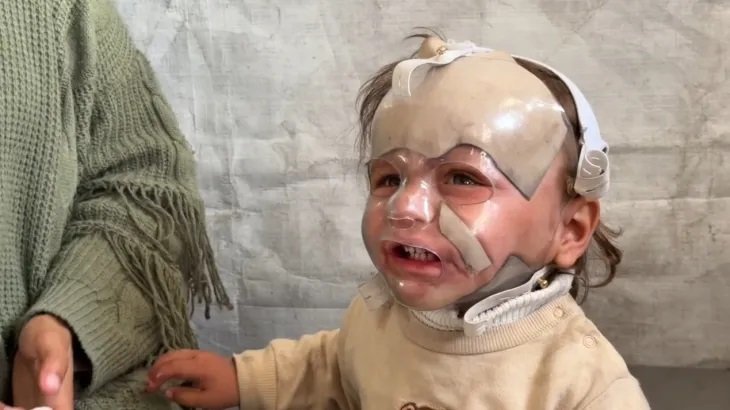
Gaza Herald _ In Gaza, childhood is no longer measured by schooldays and playtime, but by pain, medical struggle, and survival. For Mohammad Hajila, a young boy severely burned during an Israeli airstrike, every day is now a battle against permanent disfigurement and irreversible trauma.
Mohammad’s life was forever altered when Israeli forces bombed Mustafa Hafez School in Gaza City last year , a shelter packed with displaced families seeking refuge from relentless bombardment. Though he survived the attack, the explosion left him with devastating burns across his face and body, turning his recovery into a long and painful journey.
Surviving the Strike, Enduring the Aftermath
Mohammad’s mother, Ghadir, recalls the terrifying moments after the strike, describing how her son narrowly escaped death but spent weeks in critical medical care. While his initial wounds began to heal, severe complications soon followed.
One of the most dangerous outcomes was the development of excessive scar tissue, known medically as hypertrophic scarring , a condition that can cause permanent facial deformities if left untreated. With Gaza’s healthcare system crippled by Israel’s blockade and repeated attacks, specialized treatment options were virtually nonexistent.
A Plastic Mask and a Mother’s Desperation
In a desperate attempt to prevent worsening disfigurement, local medical teams managed , against overwhelming odds , to create a custom plastic compression mask for Mohammad’s face. The materials were scavenged and assembled inside Gaza under extreme shortages.
Now, Mohammad must wear the mask for nearly 20 hours a day, an exhausting and emotionally painful ordeal for a child. Yet, his mother says, there is no choice.
“The war burned my child’s face and body , and burned our hearts,” Ghadir says. “But we keep searching for any chance to treat him outside Gaza before it’s too late.”
Blocked Care and Vanishing Hope
Doctors warn that Mohammad urgently needs advanced reconstructive surgeries, which are unavailable inside Gaza. Without evacuation abroad, his condition could permanently scar both his face and his future.
Yet, Israeli restrictions on travel, combined with tightening border closures and the shutdown of international aid operations, have left his family trapped.
Ghadir fears that the closure of humanitarian offices and the shrinking presence of international medical organizations could erase her son’s last chance for recovery.
“If we lose the opportunity for treatment,” she says, “my child will carry this war on his face for the rest of his life.”
A Child Between Survival and Hope
Today, Mohammad stands suspended between a plastic mask shielding his fragile skin and a fragile hope for medical rescue beyond Gaza’s sealed borders. Like thousands of children across the Strip, he embodies the silent suffering inflicted by war — a generation marked not only by trauma, but by scars that may never fade.
His story is one of countless others in Gaza, where survival itself has become a daily act of resistance, and where childhood is slowly being erased beneath rubble, pain, and blockade.

