
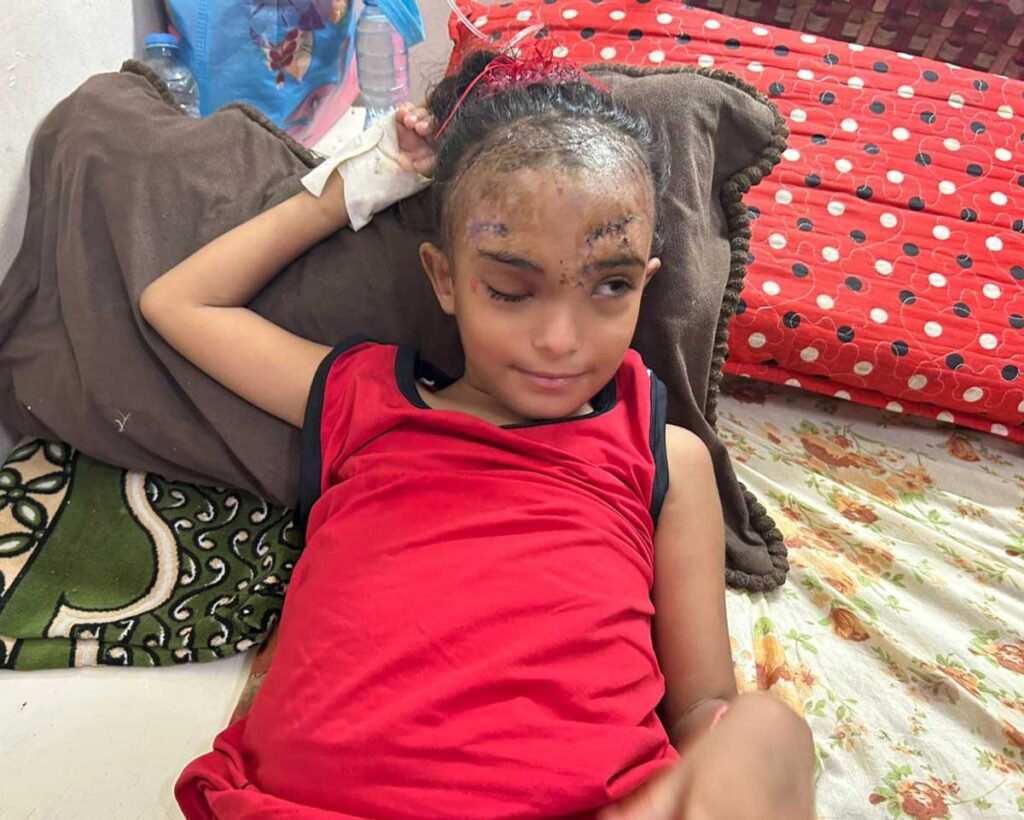
Gaza Herald _Sila Houso’s wound was not born on a battlefield. It was born along a road of displacement, in the arms of a mother forced to navigate war alone. At just seven years old, Sila left one morning carrying nothing but her school bag. She returned carrying a lifetime of trauma, her small body marked by a war that makes no distinction between classrooms and tents, between children’s games and Israeli missiles.
Sitting beside her injured daughter is Aya Houso, 39, a displaced mother whose exhausted voice carries the weight of an entire war. Aya’s story begins in Gaza City’s Shuja’iyya neighborhood, where she once lived with her husband Jamal and their six children. Two weeks after Israel launched its assault, evacuation orders arrived. Aya gathered her children and fled south, while her husband stayed behind to care for his elderly parents. For months, she faced displacement alone.
Their first stop was a school in Deir al-Balah that had been converted into a shelter. What followed were two months of extreme overcrowding, hunger, disease, and filthy bathrooms, with almost no humanitarian aid. The children wore thin clothes that offered no protection from heat or cold. Aya says all of her children contracted hepatitis A. Her sons Yazan, 13, and Suwar, 3, grew dangerously ill. At the hospital, there was no real treatment—only IV fluids. Doctors advised honey and bottled mineral water, items Aya could not afford. She diluted whatever jam she could find in sparse food parcels and relied on tap water, desperately trying to keep her children alive.
When an Israeli drone hovered above the school in December, fear overrode everything else. Aya fled again, moving her children into a friend’s home. They lived for two months crammed into a single room without electricity, running water, or safety. Then came another move, to Al-Sayyida Khadija School, where five more months passed in a cycle of deprivation, tension, and constant fear. Aya had no husband, no income, and no way to shield her children from bombs, from daily conflicts inside the shelter, or from the pitying stares of others.
On Saturday morning, July 27, 2024, Sila felt happiness for the first time in months. Her mother had enrolled her in an informal learning tent near the school. Sila packed her small backpack and left with her friends, smiling. By 11 a.m., Israeli warplanes bombed the school. The place turned into chaos—blood, screaming, scattered body parts, children running with no direction.
Sila returned to her mother in tears, asking a question Aya could not answer: “Why are they bombing us?” Soon after, another evacuation order was issued. Aya tried to flee with her children once more. Along the road, they passed the bodies of children and rushing ambulances. Then another strike hit. Shrapnel tore into Sila’s head, blood covering her face. Aya clutched her daughter and screamed, while Sila’s brother Mohammad, 12, tore off his shirt and pressed it against the wound.
An unknown young man carried Sila and ran toward the hospital. There, a different battle began. Her skull was open. Her eye socket was fractured. Her retina was detached. For hours, there was no doctor available due to the overwhelming number of wounded. When surgery finally came, it was only to stop the bleeding, to close her skull, insert a metal plate in her forehead, and keep her alive.
Sila spent months in the hospital afterward, suffering severe infections. Essential medications were unavailable. Antibiotics were missing. Doctors said she would need further surgeries to prevent fluid leakage from her skull and stressed that her real treatment could only be provided outside Gaza. But Gaza is sealed.
Sila cannot live in a tent. She needs a clean environment, fresh food, and continuous medical care. Aya tries to shield her daughter from mirrors, from old photos, from the brutal comparison between who she was and who she is now. Sila asks questions her mother cannot answer: “When will my hair grow back? When will my eye open again?”
Aya has no answers. All she has is her hand holding her daughter’s, and a long wait in a place that no longer resembles life.

