
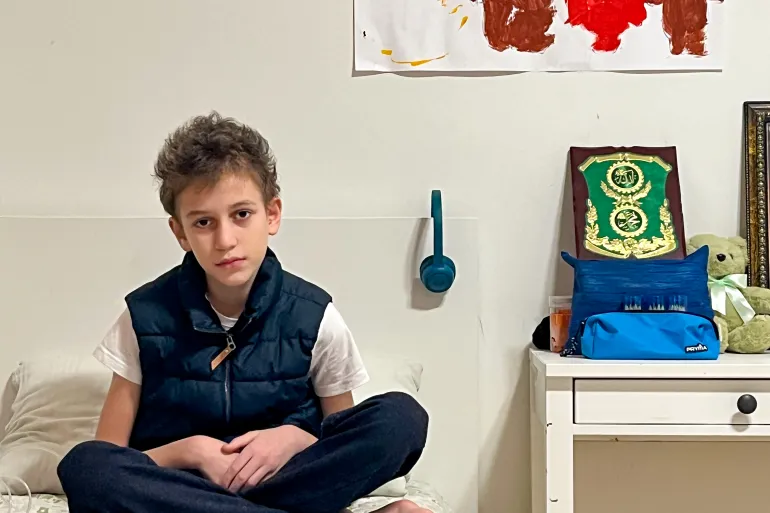
Gaza Herald_ Ten-year-old Abdullah barely looks up from his tablet, absorbed in his favorite game, where he builds a digital world that lets him imagine any life he wants.
The steady beeping of the chemotherapy pump sending medication into his veins momentarily distracts him, and he reaches for the charger before continuing to play.
His mother, Iman Ismail Mohammad Abu Mazid, explains that the gaming habit began after they escaped Gaza on May 14, heading to the Italian city of Padova so he could receive urgent treatment for leukaemia.
Back in Deir el-Balah, the family’s hometown in central Gaza, he had been “a very social boy” who “was always out playing football with his brothers and the neighbourhood kids,” she told Al Jazeera, scrolling through her phone for a photo of the child she remembers.
In the picture, three neatly dressed boys smile at the camera. Abdullah looks just as calm, though now his hair is longer and his skin carries a yellowish tint. Standing beside him are Mohammad, now 11, and Mahmoud, eight. Looming above them with his hands on their shoulders is their father, Ahmad.
The cancer consuming Abdullah also shattered their family life.
While Abdullah, his mother Iman, and one-year-old Qamar were given seats on a medical evacuation flight to Italy, the rest of the family – Ahmad and the older boys, Mohammad and Mahmoud – remained trapped in Gaza, where Israel continues its bombardment despite a declared ceasefire.
Now, the illness may be what reunites them. In early November, doctors in Gaza collected blood samples from Abdullah’s brothers and sent them to Italy to test whether either is a compatible donor for his bone-marrow transplant.
If one matches, all three will be cleared to board a medical evacuation flight to Padova. If not, they will have to request family reunification from the Italian authorities – a far slower and more complicated process.
Iman says her family’s future depends entirely on the results. The transplant could save Abdullah’s life and bring the rest of their family out of Israel’s genocidal war on Gaza.
“I worry for them every single day,” she said. “Abdullah misses his brothers, and I miss my children, too.”
Abdullah nodded shyly, admitting he also longs for a good kebab. He isn’t fond of Italian food and often reminisces about the seasoned meat from their favourite restaurant in Deir el-Balah.
Asked if he’d like to bring Gaza to Padova, he replied, “Not all of it, just my neighbourhood.”
Escaping Gaza’s war
Iman discovered she was pregnant with Qamar in March 2024, while the war raged around them. At first, she thought her period was irregular because she had been surviving on almost nothing but water and bread. When she realised another baby was coming, she remembers being “terrified”.
“I was always afraid they’d tell me the baby was deformed or sick,” due to malnutrition and lack of sanitation, she said. “My body was exhausted. I couldn’t stand. I spent the whole pregnancy lying on the floor,” she explained in fast Arabic, lifting the toddler, pulling at her leg, and placing her on her lap.
Her daughter was delivered in a makeshift field hospital in Deir el-Balah that lacked basic medicines and hygiene, as victims of Israeli strikes were rushed in.
“You could see someone injured at any moment – a severed leg, a severed hand … The scenes were horrific,” she said. “And the doctors were nervous because the area kept being targeted.”
Months later, in April, Abdullah suddenly fell ill.
“He turned yellow, had stomach pain, and a headache,” she said.
At Al-Aqsa Hospital in Deir el-Balah, he was hooked to an IV and given antibiotics and painkillers. The fluids helped keep his fever down, but nothing stopped the cancer from advancing.
Doctors told the family to take him to the European Hospital in Khan Younis, even though Israeli forces had just announced an expansion of operations there.
The short 10-kilometre trip south was “terrifying”.
“There wasn’t a single person on the road,” Iman said. Doctors there could only offer diluted chemotherapy. Abdullah was flagged to the World Health Organization (WHO) for evacuation.
Unexpectedly, a medical evacuation was approved soon after. Iman and her husband, Ahmad, barely needed to speak to make the painful decision to split the family.
“There was more silence than talking,” she said.
Ahmad arrived at the European Hospital on May 13 to say goodbye to Iman, Abdullah, and Qamar. As he walked out, the ground shook, and a chunk of concrete flew past his head.
That day, the Israeli army claimed it had dropped nine bunker-buster bombs and dozens of other munitions around the hospital, saying it had killed Hamas leader Mohammed Sinwar and more than 20 others. Attacking hospitals is prohibited under international law. Hamas later confirmed Sinwar’s death in August but did not say how he died.
“I was certain he’d been killed,” Iman recalled.
“I kept calling him, screaming, saying, ‘I swear he’s gone’,” she said. “I called more than 10 times, and he didn’t answer. I was convinced he’d been martyred. But I didn’t stop, I didn’t stop! And finally, he answered.”
A new life far from home
Abdullah is one of more than 5,500 children evacuated from Gaza for treatment through WHO-coordinated medical transfers.
Some 8,000 people have been able to leave for lifesaving care, but 16,500 remain on waiting lists, UN data shows. Of those, 3,800 are children.
Since July 2024, over 900 patients have died waiting for evacuation, according to the WHO.
Abdullah reached Padova thanks to the persistence of lawyer Rebecca Fedetto, who founded an organisation in February to coordinate and support medical evacuations.
“I knew I needed to do something,” she told Al Jazeera. “My conscience wouldn’t let me live normally.”
Fedetto spent weeks calling anyone who could help her navigate the maze of paperwork, approvals, and coordination needed for a transfer abroad.
“At one point, I thought it was impossible, everything was so complicated,” she said. “When it finally worked, I couldn’t believe it.”
Her volunteer-run NGO, Padova Abbraccia i Bambini (Padova Hugs Children), has since facilitated six evacuations, supporting 25 people. Among them are six-year-old Ahmad, recovering from severe burns, and eight-year-old Seela, who lost both legs.
Volunteers help with transportation, babysitting, lessons for the children, and emotional support.
Fedetto says the city has responded with overwhelming kindness.
“Many people emailed asking how they could help, because this war weighs on everyone’s conscience,” she said. “People want to help; they just don’t know how.”
WHO continues to urge countries to accept more patients, as Gaza’s shattered health system struggles. Only 18 of 36 hospitals are even partially functioning.
More than 30 countries have accepted patients so far, including EU states, Qatar, Jordan, Egypt, and the UAE.
“We are grateful for their solidarity,” said Rik Peeperkorn, WHO’s representative for the occupied Palestinian territory.
Peeperkorn explained that under the ceasefire, the WHO should evacuate around 50 patients per day along with their caregivers.
“To make that possible, more countries must step up with generosity and receive patients in need,” he said.

