
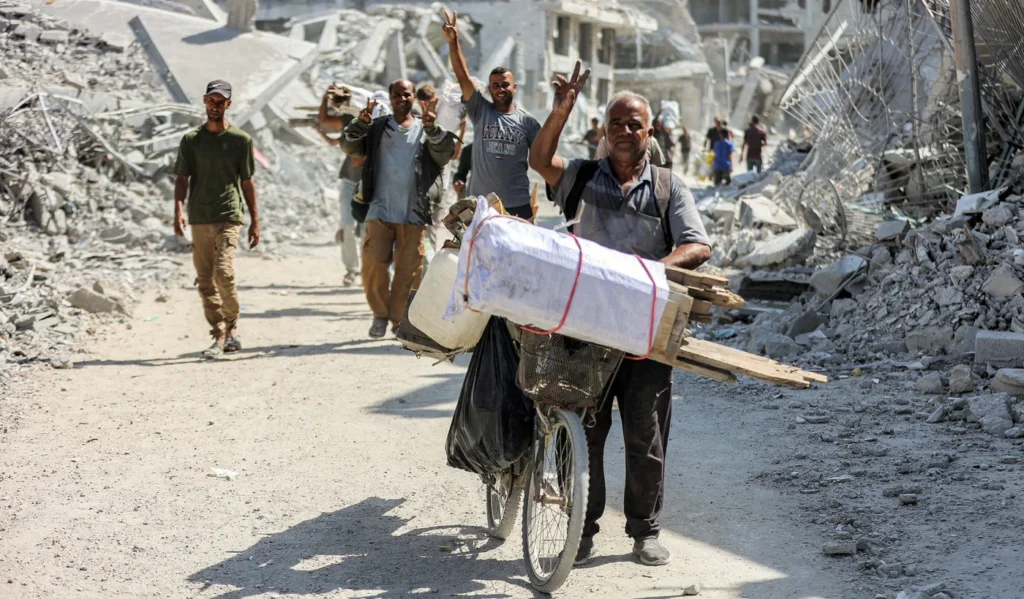
Gaza Herald — Near a burned-out car struck just outside their home, Faiq Ajour and his relatives stood sweeping away shards of glass and charred debris. Moments earlier, he had walked to a nearby vegetable stall to buy a few items. The Israeli missile landed right after he crossed the street.
“I survived by a miracle,” he said, still shaken. “I thought my house was hit. I ran back to find my daughters trembling, terrified that the war had returned.”
What Israel calls a ceasefire has provided no real safety. Israel has carried out hundreds of attacks since the October truce began, accusing Hamas of violations. Palestinians insist the opposite, noting that Israel has launched an overwhelming force, breaching the ceasefire more than 500 times and killing more than 342 civilians, including 67 children.
The five killed in Gaza City’s al-Abbas neighborhood, where Faiq lives, were among 24 Palestinians killed across the Strip that day.
“This is a nightmare, not a ceasefire,” he said. “Life becomes war again in a second. You see smoke, bodies, shattered glass. We still haven’t healed from these scenes.”
‘Lost hope in everything’
Faiq, 29, originally from Tuffah, has lost nearly his entire extended family. In February 2024, an Israeli airstrike flattened the house they had all sought shelter in, killing his parents, cousins, his brother’s children, and injuring his wife, who later had a finger amputated.
“My whole family is gone,” he said quietly.
He has moved from place to place, fleeing bombardment, seeking what he calls a “nonexistent safety”. The so-called ceasefire has changed little.
“Every few days, something blows up. Everything turns upside down again. We’re exhausted. Life in Gaza is 99 percent dead.”
Before the war, he worked with his father in clothing trade. Now everything is gone. Their home lies inside Israel’s “yellow line”, an area under total Israeli control, where Palestinians are denied entry.
“There is no work, no construction, no life there. So when does this war end?” he asked. “Today I sit at home all day. We survive on bitterness. Open the crossings, let us live.”
A future with no roadmap
As uncertainty deepens, political discussions outside Gaza grow more abstract and disconnected from daily devastation.
Washington’s current 20-point plan for Gaza proposes an unelected technocratic authority made up of Palestinian figures and international experts, overseen by an international “board of peace” headed by Donald Trump. It calls for an economic plan and a foreign stabilization force, promising stability.
But the plan excludes any role for Hamas and ignores the scale of destruction that will take years to rebuild. It also fails to address Israel’s refusal to commit to an actual end of the war.
Ahed Farwana, a Palestinian political analyst, believes Israel intends to maintain Gaza in a suspended state.
“The occupation wants a situation like southern Lebanon,” he said. “Periodic escalation, assassinations, and no transition to any real political phase.”
Israel’s 2024 ceasefire with Hezbollah has not stopped ongoing attacks in Lebanon, including assassinations, the killing of a Hezbollah commander in Beirut, and strikes on Palestinian refugee camps.
Farwana argues that these tactics reflect Israel’s long-term strategy: avoid reconstruction, entrench chaos, and expand military control inside Gaza.
“Netanyahu does not want to move to the second phase of the ceasefire,” he said. “He wants to seize more land to strengthen Israel’s hand in any future arrangements.”
Political survival over policy
Analysts say Netanyahu’s reluctance is rooted in political self-preservation. Israeli politics today is defined not by ideology, but by positions for or against Netanyahu. A power shift could accelerate corruption trials against him and investigations into Israel’s failures leading up to October 7.
Despite Israel’s evasions, analysts believe that the previous scale of destruction is unlikely to return due to pressure from Washington, which wants its plan for Gaza to succeed.
“The situation will stay limited to expanding the yellow zone and occasional targeted strikes,” Farwana said. “Enough to destabilize life, but not enough to trigger a full war.”
This limbo means Gaza’s people will not feel real calm, and families like that of Raghda Obeid continue to live in constant fear.
Life in tents, life without life
Raghda, a 32-year-old mother of four, has been displaced repeatedly. Her home in Shujayea is gone. She now lives in a tent in western Gaza City, where an Israeli strike recently hit nearby.
“The moment of the last strike felt like the first day of the war,” she said. “Smoke, screaming, bodies. My children were shaking. Even I was terrified.”
With no home, no income, and no work, Raghda’s family depends entirely on aid kitchens. She will face the coming winter in a tent.
Every day is defined by survival: searching for food, waiting for water, hoping not to be struck.
“It has been more than two years. We are entering the third like this – displaced, broken. Isn’t there any solution for us?”
“We live off the community kitchen and water,” she said. “Our life is a war without an actual war.”

