
Gaza Herald — Late on October 8, 2025, as the rest of the house lay asleep, I stayed awake, scrolling endlessly through journalist chat groups and fragmented updates from the ongoing ceasefire negotiations.
There were mixed messages, whispers of progress, setbacks, hope, and deep skepticism. My phone’s battery blinked red before I finally drifted into restless sleep, stirred occasionally by the distant sound of shelling that said more than any news alert could.
When I awoke before dawn on October 9, my Wi-Fi was gone. I rushed to the rooftop, searching for an eSIM signal as the first light broke over Deir el-Balah. Updates began to load slowly, and then there it was: “Ceasefire agreement in Gaza to take effect within hours.” I looked around at the tents and homes still wrapped in silence and felt both disbelief and relief. I called out, “Wake up, the war is over.”
My husband stirred, half-awake. “Swear it?” he asked. I showed him the headline, and soon my father, sisters, and brother’s family all displaced from the north and living with me gathered in stunned silence. Then joy began to break through. My nine-year-old daughter, Banias, cried as she asked, “Really? Are you serious?” For the first time in months, her tears were from happiness.
A Wedding Day and a Ceasefire
Banias’s joy reminded me that this day carried another meaning: it was my friend Islam’s long-delayed wedding day. She had been engaged during the first truce in February 2025, but the ceremony was postponed five times as bombardments resumed. Only a week earlier, she had lost everything when her family fled from the Shati refugee camp. Her fiancé’s family, also displaced, had agreed to a modest wedding under a tent in Nuseirat.
When I last saw her, Islam was anxious. “The dresses are worn out, covered in dust,” she sighed. “I don’t feel like a bride.” Her words echoed the exhaustion of a people stripped of normal life yet still yearning for it. When the ceasefire came on her wedding day, it felt like a rare blessing a fragile promise of renewal amid ruin.
The Morning of Hope and Caution
That morning, I headed toward Al-Aqsa Martyrs Hospital in Deir el-Balah, where journalists gathered. The streets buzzed with cautious optimism. Some doubted the ceasefire would last; others whispered prayers of gratitude. My colleague Nour exhaled deeply. She hadn’t seen her children for nearly two years, having sent them to Egypt for safety. “Maybe now I’ll see them again,” she said.
Displaced families surrounded us, seeking confirmation that the war had truly stopped. “Is it real?” one woman asked me. “Can we go home?” Yet even as news spread that Israel’s cabinet had approved the agreement, skepticism lingered. “We’re relieved, but not joyful,” another woman from Beit Hanoon told me. “How can there be joy when our homes are gone?”
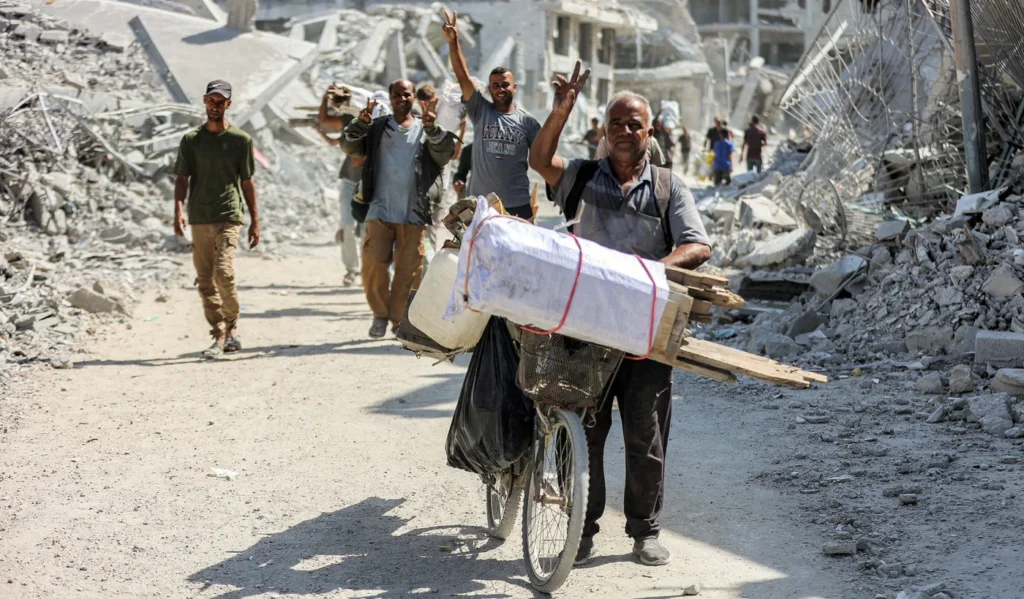
By the afternoon, thousands gathered on al-Nuwairi Hill, waiting to return north. Some clutched photographs, others sat silently atop bundles of belongings. One woman with three children told me, “I’ll wait all night if I have to.” For her, and many others, “return” was not about comfort but identity a declaration of existence.
A Small Wedding, a Symbol of Life
That evening, I attended Islam’s wedding. It took place in a small, empty shop — now a temporary shelter for displaced families. Plastic chairs lined the walls; an old brown couch served as the bridal stage. Yet laughter filled the room, and for a brief moment, the war felt far away.
I hugged Islam. “See,” I told her, “The war ended on your wedding day. It’s a blessed day now.” Her groom laughed when I asked if they’d return north immediately. “If that’s true, I’ll take my bride and go tonight,” he said. Their smiles carried the quiet defiance of people choosing life in spite of everything.
Between Relief and Ruin
In the days that followed, Gaza oscillated between relief and despair. Many began returning north to what remained of their homes. My own family debated the same. When we learned that our houses were destroyed, we were hardly surprised the story was the same for thousands.
Life remained nearly unlivable. There was still no water, power, or communication. A neighbor warned us not to go north; he had walked miles just to find water. Then came another shock the assassination of journalist and activist Saleh Aljafarawi by Israeli-backed militia. His death reminded us that even as bombs stopped falling, Gaza’s wounds could still deepen from within.
Meanwhile, the prisoner exchanges began. Families rejoiced, wept, and mourned in the same breath. One woman danced after learning her sons were alive; another man fell to the ground upon discovering that his family had been killed. And in bitter irony, Saleh’s brother, Naji, was released from prison the same day Saleh was buried.
Dignity in Small Victories
By mid-week, markets reopened. Prices dropped, and my daughter ran home excitedly: “Mama, chocolate is six shekels now, not eighteen!” But the true celebration came with the arrival of cooking gas. My husband read the message aloud: “Get ready you’ll cook on gas today for the first time in nine months.”
We cleaned the old stove and waited for the blue flame. When it lit, we clapped like children. The first coffee brewed on real fire in almost a year felt like a quiet act of liberation. My father smiled as he drank. “We’re reclaiming a small piece of dignity,” I thought.
Yet even as normalcy flickered, fear persisted. Some who tried to return north were shot by Israeli forces. My father said, “I can live among ruins, but not without safety.” His words echoed Gaza’s fragile truth: survival is not peace.
A Reflection from the Shadows
Now, as I write these words on solar power, unplugging every other device to save energy, I wonder how readers abroad will perceive them. Can they imagine what it means to live — and write in this silence between wars? To celebrate coffee and gas as signs of resistance?
For two years, Gaza has endured what no people should. The ceasefire offers no illusion of justice, only a pause yet within that pause, Palestinians continue to rebuild fragments of life, reclaiming what was meant to be erased. In these small, defiant moments of dignity, Gaza still resists annihilation not through arms, but through endurance.

