
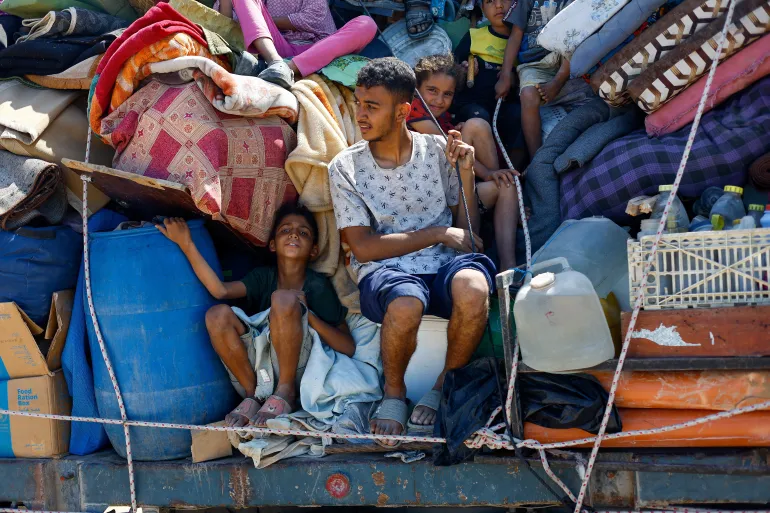
Gaza Herald_ Two years after Israel’s genocidal war began, Gaza is witnessing a scene that defies both destruction and despair. The people who were forced into exile in their own land are now marching back, carrying neither weapons nor banners, only an unbreakable faith that home, even in ruins, is still worth returning to.
Amid dust and devastation, this return is not merely physical; it is moral, symbolic, and deeply human. It is Gaza’s declaration to the world that no siege, no war, and no erasure can defeat the will to belong.
Along the road stretching from the south to the north of the Gaza Strip, tens of thousands of citizens line up in an unforgettable scene for the second time in a year. Men, women, and children walk with dust-laden steps but eyes filled with hope. This is no ordinary return it is a clear declaration that the project of extermination and displacement has failed before the people’s determination to remain.
Joyful return amid pain
As soon as the genocide war was declared over, ululations erupted from the displacement camps in the south. Young men waved flags and chanted loudly, while children ran and danced with joy.
Amid these scenes, Umm Mahmoud Mehanna, 45, displaced in Deir al-Balah and preparing to return to Gaza City’s al-Zaytoun neighborhood, said, “There’s nothing in this world that can replace our home. Even if it’s destroyed, we’ll go back, spread out the stones, and sleep on them. We’re tired of displacement, but every time we return to our land, it gives us new life.”
From exile to roots
From Khan Yunis to Gaza, convoys of return stretch along the coastal road. People walk for tens of kilometers, carrying what remains of their belongings on small carts, baby strollers, or on their weary shoulders.
Halfway along the road, we met Abu Rami Yaghi, 52, dragging a torn suitcase beside two children. “It doesn’t matter how tired we are… what matters is that we’re going back. We measured the distance in steps of longing. Even if the house has turned to dust, that dust is ours; it belongs to no one else.”
A firm rejection of displacement
Standing on the ruins of her house in al-Shati Camp, after walking there from the southern Gaza Strip, Layan Miqdad, 33, burst into tears as she retraced al-Rashid Street on foot. She had been forced to flee a month earlier under Israeli bombardment and mass displacement when the military assault on the city began.
“they told us to go to Egypt, to the south, anywhere. But we don’t want anywhere else but Gaza. Perhaps there are no homes left, but the meaning of life remains. Staying is our only answer to every attempt at erasure and expulsion,” Layan said.
This refusal is not a passing feeling; it is an act of collective resistance. Every person who returned to a destroyed home is helping write a new chapter of Palestinian steadfastness, proving that forced displacement will never become a permanent reality.
Destruction bears witness, and so do the people.
In Gaza City’s Tel al-Hawa neighborhood, the shattered buildings seem to tell a story of pain. Yet among the rubble, astonishing scenes emerge: children drawing on broken walls, women cleaning in front of destroyed homes, and men preparing shelters and tents.
They have just returned from the south, walking back on foot, carrying their burdens but also their will to live, despite the arrogance of the occupation.
On Friday afternoon, the ceasefire officially took effect, marking the end of a two-year genocide war. Within moments, Gaza’s al-Rashid Street was packed with thousands of citizens heading back to their neighborhoods and villages in the north.
The symbolism of staying
These scenes of return are not only human; they are profoundly political and moral. They mark a practical end to the project of uprooting Palestinians from their land and affirm that existence here is, in itself, an act of defiance.
In a moment, the occupier had intended it as an ending, but the people chose to make it a new beginning.
“Those who survived the bombing came back to live again. And we say to the whole world: we are staying,” said a young man returning from Mawasi Khan Yunis to Gaza City’s Sheik Radwan neighborhood, carrying what little he has left.
The second return is not just the movement of people; it is the resurrection of a nation’s spirit. Amid ruins and silence, Gaza’s people are rebuilding the meaning of home with their footsteps. Their march northward transforms loss into legacy and turns pain into purpose. The world may call it a ceasefire, but for Gaza, it is something far greater: a renewal of life, dignity, and belonging. Against all odds, they have proved once again that while the land can be bombed and the homes can fall, the will to stay will forever remain unshaken.

