
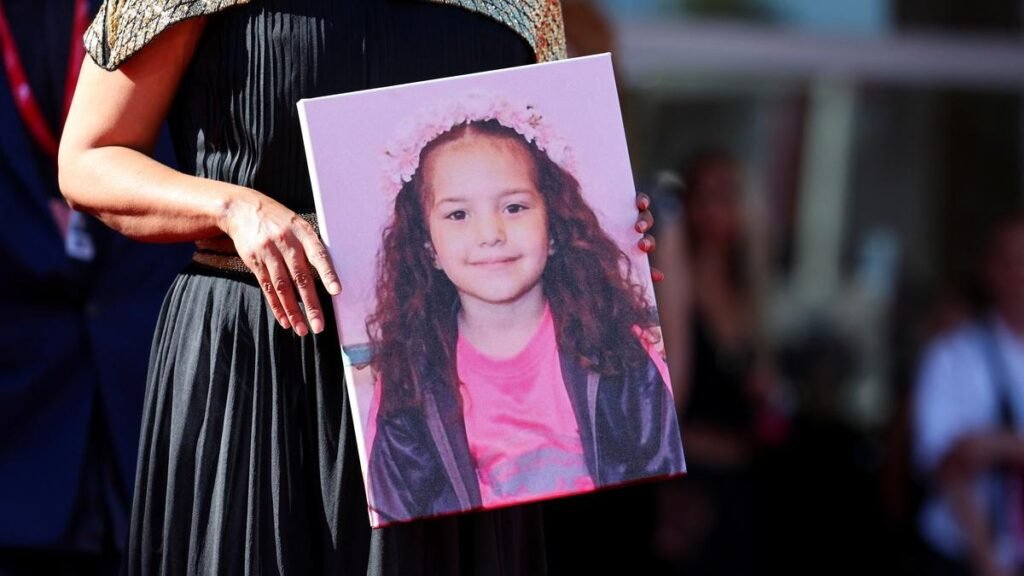
Gaza Herald – The Venice Film Festival witnessed an extraordinary moment this week when The Voice of Hind Rajab received an unprecedented 23-minute standing ovation, the longest in the festival’s storied history. The powerful docudrama, directed by Franco-Tunisian filmmaker Kaouther Ben Hania, tells the harrowing story of Hind Rajab, the five-year-old Gaza girl whose desperate cries for help echoed across the world before she was silenced by Israeli fire in Gaza City on January 29, 2024.
The screening unfolded in an atmosphere charged with emotion. Audience members broke into tears, chants of “Free, Free Palestine” rang through the hall, and Palestinian flags were raised high. The overwhelming response reflected not only admiration for the film’s artistry but also a collective expression of grief and solidarity with the Palestinian people, whose suffering continues under Israel’s relentless war on Gaza.
At the heart of the film are the haunting recordings of Hind’s final hours, preserved by the Palestinian Red Crescent Society. In those calls, Hind’s voice trembles as she pleads for rescue: “Please come to me, please come. I’m scared.” Trapped in the backseat of a car riddled with bullets, she was surrounded by the bodies of her aunt, uncle, and three cousins all killed by Israeli gunfire. For hours, Red Crescent staff tried to comfort her over the phone, while the sounds of ongoing shooting could be heard in the background.
Despite repeated appeals from the Red Crescent, Israeli forces blocked rescue teams from reaching the site for more than three hours. When an ambulance was finally permitted to approach, contact with Hind was suddenly cut off just as the rescuers reached the car. Days later, her small body was discovered alongside her slain relatives. The two paramedics who tried to save her were also found dead; their ambulance had been deliberately targeted and destroyed.
Speaking ahead of the premiere, director Kaouther Ben Hania criticized the way mainstream media has often dehumanized Palestinians by framing their deaths as “collateral damage.” She explained that the purpose of her work was to give back a face, a name, and a voice to those who are reduced to statistics. “This is why cinema, art, and every form of expression is essential because it restores dignity and humanity where it has been stripped away,” she said.
The film not only documents Hind’s personal tragedy but also places it within the broader context of the war in Gaza. Hind’s mother, Wissam Hamada, speaking from Gaza City where she remains with her surviving five-year-old son, told AFP that she hopes the documentary will force the world to confront its silence. “The whole world has left us to die, to go hungry, to live in fear, and to be forcibly displaced without doing anything,” she said, her words echoing the anguish of countless Palestinian families enduring similar fates.
Independent investigations have since corroborated the details of Hind’s killing. In June 2024, Fault Lines, working with investigative organizations Forensic Architecture and Earshot, meticulously reconstructed the incident. Their findings revealed that an Israeli tank was stationed just 13 to 23 meters (42 to 75 feet) from the vehicle when it opened fire, contradicting Israeli military claims that their forces were not in range. A subsequent United Nations report in July provided forensic confirmation that the car had been struck from close range with a weapon type uniquely used by Israeli forces.
Despite this mounting evidence, Israel has continued to deny accountability. Earlier this week, the Israeli military responded to renewed questions by claiming that the incident remains “under review,” offering no further explanation. For many observers, this evasive stance reflects a broader pattern of impunity, in which the deaths of Palestinian children are met with denial and deflection rather than justice.
For those who filled the Venice theater, however, Hind’s story could not be denied or erased. The chants, tears, and applause were a testament to the profound impact of her short life and brutal death. The Voice of Hind Rajab has already become more than a film: it is a cry of remembrance, a call for accountability, and a symbol of the resilience of a people who refuse to be forgotten.
By immortalizing Hind’s voice and story, Ben Hania’s film ensures that the little girl’s plea “Please come to me, I’m scared” will continue to echo not only through cinema halls, but also in the conscience of the world.

