
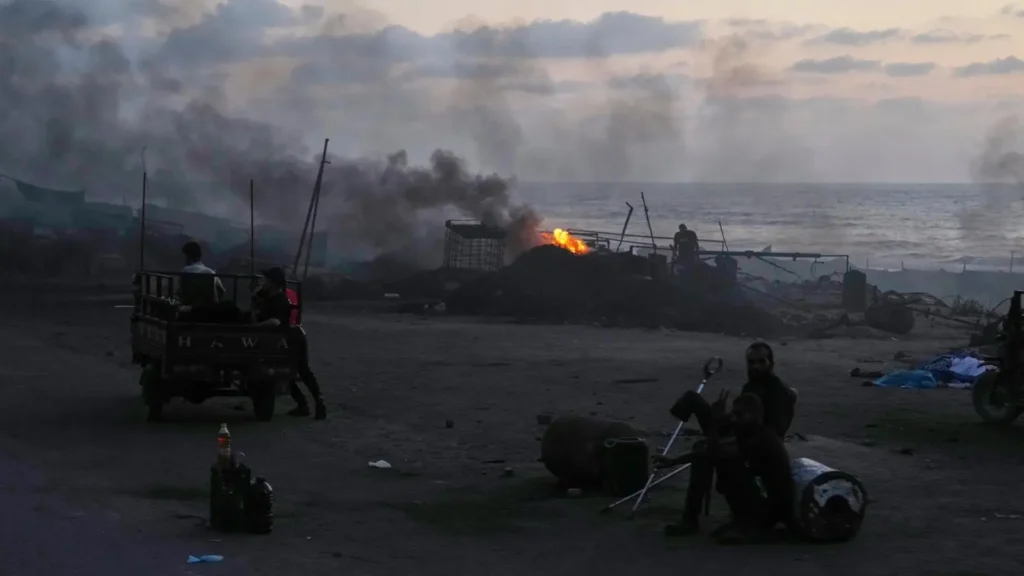
Gaza Herald- In Gaza, the sea, once a lifeline and source of income for thousands, has turned into a graveyard for fishermen, the result of what many call war crimes committed by Israel during the ongoing conflict, widely described as genocidal.
Just last Monday, in under 24 hours, two fishermen, Hassan Al-Habeel and Ismail Salah, were shot and killed by Israeli naval forces. Ismail’s brother now fights for his life in intensive care, critically injured in the same attack.
This tragic incident captures the painful reality facing thousands of fishermen in Gaza, who are caught between two grim choices: risking death at sea or facing starvation on land.
Since the war began, over 210 fishermen have lost their lives, according to the Union of Agricultural Work Committees. The coastline has turned into a daily battlefield, constantly patrolled by Israeli warships and drones.
The Sea That Betrayed Its People
Once the backbone of Gaza’s economy for tens of thousands of families, the sea has become a zone of constant danger. Boats are targeted, ports lie in ruins, and fishermen often dive into the sea to escape Israeli gunfire.
“All six fishing ports we used to rely on have been destroyed, including the central port in Gaza,” says Zakaria Bakr, who heads the local fishermen’s committees.
In a recent press statement, Bakr explained that the fishing sector, second only to agriculture in production before the war—has been devastated. More than 95% of its infrastructure, including boats and equipment, has been wiped out. Out of 4,500 registered fishermen before the war, only 450 are still attempting to work. Most of them are using old nets salvaged from rubble and debris.
In the Al-Shati refugee camp, west of Gaza City, 42-year-old Mahmoud Miqdad sits silently outside his damaged home, staring at a weathered fishing net he managed to recover from the wreckage. His boat was destroyed in an airstrike, but hunger has driven him back to sea using whatever means he can find.
“I know I might be shot at any moment, but my five kids are starving. I can’t stand by while they cry themselves to sleep from hunger. The sea was our livelihood. Now it’s a threat. But I don’t have another option,” Mahmoud explains.
One cold morning, he went out on a makeshift raft made from rotting wood called a “hasaka” venturing barely a kilometer from shore. He returned with only a few small fish, but it felt like a victory. “My kids had fish for the first time in weeks. And I felt like I beat the blockade, even if just for a few hours,” he said.
Struggling to Stay Alive
But his small triumph was short-lived. On his next outing, Israeli gunboats opened fire around him. He jumped into the sea to escape and barely made it out alive. Despite the close call, he still considers returning. “We either die from bullets, or from hunger. At least at sea, there’s a chance I might bring something home,” he said.
Mahmoud’s experience reflects a much larger crisis shared by thousands of other fishermen in Gaza. With no other options, they continue to risk their lives at sea. Some resort to makeshift rafts crafted from refrigerator doors or car tires, but these efforts produce barely 2% of the fish caught before the war.
According to Bakr, Israeli forces have imposed a one-kilometer fishing limit far too short a distance to make a viable catch.
Fishing production has all but collapsed. Families who once relied on daily catches for food now go hungry, and over two million people in Gaza are teetering on the edge of famine.
The crisis extends beyond just the fishermen. Thousands of families used to depend on the sea for sustenance and income. Fish was once a regular source of protein for Gaza’s population. With fishing practically shut down, the region’s food shortage has reached catastrophic levels.
Before the war, fish was a staple in most households. Now, it has become a rare luxury available only to those who are willing to risk their lives in the face of gunfire.
With the blockade cutting off outside food supplies and tightening restrictions, the loss of fishing as a resource has become a defining feature of Gaza’s worsening hunger crisis.
A Fight for Food and Survival
For Gaza’s fishermen, this is no longer just about earning a living it’s about basic survival. “The occupation doesn’t want us to provide food for our children or help ease the hunger crisis,” says Bakr. He insists that this is part of “a deliberate policy to starve and besiege the population.”
He concludes by stating, “There is no longer a real fishing sector in Gaza. There are only men risking their lives for a single meal to feed their kids. The occupation may have destroyed the ports and boats, but it hasn’t broken the fishermen’s will to face the sea”
As the death toll climbs and the risks grow, Gaza’s fishermen are left to choose between two agonizing paths: to sail into deadly waters in search of food, or to return to homes filled with empty plates and desperate hunger.
The plight of Gaza’s fishermen is a powerful symbol of the broader humanitarian catastrophe unfolding in the region. Once guardians of a rich maritime tradition, they found themselves now forced to navigate a sea that turned hostile not by nature, but by human-made conflict and siege. With their boats shattered, their ports in ruins, and their lives constantly at risk, these men continue to venture into dangerous waters driven not by choice but by the desperation to feed their families. Their struggle is not merely for livelihood, but for dignity, survival, and the hope that one day, the sea will once again offer life instead of death. In the face of unimaginable hardship, the resilience of Gaza’s fishermen remains a haunting reminder of both human endurance and the urgent need for justice and peace.

