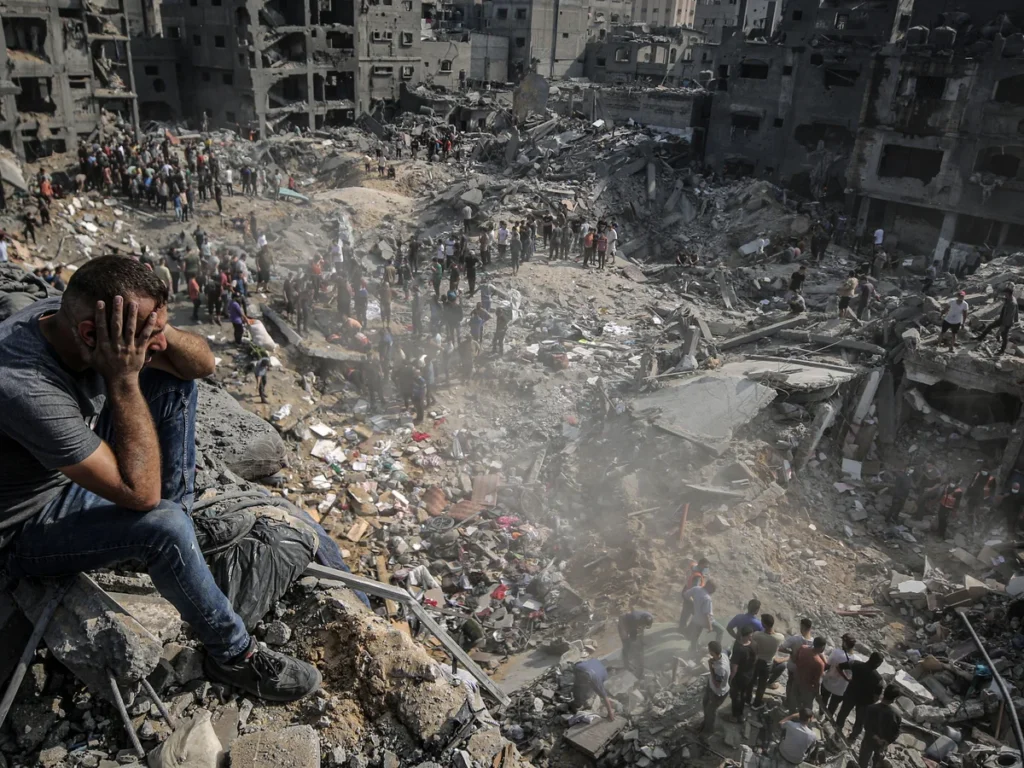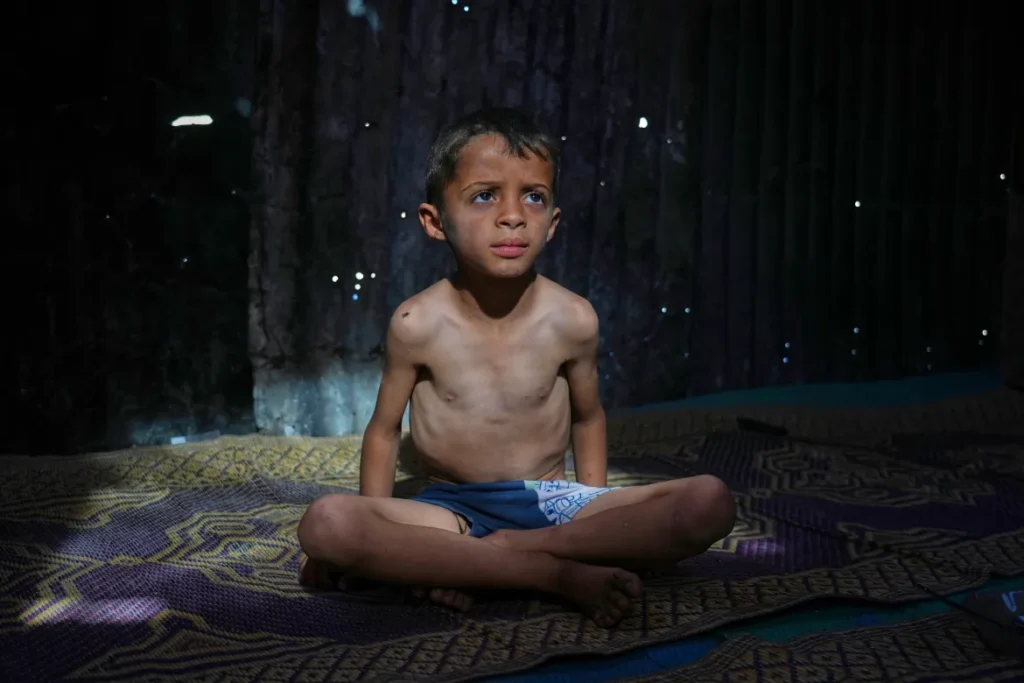
Gaza Herald- For nearly two years, Gaza has endured an unrelenting campaign of siege, starvation, and bombardment. Entire neighborhoods have been reduced to rubble, families have been torn apart, and the surviving population has been pushed to the brink of collapse. Now, as the physical destruction continues, Israel is advancing a new phase of its assault one that could claim more Palestinian lives than missiles or bullets. This phase relies not only on deliberate deprivation but on the lethal spread of disease within a population already weakened by hunger, thirst, and trauma.
Israel continues to bombard starving Palestinian civilians while advancing what may be its ultimate vision for Gaza: the mass confinement of survivors in a heavily guarded zone built on the ruins of Rafah – in effect, a modern concentration camp. If this plan is not stopped, the disease could become Israel’s most effective killing tool.
Throughout history, epidemics have often been deliberate or strategic components of genocides. From the smallpox outbreaks that decimated Indigenous peoples in the Americas to the deadly diseases in Auschwitz’s barracks, concentration camps have long been associated with conditions that kill more detainees through illness than direct violence. During the Napoleonic Wars, British soldiers were eight times more likely to die from infectious disease than from combat wounds, and in the American Civil War, malaria, dysentery, and other infections claimed some 600,000 lives.
Cramming a traumatised, malnourished population into overcrowded and unsanitary conditions magnifies the danger of outbreaks. This is now becoming a reality in Gaza, where 2.3 million genocide survivors are being pushed into smaller and smaller areas. Soon, the most acutely starving – described by Amnesty International as victims of a “live-streamed genocide” – are to be forced into what remains of Rafah, once US President Joe Biden’s untouchable “red line,” now reduced to 64 square kilometres of rubble and human remains.
Deadly Confinement Plans
This strategy follows a proposal first put forward by Defense Minister Israel Katz: a so-called “humanitarian city” to hold an initial 600,000 heavily screened survivors, excluding those executed or detained at the gates, before eventually absorbing the entire remaining population of Gaza. The resulting density could approach 36,000 people per square kilometer – an environment where even minor infections can become deadly.
According to Israeli media, the camps would be guarded and supplied by international partners, likely US- and Israel-backed private security contractors with records of violence against aid seekers. Other reports suggest the involvement of Emirati forces and the militia of Abu Shabab, a notorious gang leader allegedly armed and supported by Israel, whose men have looted aid trucks in Rafah.
History leaves no doubt about the outcome of such conditions. British concentration camps in the Boer War saw 28,000 prisoners die of typhoid. In Germany’s first genocide, the Herero and Nama perished in camps in Namibia. Japanese-Americans and Japanese-Canadians in WWII suffered epidemics, and Anne Frank famously died of probable typhus at Bergen-Belsen just before liberation.
Engineered Outbreaks Through Siege
For nearly two years, Israel’s siege, bombardment and ground invasions have deliberately destroyed Gaza’s healthcare system and personnel. Malnourished mothers cannot produce breast milk, yet baby formula is banned. Water desalination plants, sewage treatment facilities, fuel supplies, and solar panels have been targeted. Israel also blocks chlorine and repair materials, further crippling water and sanitation systems. Katz himself declared in October 2023: “They will not receive a drop of water or a single battery until they leave the world.”
As a result, epidemics have swept Gaza: viruses, bacterial infections, fungal diseases, and illnesses spread through water, air and physical contact. The World Health Organization warned in December 2023 that more Palestinians could die from disease than from bombs if the health system is not restored. Outbreaks of diarrhoea, skin diseases, hepatitis, jaundice, polio, and respiratory infections have been reported. Cholera remains a constant risk.
Even humanitarian pauses for vaccination have been attacked: during one such pause to prevent polio’s spread, an Israeli quadcopter dropped a stun grenade beside a clinic, injuring six people, including four children.
Collapse of Healthcare and Rising Disease Rates
Healthcare workers are now collapsing from hunger, dehydration, and exhaustion, yet still report for duty. A surgeon described operating while suffering gastroenteritis. Malnutrition has left children unable to fight infections, and antimicrobial resistance is worsening. Oxfam warns Gaza has become “a petri dish of disease” with acute jaundice cases doubling, bloody diarrhoea up 302 percent, and water-borne diseases rising by 150 percent.
Conditions in overcrowded tent camps mirror those documented at Auschwitz-Birkenau, where poor sanitation, pests, contaminated food, and inadequate latrines fuelled epidemics such as typhus, dysentery, tuberculosis, scabies and malaria. Many of these diseases are already present in Gaza at epidemic levels.
Vaccination rates have plummeted from near-universal coverage to dangerous lows, making mass outbreaks more likely. By mid-2025, 77 percent of water and sanitation facilities were inaccessible, and more than 80 percent of Gaza’s territory lay under evacuation orders or Israeli military control.
A Program for Mass Death
Stopping the bombing will not be enough. Survival will require a carefully monitored refeeding program to address months of starvation, alongside full restoration of access to sanitation and hygiene. Without this, Gaza’s weakened population will remain unable to fight infections, and disease will complete the work of Israel’s siege.
The history of enforced detention sites makes the conclusion clear: these conditions are not accidental. They are the deliberate creation of a system in which pathogens, not just missiles, carry out the genocidal mission against the Palestinian people.
What is unfolding in Gaza is more than a war; it is the calculated dismantling of a society’s ability to survive. Bombs destroy homes, but disease, nurtured by siege and confinement, destroys the body from within. The international community cannot claim ignorance of the outcome: history’s record is unambiguous. Without urgent intervention that restores health, sanitation, and freedom of movement, Gaza will not just be remembered for its destruction by bombs, but for the silent, preventable slaughter carried out by disease in the shadows of Israel’s blockade.