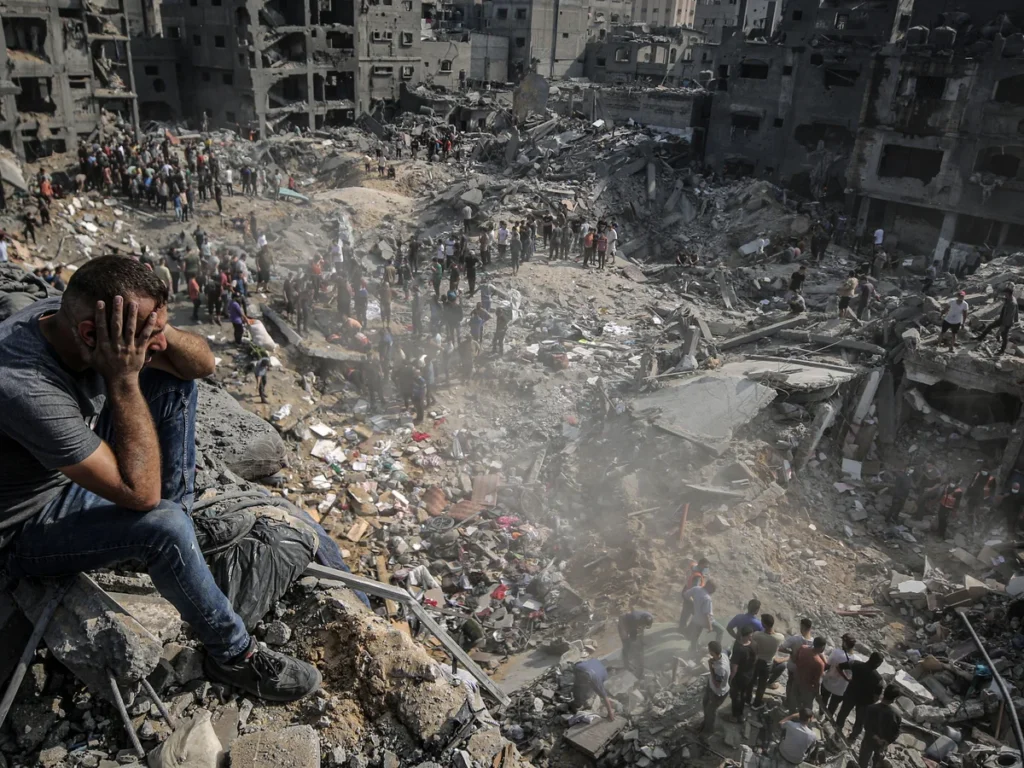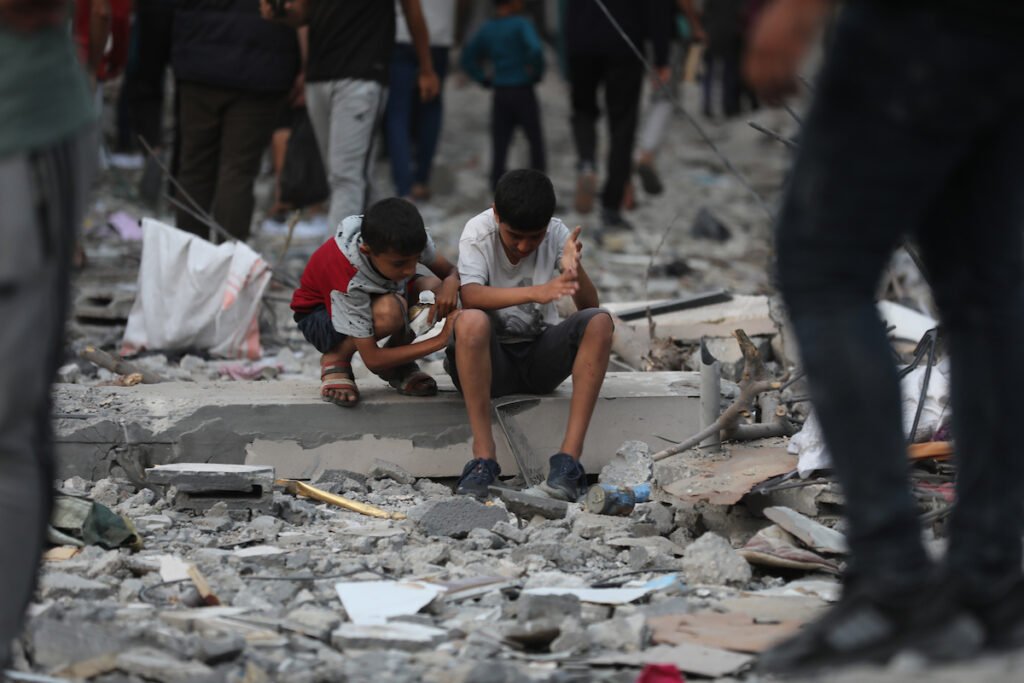
Gaza Herald– Gaza is on the brink of famine as aid convoys remain stalled and hunger-related deaths continue to rise under Israel’s ongoing military campaign. The enclave is facing an unprecedented humanitarian crisis: starvation on a mass scale.
Civilians report that even if they had money, there is simply no food available to buy. The hunger is not accidental; it is the result of Israel’s sustained blockade on humanitarian assistance and a distribution system that exposes civilians to gunfire nearly every day.
“It’s one of the most barbaric forms of killing,” said Dr. James Smith, an emergency physician who has volunteered in Gaza. “Starvation is a slow, deliberate act. It’s designed to prolong agony.”
UN Warns of Famine as Deaths Rise
On July 29, the UN-backed Integrated Food Security Phase Classification (IPC) issued its most alarming assessment yet, stating that “the worst-case scenario of famine is currently playing out in the Gaza Strip.”
Evidence continues to mount: hunger-related deaths are increasing. Famine thresholds for food consumption have already been crossed in most areas, and acute malnutrition has reached emergency levels in Gaza City.
Gaza’s Health Ministry reports that at least 180 people have died from starvation so far, half of them children, revealing the grave impact on the most vulnerable.
The IPC says more than 20,000 children have received treatment for acute malnutrition between April and mid-July. Over 3,000 were classified as severely malnourished.
Starvation breaks the body down from the inside. After days without nourishment, it starts consuming its muscle and tissue. The metabolism slows, kidney function deteriorates, and the immune system weakens.
As vital organs such as the heart and lungs fail, muscles waste away, and weakness sets in. Without intervention, the body runs out of protein reserves and begins shutting down entirely.
Aid allowed into Gaza
Despite this suffering, Israel permitted only 36 trucks to enter Gaza on Saturday, while more than 22,000 trucks remain stuck at the crossings, waiting for clearance, according to the Government Media Office.
Before October 2023, Gaza used to receive about 500 aid trucks each day an amount that has not been reached since the start of the war.
In March, Israel fully closed the crossings, cutting off all aid. Only small trickles of assistance have been allowed through over the past two months.
After aid arrives at the borders, humanitarian agencies must request clearance for their convoys to proceed into Gaza. These approvals are unpredictable.
Between July 19 and 25, the UN World Food Programme reported that only 76 of 138 convoy requests were approved.
Even after receiving clearance, aid convoys are often forced to wait for hours, sometimes up to 46 before moving. Crowds of desperate civilians gather along the roadsides, hoping to intercept food.
Deliveries are extremely dangerous. It can take up to 12 hours to complete a single mission due to constant delays at checkpoints, exposure to sniper fire, aerial surveillance, and frequent route changes.
Aid workers face risks not only from the military but also from desperate civilians. Drivers are often mobbed or attacked by starving people trying to grab supplies. There are only 60 approved drivers to operate in Gaza, nowhere near enough.
On May 27, the Gaza Humanitarian Foundation (GHF), backed by the Israeli and US governments, took over much of the aid distribution in Gaza. Its operations replaced about 400 distribution points previously managed by UNRWA, instead creating four large “mega-sites” situated near combat zones.
Civilians must walk long distances, often spending the night outside and risking their lives to reach these GHF sites. Once there, they compete for limited scraps of food amid the threat of violence.
Children, the elderly, pregnant women, and the wounded are among those forced to make this hazardous journey.
One former GHF guard, a US military veteran named Anthony Aguilar, recounted how a child was killed when security forces opened fire near a crowd seeking aid. Tear gas, stun grenades, and live rounds were used on civilians waiting for food.
Reports indicate that Israeli forces fire regularly on Palestinians gathering near GHF aid sites. As of August 5, at least 1,487 people have been killed and more than 10,578 wounded while trying to access aid.
Israel claims that the GHF is essential to prevent Hamas from diverting aid. However, an internal review by the US Agency for International Development found no proof of systemic aid theft by Hamas.
Israeli military officials have also acknowledged to the press that they have seen no evidence of organized aid diversion.
Airdrops
In light of the deteriorating situation, countries including France, Jordan, and the UAE have turned to airdropping aid. But much of the assistance lands in hazardous or unreachable locations, and some people have been injured or even killed trying to retrieve it.
Some aid parcels fall into the sea and are rendered unusable due to saltwater damage. Others arrive covered in mold, as seen in several videos recorded by residents.
UN agencies maintain that airdrops are both dangerous and insufficient. They stress that Israel must allow significantly more aid to enter Gaza by land and grant full access to avoid mass starvation among the 2.2 million people trapped inside.
Palestinians were killed and starved for over 660 days
Since October 7, 2023, Israel’s assault on Gaza has killed nearly 61,000 people, including more than 18,430 children.
In February 2025, the medical journal The Lancet estimated that the real death toll in Gaza may be 40 percent higher than official Health Ministry figures, citing the large number of unrecorded deaths outside of hospitals.
The slow strangulation of Gaza through starvation, siege, and systematic obstruction of humanitarian aid is not a tragedy of logistics; it is a policy of punishment. Israel’s control over Gaza’s borders, its refusal to allow sufficient food, medicine, and fuel, and its deadly attacks on those seeking help reveal a calculated effort to break the will of an entire population. As the world watches famine unfold in real time, the question is no longer how much aid has entered Gaza, but how long the international community will remain complicit in a blockade that has turned hunger into a weapon of war.