
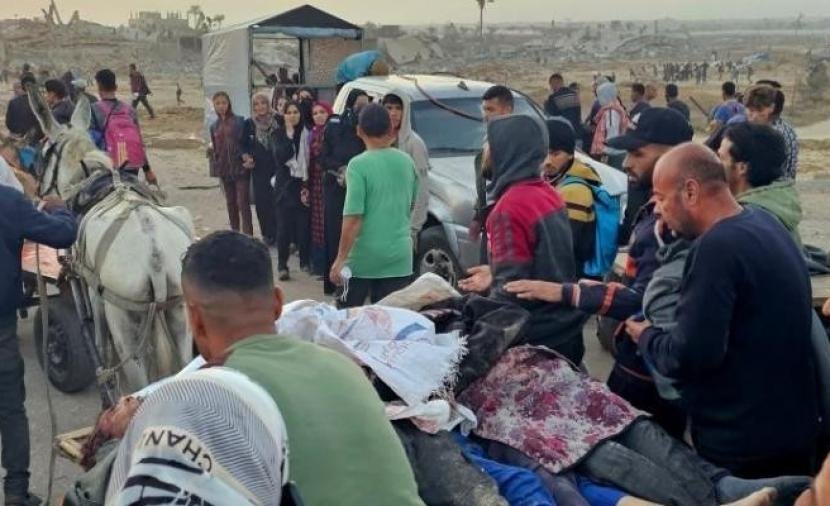
Gaza Herald- Since the war on Gaza began in October 2023, numerous legal analysts and humanitarian organizations have accused Israel of deliberately using starvation as a method of warfare, a tactic widely condemned under international law.
In late July, the Integrated Food Security Phase Classification (IPC), the premier global system for assessing hunger, confirmed that Gaza is now experiencing a scenario consistent with famine, directly resulting from the Israeli-imposed siege. According to Gaza’s health authorities, more than 160 individuals—both children and adults—have died from starvation.
Even before the latest hostilities, Israel had enforced a blockade on Gaza’s air, sea, and key land routes since 2007, severely limiting movement and goods. Nearly 80% of Gaza’s population relied on aid from international organizations. Israel retained near-total control over what and who could enter or exit the territory and even calculated caloric limits per person. As early as 2006, an Israeli government advisor described the strategy as “putting Palestinians on a diet, but not making them die of hunger.”
The war intensified this humanitarian crisis. Access to life-sustaining essentials such as food, medicine, water, and electricity was either cut off or tightly restricted, causing international condemnation. On 21 November 2024, the International Criminal Court (ICC) issued arrest warrants for Israeli Prime Minister Benjamin Netanyahu and others, marking the first instance of a Western-allied leader being charged with using starvation as a weapon of war.
Weaponisation of Humanitarian Aid
Since 7 October 2023, Israel has obstructed or destroyed resources vital for civilian survival, including food supplies, fuel, healthcare systems, and communication networks. The limited aid permitted to enter Gaza has faced major delays and security risks. Numerous Palestinians have been killed while attempting to access aid, either by Israeli forces or armed contractors working for a US-supported aid body known as the Gaza Humanitarian Foundation (GHF). Aid workers and medical personnel have also come under direct attack, and ceasefires have repeatedly collapsed within days.
How Hunger Is Assessed in Gaza
UN agencies rely on the IPC’s five-phase system to assess food insecurity, with the fifth and most severe phase being famine. A famine is officially declared when at least 20 percent of households face extreme food shortages and dangerously high levels of acute malnutrition, 30 percent of children under the age of five exhibit signs of acute malnutrition, and the death rate surpasses two deaths per 10,000 people each day.
The IPC’s 29 July assessment confirmed that the first two criteria had already been met in Gaza, with growing evidence that deaths are accelerating due to the ongoing blockade, mass displacement, shortages of essentials, and a near-total breakdown of health and sanitation systems.
The Legal Distinction Between Starvation and Famine
Although the terms “famine” and “starvation” are often used interchangeably in media and public discourse, they hold distinct legal meanings. Famine is considered the outcome, an end-stage disaster. Starvation, on the other hand, is a policy-driven process and is prosecutable as a war crime.
The distinction matters. For example, the 2011 famine in Somalia was only formally recognized after over 250,000 people had already died, half of them under five. By criminalizing starvation from the onset of deprivation, international law aims to prevent such irreversible outcomes.
What International Law Says About Starvation
Starvation has both a procedural and a result-based definition under international law. The “process” involves systematic denial of resources essential for civilian survival; the “outcome” includes resulting malnutrition, suffering, and death.
International law scholar Tom Dannenbaum, a leading voice on the crime of starvation, emphasizes that violations begin before famine-level indicators are reached. “It’s about the denial of objects essential to survival,” he said. This includes not just food but also infrastructure needed to secure food, water, shelter, and healthcare.
Israeli officials have made statements that are being scrutinized for intent. On 9 October 2023, then-Defense Minister Yoav Gallant declared a “complete siege” of Gaza: “No electricity, no food, no fuel.” Netanyahu also admitted in January 2024 that Israel provided only “minimal humanitarian aid,” asserting that this aligned with their military goals.
Measuring Starvation’s Impact
While legal accountability does not require that starvation lead to a famine declaration, it does require evidence that the deprivation was intentional and caused suffering. Acute malnutrition and related deaths, especially in the presence of clear knowledge that civilians would suffer, are key indicators.
Alex de Waal, a globally recognized expert on famine, emphasized Israel’s high degree of control over aid access. “If Netanyahu wanted every child in Gaza to eat breakfast tomorrow, it would happen,” he said. Unlike other famines driven by state collapse or conflict, the one in Gaza is tightly managed, he argued, adding that this makes it unprecedented in modern times.
The Evolution of Legal Norms on Starvation
Although starvation has long been used as a weapon in warfare, it has only been formally recognized as a war crime within the past 25 years. Historically, the 1863 Lieber Code permitted the starvation of hostile populations, and following World War I in 1919, efforts were made to categorize civilian starvation as an offense, though without enforceable legal weight. In 1949, the Geneva Conventions established responsibilities for occupying powers to provide essential goods to civilian populations. This was further developed in 1977 when additional protocols explicitly prohibited starvation in both international and civil conflicts. A major legal turning point came in 1998 with the Rome Statute, which defined starvation as a prosecutable war crime, but only in the context of inter-state wars. It wasn’t until 2021 that the Rome Statute was amended to include internal conflicts, although only 21 out of 125 ICC member states have ratified this amendment. According to Article 8(2)(b)(xxv) of the Rome Statute, starvation constitutes a war crime if it involves the intentional deprivation of civilian access to essential resources and is carried out with the deliberate aim of causing starvation.
This definition includes the destruction or control of food systems, agriculture, water, and sanitation areas heavily impacted in Gaza.
Concurrent Crimes and Genocidal Acts
The use of starvation in Gaza also intersects with other alleged crimes, including murder and persecution. In its November 2024 filings, the ICC said that these acts were interconnected, forming part of a broader strategy.
South Africa’s case at the International Court of Justice (ICJ) accuses Israel of genocide, citing four key acts under the Genocide Convention, including deliberate starvation. In March 2025, a UN panel found that Israel’s blockade and obstruction of aid were in breach of that convention.
De Waal described the situation as “genocidal starvation,” emphasizing the long-term psychological and social trauma it creates. “This is what genocide looks like: families scavenging garbage, children wasting away.”
Intent: The Key to Prosecuting the Crime
Proving a war crime does not require linking policies to specific deaths. Prosecutors must establish that the policies were implemented with intent, either direct or oblique (meaning the result was foreseeable and accepted).
Evidence includes Israel’s statements, enforcement of a total blockade starting March 2025, and repeated failure to respond to IPC warnings. According to experts, these collectively demonstrate intent to starve.
Israel’s Justifications and the Humanitarian Response
Israeli officials argue that restrictions are necessary to pressure Hamas for hostage releases and prevent aid diversion. However, UN officials and U.S. intelligence assessments have found no substantial proof of this claim. Under international law, aid cannot be withheld based on hypothetical diversions unless there’s overwhelming evidence that it is not reaching civilians.
During ceasefires, aid distribution improved significantly, refuting the claim that civilians were not reachable.
The Gaza Humanitarian Foundation: A Failed Model?
In May 2025, Israel replaced the UN’s humanitarian system in Gaza with the GHF. The new model has been heavily criticized: operating only four distribution hubs compared to the UN’s 400 points, it is controlled by U.S. contractors and Israeli military monitors.
UN officials described it as an instrument of forced displacement, designed to push populations toward southern Gaza. Since the GHF took over, over 1,300 Palestinians have died trying to access aid.
The system is widely seen as inadequate, with many unable to reach distribution centers due to security risks or physical limitations. Attacks, theft, and chaos plague the process.
Legal Proceedings: ICC and ICJ
The ICC’s arrest warrants for Netanyahu and Gallant cite deliberate deprivation of water, food, and medicine from October 2023 to May 2024. The court cited these policies as having a direct effect on hospitals, water supplies, and civilian survival.
Beyond starvation, the ICC also charged them with other crimes against humanity, including murder and “inhumane acts” such as conducting surgeries without anesthesia due to supply shortages.
At the International Court of Justice (ICJ), South Africa’s genocide case against Israel places starvation at the heart of its allegations. Since January 2024, the court has issued three provisional orders, mandating that Israel take immediate action to prevent acts of genocide, guarantee unimpeded access to humanitarian aid, and halt its military operations in Rafah.
Israel has refused to comply and denied the allegations, while many nations argued that the siege and aid restrictions constitute war crimes and breach the Fourth Geneva Convention.
Legal scholars, humanitarian leaders, and global bodies increasingly agree: Israel’s use of starvation in Gaza is not just morally reprehensible it may constitute a prosecutable war crime. With multiple international proceedings underway, the question now is not whether Gaza is starving, but whether justice will be delivered before more lives are lost.

