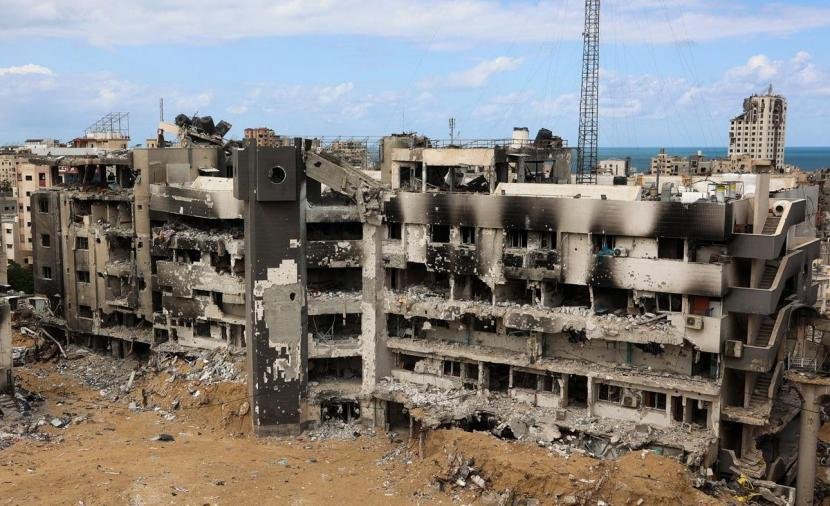
Gaza Herald – The Palestinian Center for Policy and Survey Research stated that the health system in the Gaza Strip has not recovered despite the ceasefire. The center noted that all 36 hospitals in the sector suffered varying degrees of damage during the Israeli war, and none have managed to restore their full operational capacity.
The research paper was authored by Ibrahim Al-Hawajri under the title “The Health System Under Fire: Documentation and Analysis of Targeting Hospitals and Health Facilities in the Gaza Strip (October 2023 – August 2026).” It indicated that only 19 hospitals were functioning partially as of June 2026.
According to the study, which was released on Monday, the number of partially operating hospitals increased from 16 in July 2024 to 19 in June 2026. The researchers considered this limited progress to reflect slow recovery and stagnation in health readiness despite months passing since the ceasefire began.
The paper traced the stages of targeting health facilities, starting with attacks on Shifa, Nasser, and the Turkish hospitals. It continued through sieges and raids in 2024, reaching ongoing attacks and restrictions on supplies and access after the ceasefire. The study concluded that targeting the health system followed a widespread and repeated pattern across different geographical areas and time periods.
The document emphasized that the damage went beyond building destruction to undermine the therapeutic, diagnostic, and preventive capabilities of Palestinian society. Regarding the Israeli narrative about Palestinian factions using hospitals for military purposes, the study said many claims lacked independent verifiable evidence.
It relied on comparing these claims with results from independent investigations, including the report of the UN Independent International Commission of Inquiry. The study affirmed that allegations of military use do not automatically remove legal protection unless strict legal conditions are met, including issuing warnings and allowing reasonable deadlines while adhering to principles of distinction and proportionality.
Regarding health repercussions, the paper pointed out that 47% of essential medicines ran out by August 2026. It also noted the loss of approximately 14% of health workforce members, alongside a decline in laboratory services, diagnostics, and epidemiological surveillance.
The study estimated the needs for recovery and rebuilding the health sector at around 10 billion dollars. It warned that the reduced pace of attacks does not mean the end of targeting the health system, as significant harm shifted to restrictions on fuel, medicine, and medical equipment imports.
On the legal front, the paper discussed the possibility of characterizing documented acts as war crimes and crimes against humanity. It reviewed accountability paths before the International Criminal Court, the International Court of Justice, and the UN commission, alongside universal jurisdiction mechanisms.
The study called for creating a unified national database to document attacks on health facilities and referring documented files to the ICC. It urged establishing an independent international mechanism to verify claims regarding military use of hospitals and providing dedicated funding for sector rehabilitation.
This report was produced in the Gaza Herald newsroom.