
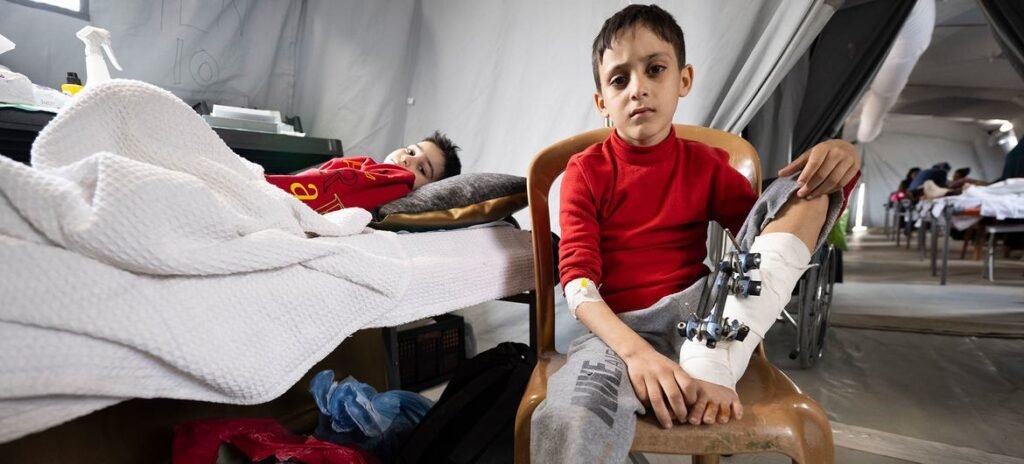
Gaza Herald _For thousands of Palestinians with disabilities across the Gaza Strip, basic everyday acts, leaving a tent, reaching a bathroom, or getting to a hospital, have become grueling obstacles under Israel’s genocidal war.
Wrecked wheelchairs, scarce spare parts, and a severe shortage of assistive equipment have turned routine daily necessities into exhausting struggles, trapping countless people inside displacement shelters and forcing total reliance on others while they wait for the means to move again.
This crisis reaches far deeper than physical trauma and pre-existing disabilities. It has stripped many people of their hard-won autonomy, compelling them to depend on family members and caregivers amid the deliberate devastation of roads, healthcare facilities, and rehabilitation centers.
Reaching the equipment needed for everyday survival has grown progressively harder, tightening the isolation of a population already facing relentless hardship.
Three Years of Isolation in Displacement
The ordeal of 37-year-old Ahmed Al-Maghribi captures the brutal reality of this confinement. For three years, he has been unable to step outside his displacement shelter after all of his wheelchairs became unusable, while his family has been unable to fix them because essential spare parts cannot be found.
Al-Maghribi sustained an injury during Israel’s 2004 invasion of the Zeitoun neighborhood that left him with triplegia. Since then, his wheelchair has been vital to his mobility and his ability to carry out daily life.
Prior to the current genocidal war, he had two manual wheelchairs and an electric one. However, Israeli destruction left his electric wheelchair buried beneath the rubble of his northern Gaza home, while his two manual chairs broke down during grueling, repeated displacements.
Cut off from replacement parts and repair services, Al-Maghribi has been effectively locked inside his current shelter. A disability he had spent years learning to manage has been turned into enforced confinement by war, displacement, and the collapse of vital support networks.
A Missing Spare Part Can Mean Complete Dependence
The crisis extends beyond wheelchairs that are ruined beyond repair. Even minor mechanical faults can strip someone of independent movement when replacement components are nowhere to be found.
Ramzi Al-Fajm, a technician specializing in wheelchair and assistive-device maintenance who has worked in the field since 1997, explains that demand for wheelchairs has surged dramatically throughout the genocidal war, even as devices and repair supplies have grown scarce.
According to Al-Fajm, missing spare parts have forced technicians to improvise, scavenging usable pieces from old or broken equipment just to keep existing wheelchairs rolling.
He notes that while some repairs involve straightforward issues, lacking a single specific component can make even simple fixes nearly impossible. In many instances, technicians are left with no choice but to strip older wheelchairs for parts that can be reused elsewhere.
His experience underscores an often-ignored aspect of the humanitarian catastrophe: sending new wheelchairs alone is not enough. Countless existing chairs also fail when maintenance supplies are blocked and proper replacements are unavailable.
Broken Wheelchairs Pose Serious Health Threats
Relying on damaged mobility gear brings severe medical risks that go far beyond discomfort and limited movement.
Dr. Fadel Masoud, head of the physical therapy department at Hamad Hospital for Rehabilitation and Prosthetics in Gaza, warns that prolonged use of faulty wheelchairs can trigger serious health problems.
Staying in unsuitable equipment can lead to chronic pain in the back, neck, and shoulders, along with muscle wasting and joint stiffness. It also raises the danger of pressure sores, which can turn into grave infections without proper care.
Worn tires, brakes, wheels, and cushions can undermine a wheelchair’s stability, making falls and additional injuries far more likely. These failures also block access to vital services and opportunities, including healthcare, education, and work.
Ultimately, lacking proper mobility equipment locks people into a cycle of declining health and social exclusion, making it steadily harder for persons with disabilities to protect their bodies and take part in everyday life.
Children Struggle to Regain Their Independence
Shortages of assistive gear are also inflicting deep harm on children with disabilities, cutting off chances to learn, move freely, and build independence.
A recent human-interest report by the United Nations Office for the Coordination of Humanitarian Affairs (OCHA) documented the story of 10-year-old Anas Al-Sharif, born without legs and with only two fingers on each hand.
Before getting specialized support, Anas moved by crawling on his hands while his mother carried him. Everyday tasks like eating and writing were especially tough due to his limited grip and balance.
His situation improved after the EducAid foundation stepped in, providing him with an upgraded wheelchair and specialized tools to help with writing and mobility.
His mother called the change profound, recalling how she once had to carry him while he struggled to crawl. With the new equipment, he can now handle daily tasks like writing and eating with greater independence.
The same report shared the story of his 17-year-old sister, Sujood, who also received a wheelchair. Sharing her joy, she said, “For the first time, I have a chair of my own,” adding that the act made her feel someone cared about her.
Their stories show that assistive devices mean far more than basic transport. For children with disabilities, the right equipment can unlock education, personal growth, and the ability to do ordinary things without constant help.
A Growing Emergency Reflected in Alarming Figures
The World Health Organization (WHO) laid out the scale of this crisis in its May 2026 report, estimating that around 43,000 injured people in Gaza have suffered potentially life-altering injuries out of more than 172,000 injuries recorded since October 2023.
The agency reported more than 5,000 amputations caused by the war, with between 49,000 and 55,000 injured people needing long-term rehabilitation. At the same time, not a single rehabilitation center in the Gaza Strip is running at full capacity.
According to the WHO, Gaza needs roughly 33,000 assistive devices and technologies, including wheelchairs and prosthetic limbs. Even though over 12,000 mobility aids were distributed between January 2025 and May 2026, that meets only about one-third of the identified need.
The agency also pointed to roadblocks keeping rehabilitation supplies out of Gaza, noting that shipments holding vital gear, including wheelchairs and prosthetics, have faced long delays waiting for entry approvals.
These numbers reveal a massive gap between what persons with disabilities need and what humanitarian aid can currently deliver, especially as the ranks of those needing long-term rehabilitation keep rising.
Mobility Is a Fundamental Right, Not a Privilege
Repeated displacement has made life even harder for persons with disabilities in Gaza. Unpaved ground, packed tents, inaccessible shelters, and poor sanitation turn even brief trips into major physical hurdles.
In testimony documented by Human Rights Watch in 2024, the organization recounted the plight of a family with a young man who uses a wheelchair, a father with quadriplegia, and a blind sister. Forced to flee from northern Gaza to the south, the young man had to carry his 12-year-old cousin, who struggled to walk, on his lap for the entire journey.
Accounts like this show how the genocidal war has stripped persons with disabilities not only of vital mobility aids, but also of the conditions needed to stay alive, reach aid, and get medical care.
Ending this emergency takes more than stopgap aid. It requires the immediate entry of wheelchairs, spare parts, prosthetics, and other assistive tools, alongside rebuilding rehabilitation centers, bringing in specialized medical staff, and making shelters, roads, and public spaces genuinely accessible.
For Ahmed Al-Maghribi, fixing a wheelchair could mean ending years of confinement and stepping outside his displacement shelter again. For a child like Anas, having the right assistive equipment can mean the difference between ongoing dependence and being able to write, learn, eat, and move with greater freedom.
Taken together, these realities expose a stark truth in Gaza: persons with disabilities are not imprisoned by their physical conditions alone. They are increasingly trapped by the destruction of the infrastructure, services, and essential equipment that make independent living possible.
Restoring their mobility is therefore far more than delivering relief supplies. It is about defending their dignity, upholding their rights, and ensuring disability is never turned into a life sentence of isolation.

