
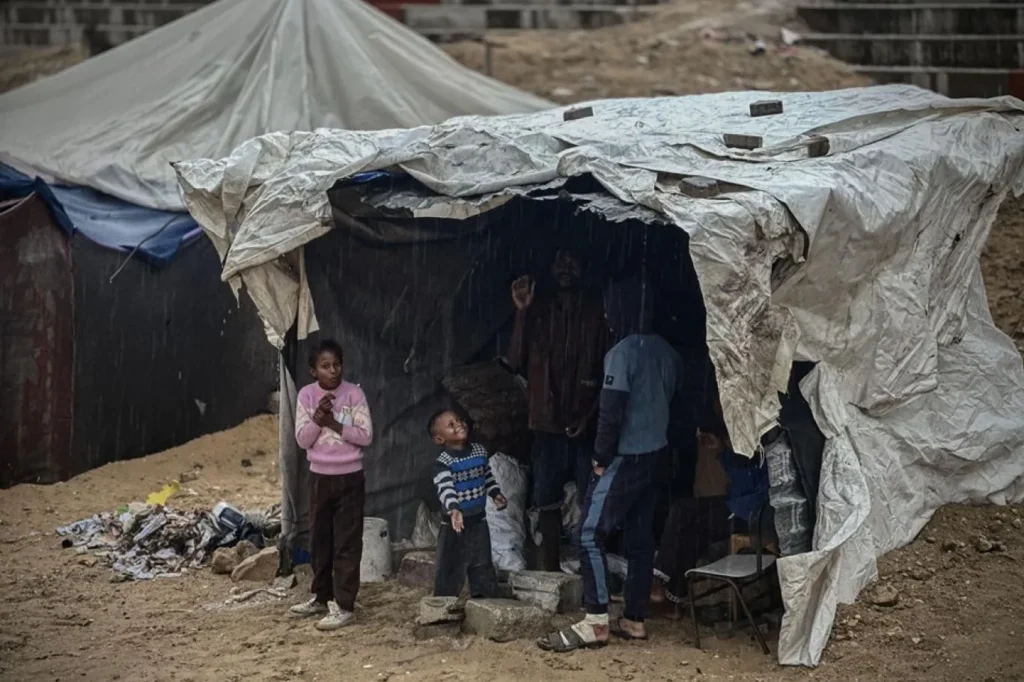
Gaza Herald — In Gaza, childhood is no longer measured by school days, birthdays, or play. It is measured by the weight of water containers, the hours spent searching for food, and the few shekels a child can bring home to keep a family alive.
Israel’s war and blockade have forced thousands of Palestinian children into adult responsibilities. With parents killed, injured, or unable to work, children are digging graves, hauling rubble, collecting firewood, selling food, and caring for younger siblings instead of attending school.
Their childhoods have been replaced by a daily struggle for survival.
Small Hands Carrying the Weight of War
Ten-year-old Hasan Saad supports his family of nine by transporting heavy stones and bricks through Gaza’s devastated streets, earning around 20 shekels a day.
The exhausting work leaves him in severe pain, sometimes preventing him from sleeping. His dream is painfully simple: to return to school and sleep without suffering.
Other children begin working before sunrise, selling food and water, extracting scrap metal from destroyed buildings, or collecting materials from garbage dumps.
These dangerous jobs expose them to injury, exploitation, pollution, and abuse. Yet for many families, their children’s earnings have become essential to survival.
Orphaned, Displaced, and Forced to Grow Up
The war has left tens of thousands of Palestinian children without one or both parents. Estimates cited in humanitarian reports place the number at approximately 56,000 to 60,000.
Among them is Dima Amin Abu Shaqian, who survived an Israeli airstrike that killed her mother and four sisters. Seriously injured, she spent months recovering before her father was also killed in October 2024.
Now living with her aunt in a tent, Dima faces disability, displacement, and the loss of nearly her entire family.
Eleven-year-old Razan suffered a similar tragedy. An Israeli attack killed her parents and siblings and resulted in the amputation of her leg, leaving her struggling to obtain adequate medical treatment.
For children like Dima and Razan, surviving an attack is only the beginning of a much longer ordeal.
A Generation Traumatized and Denied Education
Beyond physical injuries, Gaza’s children face profound psychological harm.
Repeated bombardment, hunger, displacement, and bereavement have left many suffering from nightmares, anxiety, emotional withdrawal, and persistent fear.
Some children suppress their grief because they believe they must remain strong for their families. Others have reportedly stopped speaking after witnessing extreme violence.
Mental health specialists warn that recovery is nearly impossible while children remain exposed to continuing threats and insecurity.
Education has also been devastated. More than 625,000 students have been deprived of regular schooling, while widespread damage to educational facilities has left classrooms destroyed or converted into displacement shelters.
UNRWA warned in October 2026 that rebuilding Gaza’s education system could take seven years, with more than 200,000 children still outside organized learning.
The longer children remain out of school, the greater the risk of permanent educational exclusion, child labor, and exploitation.
Fighting to Save What Remains of Childhood
Despite the destruction, Palestinian teachers and volunteers continue organizing makeshift classrooms, recreational activities, and psychological support sessions in displacement camps.
These initiatives offer children moments of learning, connection, and relief. But they cannot replace functioning schools, safe homes, adequate nutrition, or specialized medical care.
Humanitarian workers warn that Gaza’s children need far more than emergency assistance. They need sustained protection, education, rehabilitation, mental healthcare, and support for families who have lost their breadwinners.
A child should never have to dig graves to buy bread, carry rubble to feed siblings, or become a parent before growing up.
Gaza’s children have already lost their homes, schools, loved ones, and years of their childhood.
Without urgent and sustained action, they risk losing their futures as well.

