
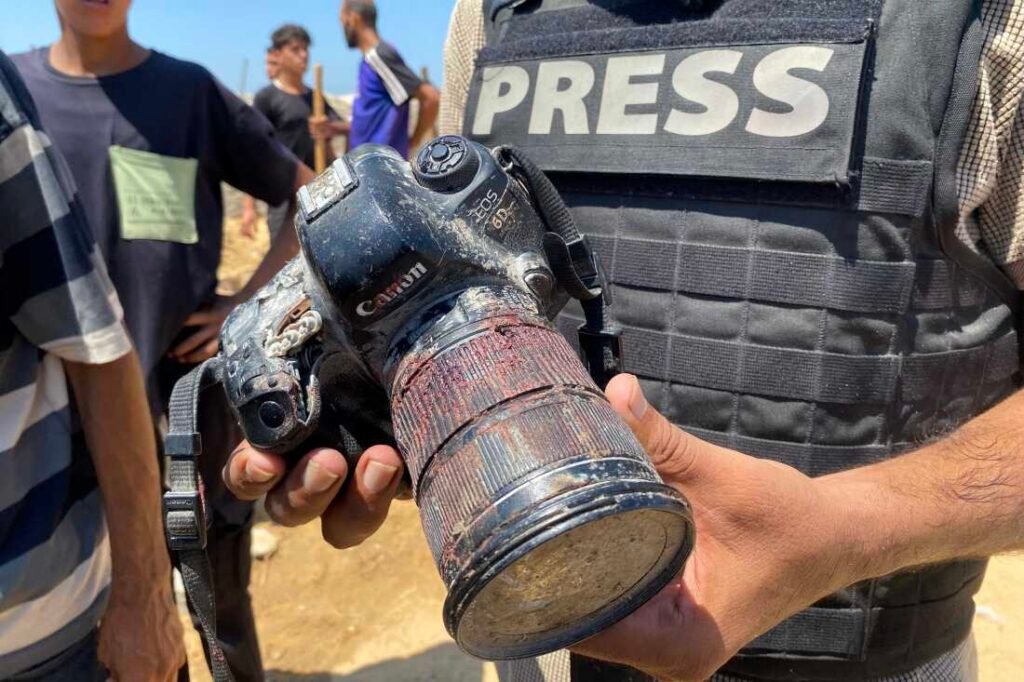
Gaza Herald — From the first hours of Israel’s genocidal war on the Gaza Strip, Palestinian journalists working across the enclave have faced an unprecedented campaign of physical targeting and total digital isolation.
In a calculated effort to conceal massacres and sever Gaza from the global public, Israeli forces have repeatedly severed telecommunications, knocked out cellular networks, and destroyed over half of the enclave’s total communications infrastructure. Beyond disrupting civilian rescue operations and preventing paramedics from receiving emergency calls, these enforced blackouts have turned daily newsgathering into a life-threatening battle to amplify the voices of victims under relentless bombardment.
To bypass the blockade, field reporters are forced into high-risk maneuvers to secure reliable signals, relying heavily on international e-SIM cards that connect to mobile networks operated inside the occupied territories or neighboring regions.
Field journalist Hani Abu Rizq explained that obtaining a single digital bar often requires media workers to travel to exposed coastal areas or navigate near frontline positions controlled by Israeli forces, placing them directly within the crosshairs of armed drones and military snipers. Abu Rizq cited the killing of journalist Hossam al-Masri, who was targeted while attempting to broadcast field reports, as a stark example of the deadly price Gaza’s press corps pays to break the media blockade.
Navigating Frontlines and Infrastructure Destruction to Broadcast the Truth
Journalist Safnaz al-Louh recounted her daily struggle to upload field footage, describing how she regularly climbed exposed upper floors of damaged buildings or approached military buffer zones near the Netzarim Corridor to catch a transient signal. The technical ordeal is further exacerbated by the total collapse of the local power grid, leaving journalists without electricity or generator fuel to charge camera batteries, laptops, and mobile devices.
Despite these conditions, deep professional solidarity has sustained media workers on the ground; al-Louh recalled how slain journalist Saleh al-Jaafrawi personally helped her acquire a mobile phone compatible with e-SIM technology, enabling her to continue field broadcasts before his murder by occupation forces.
In response to the systematic destruction of more than 140 media headquarters across the Strip, the Palestinian Journalists Syndicate established media solidarity hubs in Khan Younis, Deir al-Balah, and Gaza City.
Syndicate official Ola Kassab confirmed that these centers serve as vital lifelines, providing reporters with emergency solar power and internet connectivity to counter Israel’s enforced blackouts. By maintaining an unbroken link between the besieged enclave and global newsrooms, Palestinian media workers continue to fulfill their humanitarian duty, ensuring that evidence of ongoing war crimes is recorded and brought before international courts.

