
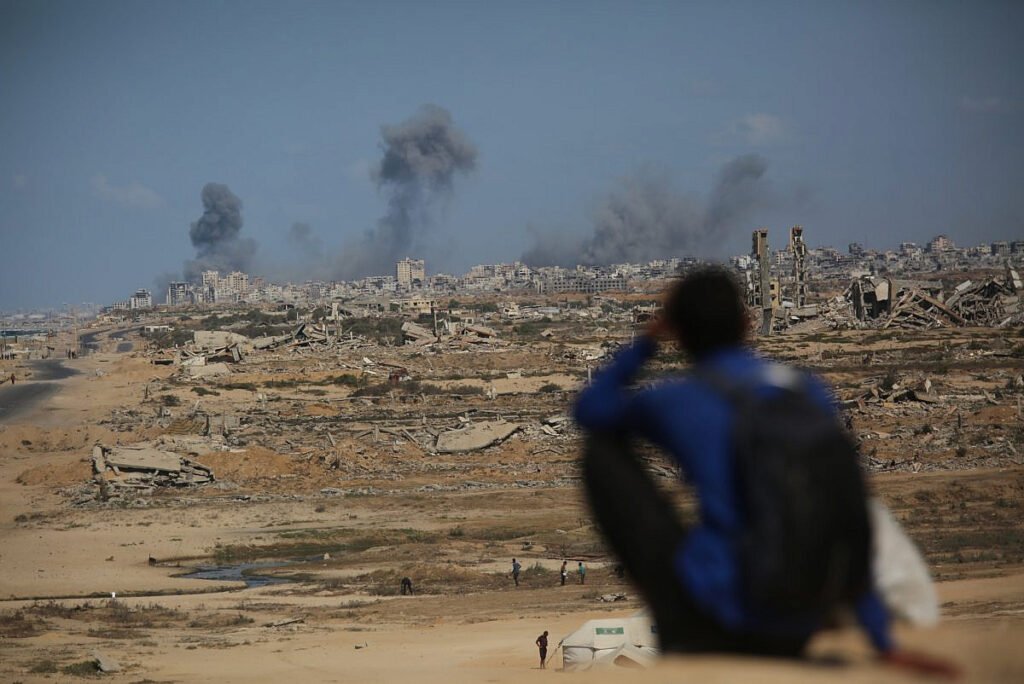
Gaza Herald — One year after the U.S.-brokered ceasefire agreement in the Gaza Strip took effect, a stark chasm divides the promises made on paper from the reality experienced by Palestinians on the ground. Instead of marking the end of the genocidal war and initiating the comprehensive reconstruction of devastated infrastructure, the agreement has yielded a volatile status quo defined by continued Israeli strikes, unresolved military expansion, severe displacement, and deep political deadlock.
A detailed report published by the Associated Press (AP News) on October 10, 2026, titled “A U.S.-Backed Ceasefire Was Supposed to End the War in Gaza. A Year Later, Progress Has Stalled,” underscores the failure to execute the agreement’s core provisions. Three years after Israel launched its all-out military assault on the Strip, Palestinians remain stripped of even the most rudimentary conditions for human survival.
Despite international assurances, the ceasefire has neither halted the loss of civilian life nor eased the humanitarian crisis, as broad swathes of Gaza remain under direct Israeli military control.
The Ceasefire That Failed to Stop the Killing
For Palestinians in Gaza, the past year has demonstrated that a declared ceasefire does not guarantee protection from military violence. Israeli breaches have persisted across the Strip, preventing the truce from transitioning into a stable, lasting end to hostilities.
According to health authorities in Gaza, more than 1,400 Palestinians have been killed by Israeli strikes and military actions since the ceasefire officially took effect in October 2025. This toll compounds the massive casualties inflicted since October 2023, which destroyed entire urban centers and displaced the vast majority of Gaza’s population.
The ongoing loss of life highlights the fundamental fragility of the existing arrangements. In the absence of enforceable international mechanisms to stop Israeli military operations, residents remain trapped in a state of constant insecurity, unable to return to their destroyed neighborhoods or rebuild their lives without fear of renewed escalation.
Between Rubble and Deteriorating Tents
On the ground, physical destruction continues to define daily existence across Gaza. Entire residential districts lie completely razed, essential water, power, and sewage networks remain non-functional, and hundreds of thousands of families reside in overcrowded makeshift tents and shelters that fail to meet basic human standards.
While the ceasefire was intended to facilitate rapid emergency recovery, persistent Israeli restrictions on the entry of heavy machinery, construction materials, and debris-clearing equipment have effectively paralyzed large-scale reconstruction.
Displaced families face severe hardship in temporary encampments, where access to clean water, sanitation, and medical care is severely constrained. Large numbers of Palestinians are explicitly prohibited from returning to their original towns due to ongoing Israeli military presence or total infrastructure destruction.
While limited commercial goods have been permitted to enter local markets, consumer imports cannot substitute for structural recovery. True rehabilitation requires rebuilding homes, hospitals, schools, and utility grids, alongside restoring lost livelihoods and economic infrastructure.
The U.S. Plan Stalls Amid Diplomatic Deadlock
The diplomatic framework put forward by the Trump administration, promoted as a roadmap to end the genocidal war and establish new political and security arrangements, remains stalled across its most critical axes.
According to the AP report, major disputes persist over key interconnected files:
• The full withdrawal of Israeli occupation forces.
• The establishment of an independent Palestinian governing administration.
• The deployment of an international stability force.
• The immediate launch of unconditional reconstruction.
Progress on physical reconstruction remains legally and logistically tied to political and security guarantees. Meanwhile, Israel’s continued military hold over expansive zones raises profound concerns regarding Palestinian territorial integrity and sovereignty.
Central to the diplomatic impasse are continued disagreements regarding the status of Hamas’s defensive capabilities and political role, alongside Israel’s refusal to commit to a full military withdrawal or provide binding security guarantees. These disputes illustrate the difficulty of transforming a limited cessation of major offensive operations into a permanent political settlement that guarantees Palestinian rights.
Withdrawal and Reconstruction: The Twin Obstacles
The continued presence of Israeli military forces across large portions of the Gaza Strip remains one of the primary obstacles to regional stabilization. This military footprint restricts freedom of movement, complicates the delivery of humanitarian relief, and halts civil defense efforts to clear unexploded ordnance and recover bodies buried beneath the rubble.
Human rights analysts warn that prolonged military control risks cementing temporary lines of deployment into permanent buffer zones, geographically fragmenting the Gaza Strip and permanently altering its demographic and economic structure.
Simultaneously, reconstruction efforts are crippled by the sheer scale of physical damage and the strict ban on dual-use construction materials. Without a clear mechanism guaranteeing that rebuilt structures will be protected from future bombardment, international funding and implementation remain heavily restricted.
Gaza requires a comprehensive structural plan that extends beyond emergency aid to encompass housing, health, education, and economic revitalization. Without concrete movement on full military withdrawal and unhindered imports, reconstruction will remain blocked.
A Year of Waiting Without a Clear Horizon
For the two million Palestinians living in Gaza, the year following the ceasefire agreement is not measured by the passage of time, but by the failure to achieve basic safety, dignified housing, and political self-determination.
Families who lost their homes remain exposed to the elements in worn-out tents; the wounded and chronically ill suffer under a collapsed health sector; and hundreds of thousands of children remain deprived of formal education.
This human suffering is directly linked to the stalled political track. As long as key issues regarding military withdrawal, administrative governance, and border access remain unresolved, the humanitarian crisis will continue to deepen.
The record of the past year demonstrates that a ceasefire alone, without enforcement mechanisms, binding timelines for withdrawal, and unrestricted entry of reconstruction materials, cannot end the destruction of Gaza. Mediating parties, led by the United States, face a critical test of whether they will enforce the commitments made in October 2025 or allow the ceasefire to serve as a framework for indefinite military occupation and permanent displacement.

