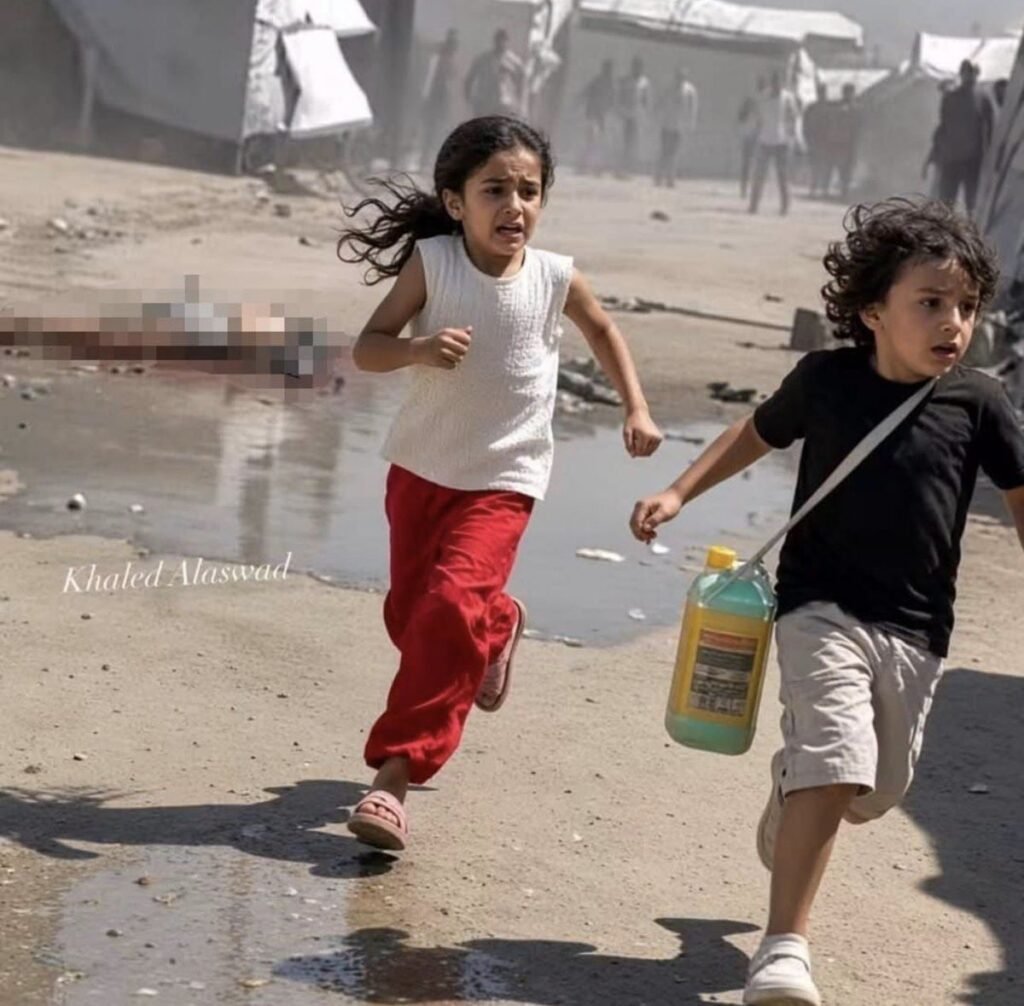
Gaza Herald — She was only five years old. Maria Hassan Siam was walking a few steps behind her father when the world around her violently collapsed. One moment, she was an innocent child walking with her parents to buy basic daily necessities; the next, her father, Hassan Siam, was murdered in front of her eyes, her mother lay bleeding from severe wounds, and Maria was left running for her life through the smoke and rubble.
The image of the terrified child fleeing the scene spread rapidly across social media, capturing a horrifying reality that defines life under occupation: a little girl forced to run away from the precise spot where her parents were struck down. According to family accounts, the family had gone out to shop when an Israeli missile hit the area. Hassan was killed instantly, while his wife was critically wounded. Maria, who had been walking just steps behind them, witnessed the graphic carnage and fled in terror. Her father had already survived injuries from an earlier strike only days before, barely beginning his recovery before the occupation forces targeted him again.
This visual record of raw trauma has drawn powerful comparisons to the historic photograph of nine-year-old Kim Phuc running from an American napalm attack in Vietnam in 1972. The comparison is striking because both images reduce the vast brutality of war to the face and movement of one terrified child. Five decades after Vietnam, the technology captured in high-definition video may have changed, but the reality of Western-backed military power targeting defenseless children remains identical. Maria was not carrying a weapon; she was a five-year-old walking behind her parents in her own homeland before an Israeli missile shattered her world.
Maria’s story is a single face behind a systematic campaign waged against Gaza’s youngest population. Human rights organizations report that tens of thousands of children in Gaza have been killed or maimed, with over 56,000 children losing one or both parents to Israeli bombardment. Behind these statistics are real human lives, children forced to learn words that no child should ever know, such as airstrike, displacement, amputation, and martyrdom.
For the international community, war is often reduced to casualty figures and political statements, but for a five-year-old Palestinian girl, it is measured by the sudden disappearance of a father’s hand and the sight of a parent lying motionless on the pavement. The deliberate destruction of Gaza’s homes, schools, and civic infrastructure exposes nearly one million children to severe trauma, turning ordinary daily tasks like shopping into fatal events. Maria’s tragedy forces the world to confront the human cost of an ongoing genocide: an entire generation of Palestinian children being stripped of their childhood, forced to carry the indelible memories of lost parents and shattered homes while the world watches.