
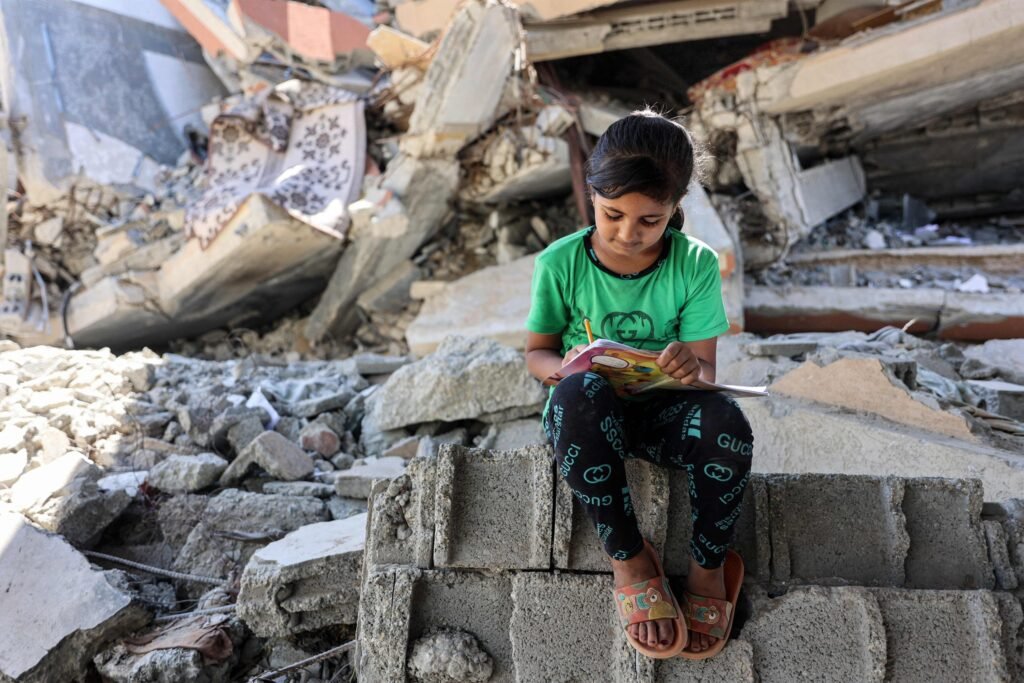
GazaHerald— Nearly half a million Palestinian students are returning to education in Gaza for the 2026–2027 academic year, defying devastating humanitarian conditions that have forced thousands of children and teachers to study and work from tents, shelters and makeshift classrooms.
The Palestinian Ministry of Education and Higher Education announced the start of the new school year amid extremely difficult educational and humanitarian conditions created by Gaza genocide. Students and teachers continue to live with displacement, severe shortages of basic educational materials and profound psychological and social trauma.
For Gaza’s children, returning to education bears little resemblance to an ordinary school year. Many remain displaced in tents and shelters, while the educational system operates without the stability, facilities, and resources needed for normal classroom learning.
Despite these conditions, the ministry said it has worked with partners to return approximately half a million students to education, while establishing and supplying dozens of field schools and alternative learning spaces with whatever furniture and educational materials are available.
The ministry stressed that these makeshift classrooms are emergency measures rather than a substitute for children returning to safe, functioning schools.
Education Amid Displacement
The new academic year also exposes one of Gaza’s most painful realities: school buildings are needed simultaneously as classrooms and shelters for displaced families who have nowhere else to live.
The ministry called on the international community and UN agencies to provide dignified and sustainable housing solutions for displaced Palestinians currently sheltering inside schools, allowing damaged educational facilities to be repaired and restored to their original purpose without abandoning families who depend on them for shelter.
It also urged UNRWA to take broader steps towards formally reopening its schools, warning that thousands of Palestinian students continue to suffer the consequences of prolonged disruption to their education.
Years of war and interrupted schooling have created an enormous educational deficit. The ministry called for urgent and sustainable funding, school furniture and basic supplies, alongside remedial learning programmes to help students recover years of lost education.
It also stressed the urgent need for psychological and social support for both students and teachers, many of whom are attempting to return to classrooms while carrying the trauma of genocide, displacement and loss.
The ministry paid tribute to students, teachers and education workers killed during the Gaza genocide and expressed solidarity with those wounded or imprisoned, while praising educators who continue teaching despite unstable conditions and scarce resources.
In Gaza, reopening a classroom today means far more than restarting lessons. For children surrounded by displacement and destruction, returning to education is an insistence that their future will not be erased.
The tents and makeshift classrooms cannot replace the schools Gaza’s children have lost, but the return of nearly half a million students carries a powerful message: even under extraordinary conditions, Palestinians continue to defend their children’s right to learn, remain and build a future in their homeland.

