
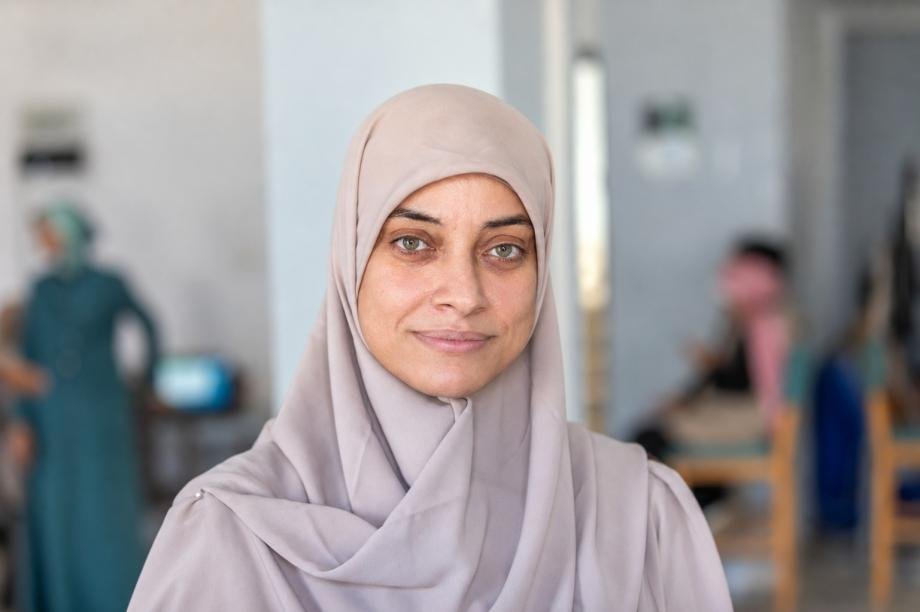
Gaza Herald _At a time when the ongoing genocidal war in Gaza forced many to put their dreams on hold, Alaa Al-Madhoun actively searched for a way forward. She possessed neither ideal learning conditions nor a paved road to success. A 36-year-old widow and mother, Al-Madhoun carried the painful memory of her martyred husband, who was killed by Israeli forces in 2018 during the Great Return March demonstrations.
Living under a prolonged siege that weighed heavily on every detail of daily existence, she chose not to let these crushing realities stop her. Amid pervasive fear, forced displacement, blackouts, and total communication blackouts, Al-Madhoun opened a window toward the future, diving deep into artificial intelligence until her personal interest evolved into an academic and professional career, transforming her into a recognized trainer, researcher, and prominent voice in emerging technology.
Her journey did not begin with AI, but with a dream she carried since studying journalism and media. Following her husband’s martyrdom, Al-Madhoun faced daunting new responsibilities, including raising her child and completing her unfinished higher education.
A year after his loss, she returned to university to finish her credit hours, propelled by her father’s steadfast support and a desire to fulfill her husband’s dream of seeing her become an accomplished academic. Returning to her studies was more than earning a degree; it was a conscious effort to rebuild her life from the ground up. She completed her degree in journalism, enrolled in a master’s program, and simultaneously pursued an applied degree in multimedia at the University College of Applied Sciences alongside her theoretical master’s studies at the Islamic University of Gaza.
Balancing two academic tracks, household responsibilities, and single parenthood required incredible resolve, yet she excelled in both, molding a distinct professional identity as a tech-savvy journalist determined to carve out her own name.
When selecting her master’s thesis topic, Al-Madhoun deliberately avoided traditional subjects, seeking a field that would grant her lasting expertise. She chose artificial intelligence long before it became a ubiquitous global trend. As she recounted to Felesteen newspaper, many warned her that the path was fraught with difficulty due to a severe scarcity of accessible local sources under the siege. Refusing to step back, the challenge only fueled her determination to conduct broader research.
She launched an extensive search for reference material, establishing contact with international and Arab academic institutions, eventually receiving vital support and literature from scholars in Iraq and Egypt. After painstaking effort, she successfully defended her thesis in 2022, a milestone that propelled her deeper into the specialized field and led to her participation in key academic conferences on AI and media.
When the full-scale war erupted across Gaza, Al-Madhoun refused to view the brutal aggression as the end of her path, seeing it instead as a urgent call to master new digital tools. Whenever brief windows of internet access returned, she read and researched relentlessly, working to bridge the distance imposed on besieged Gaza by the global tech divide. Operating without basic necessities, facing constant bombardments, displacement, unstable power, and targeted infrastructure destruction, she persisted. During a partial return of residents to northern Gaza, she volunteered with the University College on an AI and media project, successfully supervising two major initiatives and solidifying her stature in the field.
Her growing reputation earned her an invitation to co-author a book on AI alongside international scholars and researchers. Approaching the task with rigor, Al-Madhoun insisted on personally testing every tool before writing about it, believing that true expertise requires direct application. In a striking testament to her resilience, a complete telecommunications wipeout hit Gaza just as her chapter deadline approached. Refusing to let the blockade serve as an excuse, she walked through active danger to Nuseirat accompanied by her father and young child just to submit her manuscript on time.
The book’s scope eventually expanded to cover quantum computing, and Al-Madhoun authored five chapters, marking her full transition from an eager learner to a vital contributor to technological discourse.
Al-Madhoun soon shifted toward empowering others, launching specialized workshops, training sessions, and an interactive media forum on AI for university students. To her, sharing knowledge under occupation is an imperative responsibility rather than an elective activity.
Today, she focuses heavily on prompt engineering and digital impact, operating on a core principle: the accuracy of the output depends directly on the precision of the input. She emphasizes that AI does not replace human intellect or Palestinian creativity, but serves as a powerful multiplier when utilized strategically.
The core power of Al-Madhoun’s journey lies in how her professional ascent occurred during a war designed to render basic survival nearly impossible. She notes that despite the immense tragedy, the war revealed a boundless thirst for knowledge among Gaza’s youth, who treat AI not as a luxury, but as a crucial instrument for survival, remote work, and storytelling across programming, media, and design. For Al-Madhoun, Gaza cannot afford to wait for the war to end to join the modern world; it must invest in knowledge and self-determination right now with whatever tools are at hand. Holding a pen and notebook, she maintains a clear vision for her future: to proudly earn her doctorate in digital media and artificial intelligence.

