
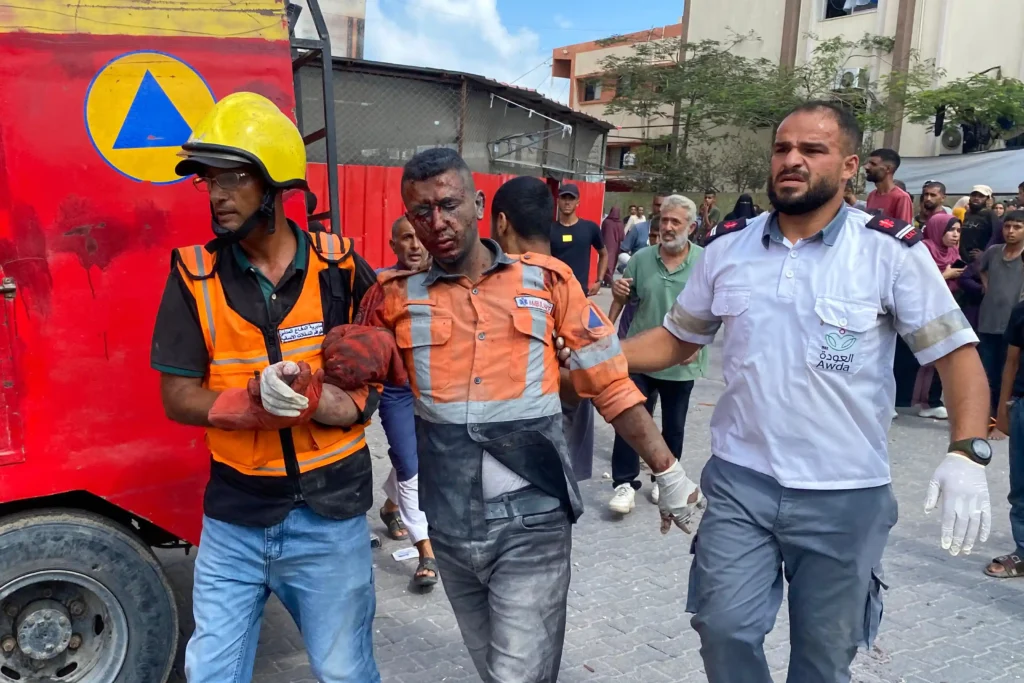
Gaza Herald — Gaza’s healthcare crisis no longer needs the spectacle of hospital raids, destroyed wards or attacks on medical facilities to demonstrate its devastating scale. Even when such scenes are absent from the headlines, the Strip’s healthcare system continues to deteriorate, leaving millions without reliable access to essential medical care.
The collapse is particularly severe in displacement camps, where some of Gaza’s poorest and most vulnerable families are living. Healthcare services often cannot reach these communities, while many patients lack the money, transportation or physical strength needed to reach the few medical facilities that remain operational.
Unsafe sanitation, limited access to clean drinking water and exposure to extreme heat and cold are further deepening the health crisis.
Healthcare beyond the reach of displaced families
Last month, a medical team visited an informal displacement camp established on the grounds of what remains of Hassan Salama School in Gaza City’s Nasr neighborhood.
The school was devastated when it was bombed alongside the neighboring Nasr School in August 2024, killing at least 30 people.
Today, hundreds of Palestinians who lost their homes and livelihoods live in tents across the school grounds and inside the damaged remains of the building.
No organization currently runs the camp, leaving residents without regular access to essential services, including healthcare.
A team of medics from a local private clinic spent a day providing free medical consultations there. More than 150 people sought care.
Their conditions reflected the wide range of health problems confronting displaced Palestinians.
Doctors treated patients with high blood pressure and chronic illnesses such as diabetes and kidney disease, as well as infections including hepatitis and scabies. Children arrived with chickenpox, gastroenteritis, diarrhea and respiratory infections.
The medical team could provide only basic care, yet the response from residents was overwhelming.
The cost of simply reaching a doctor
For many displaced Palestinians, seeing a doctor has become a journey that demands money, transportation and physical strength they simply do not have.
Long distances, transportation costs, exhaustion from repeated displacement and extreme temperatures can force patients to postpone treatment even when their conditions require urgent attention.
One patient, a 46-year-old man, arrived with a serious foot injury caused by shrapnel. He relied on crutches to move and also suffered from hypertension.
He could not easily reach nearby Al-Rantisi Hospital, which is only partially operational and primarily providing services to children and cancer patients.
Walking to another hospital was not a realistic option.
To receive a free medical assessment for his hypertension and obtain a prescription, he would have needed to spend at least $8 on transportation to the nearest facility.
For families struggling to secure their daily food, that amount can be prohibitive.
When delayed care becomes dangerous
The consequences of delayed treatment can be severe.
When medical care is postponed and essential medicines remain scarce, chronic illnesses can deteriorate, infections can spread and conditions that could have been managed easily can become life-threatening.
For many displaced families, these outcomes are not the result of a lack of need. They are the consequence of a healthcare system that has been devastated and a population whose ability to reach medical services has been severely restricted.
Restoring basic healthcare across Gaza is therefore an urgent necessity, particularly through organizations capable of reaching communities where conventional medical services can no longer operate.
A healthcare network in ruins
Following the Nakba, UNRWA played a major role in establishing basic healthcare services for Palestinian refugees in Gaza. Clinics were established across refugee camps, providing generations of Palestinians with access to essential medical care free of charge.
Before the current war, UNRWA operated 22 clinics throughout the Gaza Strip. Recent figures indicate that only six remain operational.
The situation in Gaza’s hospitals is similarly dire.
Of the Strip’s 34 hospitals, only 19 are currently partially functioning. The word partially is critical: extensive destruction has left many hospital departments and wards unable to operate.
Across Gaza, only around 2,200 inpatient beds are currently available for a population of approximately two million people.
Before the war, Al-Shifa Hospital alone had around 700 beds.
Essential medical services have also been severely disrupted. Laboratory testing, surgeries and other treatments have become unavailable in many locations because of the destruction of facilities, shortages of medical supplies and the loss of medical personnel.
Healthcare must reach those left behind
The destruction of Gaza’s medical infrastructure, combined with the mass displacement of its population, has transformed healthcare from a basic right into something increasingly available only to those who can afford to reach it.
Rebuilding hospitals is essential, but it cannot be the only response.
Gaza urgently needs a comprehensive healthcare intervention that restores primary-care clinics, supplies essential medicines and deploys medical teams directly to displacement camps.
For people living in Gaza’s most devastated communities, the right to health should not depend on whether they can afford an $8 journey to a doctor. It should be a right, not a privilege.

