
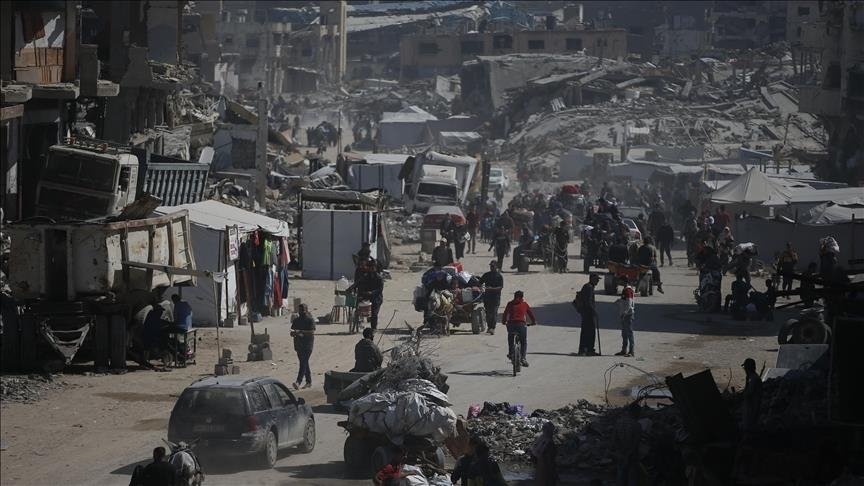
Gaza Herald — Beneath the rubble of Gaza’s destroyed homes, where steel bars are buried inside shattered concrete, workers face a daily gamble with death in search of enough income to feed their families.
Using crude tools that offer little to no protection, they strike through heavy concrete with massive sledgehammers and dig through unstable ruins to recover steel bars. They then sell the metal or repurpose it to make basic items that families desperately need amid war, displacement, and a devastating shortage of essential materials.
Gaza’s rubble is no longer simply a grim reminder of the destruction inflicted on the Strip. For thousands of Palestinians, it has become one of the few remaining sources of income and raw materials in an economy devastated by the war, siege, restrictions on construction materials, and the collapse of employment.
But every piece of metal comes with a risk. A building can collapse without warning, while unexploded remnants of war may be buried beneath the debris.
Backbreaking Work Under the Threat of Collapse
Mohammed Abu al-Araj owns a sledgehammer weighing nearly six kilograms. For weeks, he has used it every day to break apart sections of destroyed buildings and extract steel bars embedded in concrete.
Abu al-Araj said the work has become his only means of meeting his family’s daily needs amid soaring prices and the collapse of job opportunities.
But he described extracting steel from destroyed buildings as “extremely dangerous.”
Workers have no proper safety equipment, while unstable sections of buildings can collapse at any moment.
They are forced to take the risk simply to reach steel buried deep beneath the rubble, fully aware that one mistake could leave them injured or dead.
Searching for a Living Among the Ruins
For Tareq Yassin, owning a sledgehammer has effectively become a small form of capital—enough to begin working when combined with determination and, above all, necessity.
People working in the trade, he said, are “in need and have no choice.”
The extraordinary economic and social conditions created by the war have pushed them to search for a livelihood in places where a single wrong move could cost them their lives.
Workers face multiple dangers throughout the day, including collapsing structures and unexploded remnants of war buried beneath the rubble.
Yassin said workers never know whether their next strike will expose a piece of steel or uncover an explosive device.
The possibility of injury or death remains with them throughout every hour of work.
From Rubble to Essential Materials
The steel’s journey does not end once it is pulled from the concrete. Another stage begins: giving the salvaged metal a second life.
Ali al-Amour said workers sell the recovered steel to owners of small metal workshops, where it is transported, straightened, and reshaped using manual equipment.
The process requires considerable physical effort and experience.
In some cases, owners of destroyed homes hire workers to demolish remaining sections of their properties for a daily wage, allowing the property owners to keep and sell the recovered steel.
In other areas, local authorities working with international organizations transport piles of rubble away from populated areas. Some of the material is occasionally used to create paths between displacement tents or moved to dumping sites away from roads and crowded areas.
Handcrafted Workshops Give Steel a Second Life
At another point in the chain, Mahmoud Radi buys steel recovered from destroyed buildings and transports it to his workshop, where he reshapes it by hand.
Radi said the process begins with straightening and sorting the metal according to length, thickness, and quality before shaping it according to customers’ needs.
The recycled steel is used to make a range of basic household items, including tent frames and canopies, kitchen tables, beds, and storage cabinets.
With wooden products becoming increasingly expensive and difficult to manufacture because their production requires electricity, machinery, and generators—resources in critically short supply across Gaza—salvaged steel has become an increasingly important alternative.
A Tent Made From the Ruins
The recovered steel is not only being used in workshops. Displaced families are also turning it into a means of making their living conditions slightly more bearable.
Yousef Awadallah said he built his tent using steel bars recovered from destroyed buildings.
He had previously used wood to construct several tents, but they deteriorated under Gaza’s harsh weather and exposure to the elements.
Steel-framed tents, he said, are both cheaper and more durable because the metal withstands strong winds and harsh weather better than the wood available to displaced families.
For people living in tents, a few salvaged metal bars can therefore mean the difference between a fragile shelter and one capable of withstanding another night of wind, heat, or rain.
Tens of Millions of Tons of Rubble Await Removal
These individual efforts are taking place as Gaza faces one of the largest accumulations of debris in its modern history.
United Nations Environment Programme estimates put the amount of rubble across Gaza at between 61 million and 66 million tons, while approximately 371,888 housing units have been damaged or destroyed.
Under the best conditions, clearing the rubble could take around seven years. With continued restrictions on bringing heavy machinery and fuel into Gaza, the process could stretch to 10 to 20 years or longer.
Unemployment Above 80 Percent
The rubble economy has emerged alongside the near-collapse of Gaza’s labor market.
Data from the Palestinian Central Bureau of Statistics showed unemployment in Gaza exceeded 80 percent in 2025, compared with roughly 45 percent before the war, as productive sectors collapsed, thousands of businesses shut down, and hundreds of thousands of workers lost their sources of income.
For some Palestinians, the choices have become brutally narrow: remain without any income or risk their lives searching for steel beneath unstable ruins.
Making a Living From the Remains of Destroyed Homes
Steel bars once embedded in the walls and foundations of Gaza’s homes were part of houses where families lived, slept, raised children, and sought safety.
Now, those same bars are being pulled from the ruins and turned into tent frames, beds, tables, storage units, and other basic necessities.
Between the worker’s hammer and the shattered concrete of a destroyed home lies another portrait of life in Gaza: a population forced to salvage the remnants of its destroyed world simply to secure the most basic conditions for survival.

