Gaza Herald _Reducing Gaza’s reality to a daily death toll or a passing aid convoy obscures the scale of what Palestinians are enduring. Humanitarian reports provide a broader picture of a population facing bombardment, displacement, hunger, and the collapse of essential services at the same time.
But not every report carries the same weight, and the most widely circulated document is not necessarily the most comprehensive. Understanding these reports requires looking at who collected the information, what areas they were able to access, and what restrictions prevented them from documenting the full extent of the destruction.
Humanitarian assessments do not describe an isolated natural disaster. They document the consequences of a prolonged siege, border closures, restrictions on the movement of people and supplies, and the destruction of civilian infrastructure amid an ongoing assault on homes, hospitals, water systems, and shelters.
For that reason, these reports should not be treated as purely technical documents detached from the political and legal circumstances that produced the humanitarian catastrophe.
Why Gaza’s Humanitarian Reports Matter
Reliable humanitarian reports provide something breaking news often cannot: a picture of trends, cumulative damage, and growing needs over time.
A single report may document an attack on a school, while a series of health and education assessments can show how schools have been transformed into overcrowded shelters, leaving children without both education and safety.
Similarly, the announcement that aid has entered Gaza does not necessarily mean that families have received enough assistance. Food assessments may reveal that supplies remain far below actual needs or that distribution has been disrupted by insecurity, fuel shortages, damaged infrastructure, and restrictions on movement.
The figures themselves represent human lives. The number of displaced people represents families repeatedly forced from their homes. The number of hospitals and medical beds out of service represents patients waiting for care that may never arrive. Malnutrition figures represent children whose bodies are bearing the consequences of deprivation.
These numbers should therefore be understood as evidence of human suffering, not as statistics to be consumed and forgotten.
UN Humanitarian Coordination Reports
Updates from the United Nations Office for the Coordination of Humanitarian Affairs, known as OCHA, are among the key sources for tracking daily needs and the scale of displacement in Gaza.
They typically document evacuation orders, population movements, restrictions on humanitarian access, the status of crossings, and shortages involving shelter, water, sanitation, and other essential services.
Their value also lies in placing developments within a timeline and showing how conditions change from one period to another.
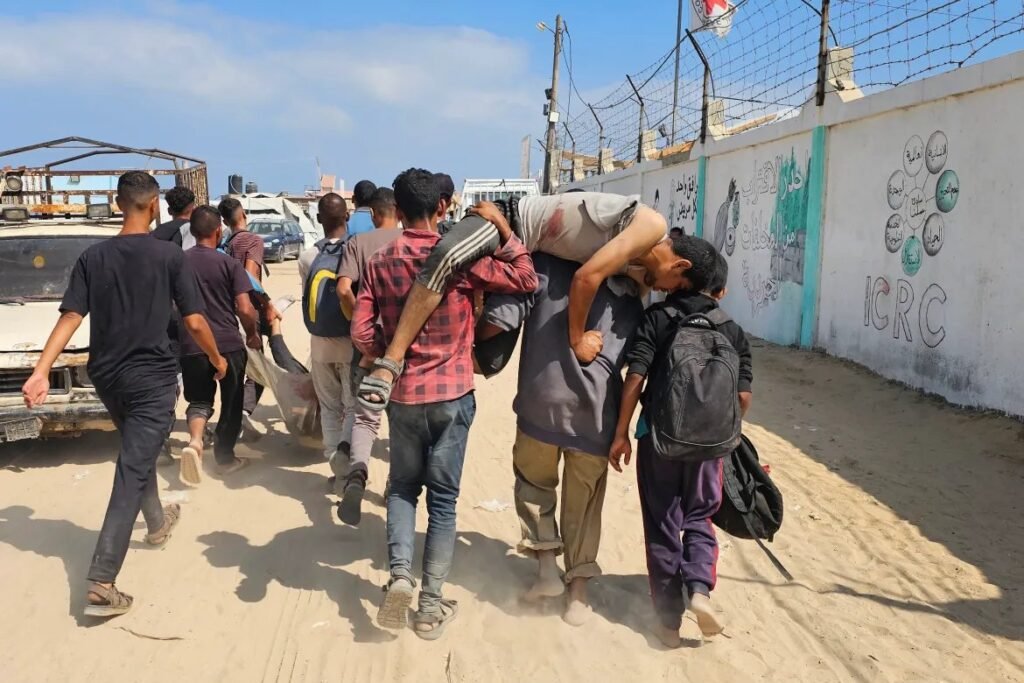
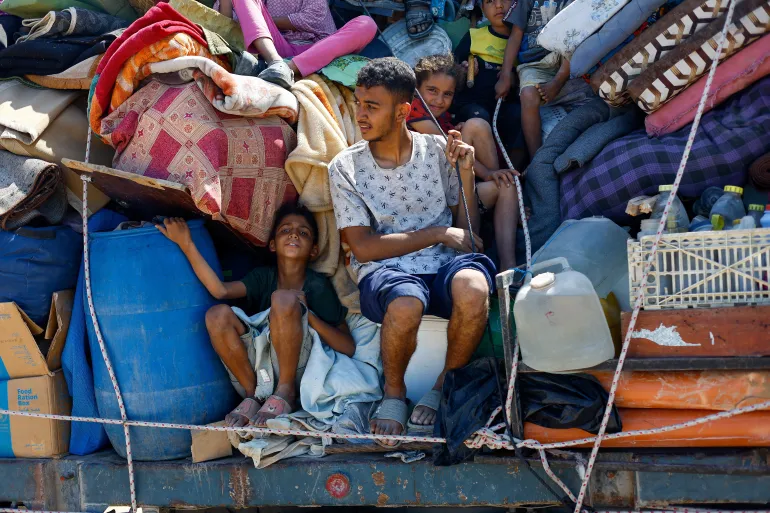
Repeated evacuation orders, for example, should not be viewed simply as administrative measures. The crucial questions are where people are being told to go, how far they must travel, whether shelters are available, and whether the areas they are being directed toward are actually safe or equipped to receive them.
In Gaza, evacuation has repeatedly meant pushing Palestinians from one devastated or threatened area into another.
At the same time, humanitarian reports have limitations. Access to many areas is restricted, humanitarian workers and facilities face danger, and data can lag behind rapidly changing conditions. Delays in documentation do not mean the damage did not occur. In many cases, they reflect the extraordinary difficulty of recording events while they are unfolding under bombardment.
How to Read Gaza Aid Figures
The number of trucks entering Gaza alone does not provide an accurate picture of humanitarian access.
A more meaningful assessment asks what those trucks carried, where the supplies went, how long they could sustain families, and whether assistance reached both northern and southern Gaza.
There is also an important distinction between aid entering a crossing and aid actually reaching people.
Supplies can become stuck at checkpoints, movement can be disrupted by Israeli attacks, and even delivered assistance can become ineffective when there is insufficient fuel to operate bakeries, water pumps, ambulances, and hospitals.
Healthcare: WHO and Gaza Health Authorities
World Health Organization assessments provide a broad view of Gaza’s collapsing healthcare system, including the availability of hospitals, medicines, medical evacuations, and the spread of diseases linked to displacement and contaminated water.
The destruction of healthcare affects far more people than those directly injured in attacks.
Pregnant women unable to access adequate care, kidney patients missing dialysis sessions, and children suffering from infections inside overcrowded shelters all form part of the wider health toll of the war.
Health authorities in Gaza also remain a central source for documenting deaths, injuries, and the growing pressure on medical facilities.
These records are compiled by medical workers operating under extraordinary conditions. The most reliable approach is to examine them alongside hospital records, medical workers’ testimonies, international health assessments, and documentation from human rights organizations.
Differences between figures do not erase the catastrophe.
In an environment where hospitals, records, communications networks, and other essential systems have repeatedly been damaged, figures can change as cases are identified, classified, or verified.
What remains undeniable is that civilians continue to bear the overwhelming burden, while the destruction of healthcare extends the consequences of the war far beyond the moment of an attack.
Hunger and Malnutrition: Food Security Reports
Reports from the Integrated Food Security Phase Classification, along with assessments by the World Food Programme, the Food and Agriculture Organization, and UNICEF, are essential for understanding the trajectory of hunger and food insecurity in Gaza.
These assessments examine more than food shortages. They track household consumption, food prices, water availability, child wasting, and the ability of markets and bakeries to continue operating.
The language used in these reports should not be diluted.
When assessments describe catastrophic levels of food insecurity, they are documenting families cutting meals, children and pregnant women facing growing health risks, and a food system damaged through the destruction of agricultural land, warehouses, roads, bakeries, and other infrastructure, combined with restrictions on essential supplies.
Hunger cannot be separated from the conditions surrounding it.
Food insecurity does not emerge in isolation in a territory subjected to blockade and severe restrictions. Control over the entry of food, fuel, and water, alongside the destruction of local systems that produce and distribute essential goods, directly shapes the humanitarian reality.
Food security reports should therefore be read alongside assessments on crossings, displacement, and attacks rather than treated as separate issues.
Children, Shelter and Water: What UNICEF and UNRWA Reports Show
UNICEF reports are essential for understanding how the war has affected Gaza’s children, including the loss of education, psychological trauma, physical injuries, separation from parents, malnutrition, and disease.
Children should not be reduced to emotional references to “the future.” They are part of Gaza’s present and have immediate rights to food, healthcare, protection, education, and a safe environment.
Reports from the United Nations Relief and Works Agency for Palestine Refugees, UNRWA, provide further insight into shelter and basic services for refugees and displaced Palestinians across Gaza.
When schools become overcrowded shelters and water and sanitation systems collapse, families face dangers that extend beyond bombardment, including disease outbreaks, lack of privacy, exposure to extreme heat or cold, and the absence of any genuinely safe space.
Water assessments also deserve particular attention.
The amount of water available per person, its quality, access to functioning toilets, and the ability of municipalities to remove waste are all indicators of public health and human dignity.
In Gaza, water is not simply a service. It is a first line of defense against disease and preventable death.
Human Rights Reports: From Documenting Harm to Establishing Responsibility
Palestinian and international human rights organizations, along with UN experts and investigative bodies, provide another layer of documentation by examining the legal dimensions of what is happening in Gaza.
Their reports document attacks affecting civilians and protected facilities, forced displacement, deprivation of essential needs, detention, and other violations associated with military operations.
These assessments go beyond asking how many people were killed or displaced. They examine who made decisions, what legal obligations applied, whether violations occurred, and whether the resulting harm could have been anticipated or prevented.
Those questions matter because describing mass suffering simply as a “tragedy” without examining responsibility can obscure accountability.
At the same time, credible human rights documentation depends on evidence, testimony, and transparent methodology. Strengthening the Palestinian narrative does not require exaggeration or unverified information. It requires precision, preserving victims’ names, documenting events carefully, and maintaining a factual record in the face of systematic denial.
How to Separate Reliable Reports From Noise
Start by checking when the report was published and what geographic area it covers. Then examine how its information was collected.
Does the source acknowledge access limitations? Does it distinguish between verified information and estimates? Does it explain the terminology it uses?
A serious report does not pretend to know what cannot be verified. But restrictions imposed by Israel should not become a reason for silence or an excuse to erase what is happening.
The next step is comparison.
Look at multiple sources, including humanitarian agencies, health authorities, rights organizations, and independent investigations. Humanitarian reports show the scale of need. Health assessments reveal its consequences for people’s bodies. Human rights documentation examines responsibility and potential violations.
When the same pattern appears across different sources—restrictions on supplies, repeated displacement, attacks affecting medical facilities, or the destruction of essential infrastructure—the evidence becomes stronger than any isolated account.
For readers, journalists, and people standing in solidarity with Palestine, the responsibility is not simply to circulate the fastest number or latest headline.
It is to reject language that presents siege as inevitable, displacement as a choice, or the deaths of Palestinian civilians as figures open to endless debate.
Reading and preserving these reports means preserving the context behind every number and recognizing the reality they document: Gaza is not merely a humanitarian crisis. It is the story of a people fighting to survive, with an enduring right to life, freedom, return, and dignity.