
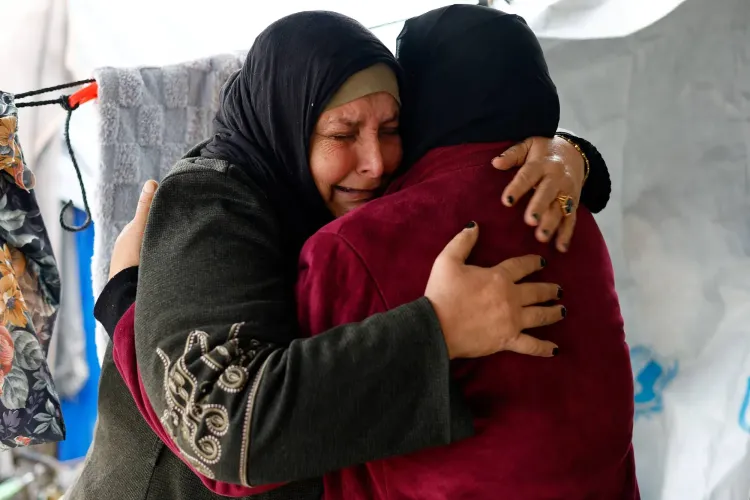
Gaza Herald _Women of all ages have been carrying an enormous burden in Gaza, particularly as displacement has reduced privacy and personal space to almost nothing.
For ordinary families, the familiar kitchen has effectively disappeared. Whatever food is available must often be prepared on makeshift stoves built from clay or stones. Mothers are forced to burn whatever materials they can find to keep these stoves running, despite the risks to their health and the environment. In some cases, the fires used for cooking have also threatened to consume the already overcrowded tents where displaced families live.
Even ordinary conversations with people in Gaza can reveal the lasting physical effects of the war. Some residents have lost teeth permanently, adding dental health to the long list of consequences left by the destruction.
Dental clinics across Gaza have been destroyed or severely damaged, while hospitals that once provided dental care have been bombed, burned or rendered inoperable. Medical workers have also suffered heavy losses. For long periods, restrictions on the entry of medicines, medical supplies and equipment made even basic healthcare extremely difficult to access.
Simple items such as toothpaste and toothbrushes became difficult to obtain. As a result, dental health has deteriorated across Gaza, affecting children, adults and the elderly alike. The widespread loss of teeth has become another visible reflection of the deprivation imposed on a population living under siege, where access to basic necessities has been severely restricted and, for many, there is sometimes barely enough food to eat, let alone chew comfortably.
Displacement on foot
The destruction and repeated displacement have forced most Palestinians in Gaza to move from one place to another, often following sudden evacuation orders or intensified attacks.
Families repeatedly travel along damaged roads, paths destroyed by bulldozers and routes filled with rubble and waste, carrying whatever belongings and makeshift camping materials they can salvage. Yet even after reaching a new location, they may soon be forced to leave again, creating an endless cycle of displacement.
People of all ages have been forced to move on foot, in horse- or donkey-drawn carts, or in whatever vehicles remain available.
Among the most striking scenes have been displaced Palestinians walking in worn-out sandals or barefoot after their shoes fell apart during long journeys and replacements became impossible to find.
With basic goods prevented from entering Gaza in sufficient quantities, buying a new pair of shoes or even inexpensive sandals has become beyond the reach of many families. People have instead been forced to repair damaged footwear repeatedly as they continue walking between displacement areas.
Yet even this hardship pales beside what many children have witnessed.
Children growing up amid death
Few children in Gaza have escaped repeated exposure to death and human remains. Some have witnessed the remains of relatives, neighbors, or friends, leaving images that can remain with them long after the moment has passed.
For children growing up under these conditions, scenes of blood, destruction and human remains risk becoming tragically normalized.
Children are not simply observers of the war. They are among its direct victims, as reflected in the devastating figures documented by international organizations.
A child trapped beneath the rubble may spend hours or even longer suspended between life and death, surrounded by darkness and hearing the final breaths of people nearby. When rescuers eventually reach them and pull them from the ruins, survival does not mean the nightmare is over.
The child may emerge to find that their home no longer exists and that most or even all of their family members have been killed. They may have nowhere to return to and no family left to protect them.
And before they have even had time to process what they have endured, the destruction around them continues, leaving them vulnerable to further danger.
The devastation raises a painful question: what remains of the international promises to protect children when Palestinian children have been exposed to such prolonged and visible brutality, while the world watches year after year without stopping it?

