
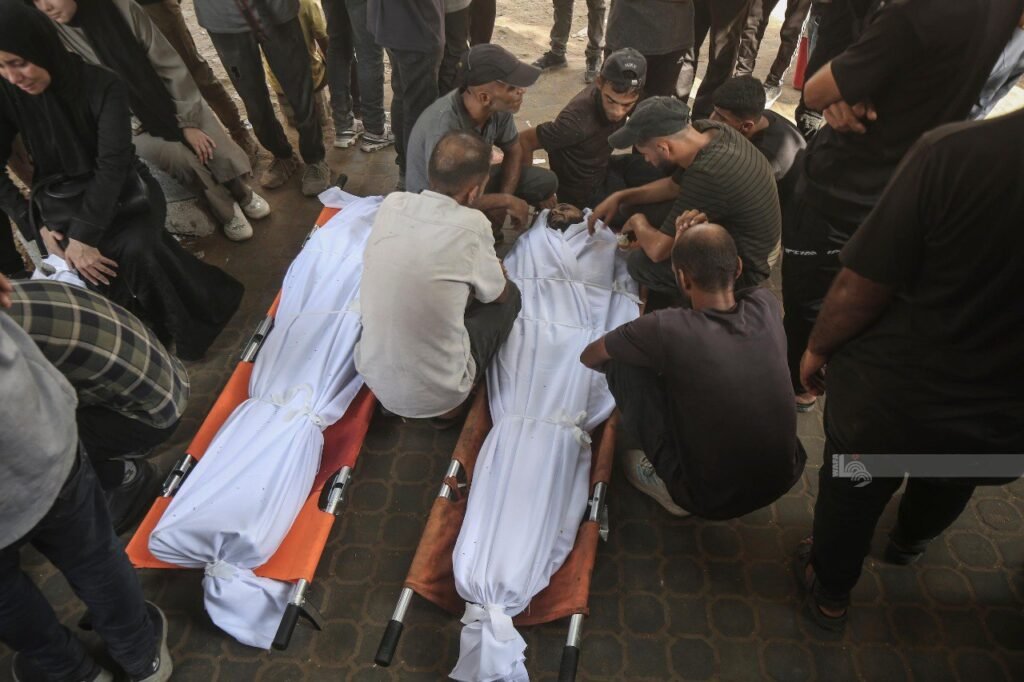
Gaza Herald _Before the ceasefire announced in October 2025 had time to take shape, many Palestinians in Gaza questioned whether anything had truly changed. Months later, that question remains unanswered as Israeli military operations continue, civilians continue to die, and daily life remains defined by fear, displacement, and destruction.
For many families across the Strip, the agreement has brought little relief. Rescue teams are still pulling victims from collapsed buildings, hospitals continue receiving casualties from new attacks, and entire communities remain trapped in conditions that humanitarian organizations describe as catastrophic. Rather than ending the violence, the current reality has left many Palestinians living through what aid groups describe as a continuation of the crisis under a different framework.
According to Gaza’s Ministry of Health, 1,185 Palestinians have been killed and 3,816 injured since the ceasefire was announced on October 10, 2025. The figures amount to roughly one Palestinian being killed or wounded every hour and twenty minutes over the following nine months. UNICEF also reported that more than 265 children had been killed by June 19 despite the ceasefire remaining in effect.
Medical teams from Doctors Without Borders (MSF) say their hospitals continue to function as emergency trauma centers instead of facilities recovering from war. Doctors, nurses, and paramedics are still treating victims of airstrikes, shelling, and gunfire while working under the same dangerous conditions that have defined nearly two years of conflict.
The violence has also reached humanitarian workers themselves. On July 16, an Israeli strike near an MSF clinic in Al-Mawasi sent several wounded civilians to the organization’s medical teams. A day later, two apartment buildings housing MSF staff in Gaza City were struck without prior warning, trapping families inside as explosions tore through the buildings. In one case, debris and bodies crashed into the lower-floor apartment of one of the organization’s employees.
That same day, medical teams in Deir al-Balah treated twelve people—including seven children—after Israeli forces struck a funeral in Al-Nuseirat. Eight Palestinians were killed in the attack, among them the 21-year-old son of an MSF staff member, who learned of his son’s death while treating patients in an emergency room.
Aid workers stress that these incidents were not isolated events but part of the daily reality across Gaza. Nearly two years after MSF established its field hospital in Deir al-Balah, doctors continue receiving patients suffering from fresh war injuries, underscoring that for Palestinians, the violence has never truly stopped.
For many Palestinians, the ceasefire has also failed to end one of the war’s defining realities: repeated displacement and shrinking living space. Instead of allowing civilians to return home, Israeli military control has expanded across large parts of the Gaza Strip, leaving nearly two million people confined to an increasingly limited area.
Areas placed under Israeli military control, including the so-called “Yellow Line” established during ceasefire arrangements, have become inaccessible to Palestinian civilians. Humanitarian organizations say the restricted zone continues to expand, reducing the already limited space available for displaced families and forcing hundreds of thousands into overcrowded shelters and tent camps.
MSF says around 90 percent of Gaza’s population has been forcibly displaced, many of them multiple times since the war began. Families continue to move from one location to another after receiving sudden displacement orders, often with only minutes to gather their belongings before leaving once again.
Even inside the areas where civilians are concentrated, attacks have continued. Airstrikes have repeatedly hit tents, schools, shelters, and residential buildings housing displaced families, while many neighborhoods east of the Israeli-controlled areas have been almost entirely leveled.
For humanitarian workers, the conditions have become increasingly difficult. Overcrowding, limited access to clean water, poor sanitation, and collapsing public services have fueled the spread of disease, including respiratory infections, skin diseases, and other preventable illnesses, particularly among children.
MSF medical teams say repeated displacement has become more than a consequence of the war, it has become part of daily life for Gaza’s population. Families rarely know whether they will spend another night where they are sheltering or be forced to flee again.
The uncertainty extends to humanitarian staff as well. Like the civilians they serve, MSF employees often receive evacuation orders with little warning, forcing them to abandon temporary shelters while continuing to provide emergency medical care. Even on nights without new orders, many families go to sleep unsure whether they will wake to another airstrike or another forced displacement, making any sense of stability or recovery impossible.
Humanitarian organizations say the humanitarian crisis in Gaza has also deepened because access to aid remains severely restricted, leaving millions dependent on limited supplies of food, medicine, fuel, and clean water.
MSF says humanitarian assistance should never depend on military or political negotiations and argues that, under international law, civilians must have uninterrupted access to essential aid regardless of the status of any ceasefire.
According to the organization, emergency supplies continue to face restrictions and delays, while the flow of humanitarian assistance has remained far below the level needed to meet Gaza’s overwhelming needs. Medical organizations have also warned that shortages of medicines, equipment, and fuel continue to undermine hospitals already struggling after months of war.
MSF says the prolonged crisis has prevented meaningful recovery. Thousands of families remain unable to rebuild their homes or return to their neighborhoods, while many continue to live in overcrowded tents and makeshift shelters with little access to basic services.
Beyond the physical destruction, aid workers report a worsening mental health emergency. MSF teams say they continue to treat children and adults experiencing severe psychological distress, including anxiety, depression, chronic fear, and trauma after enduring repeated displacement, loss of family members, and constant exposure to violence.
Medical staff say many parents describe living in a permanent state of uncertainty, never knowing whether another attack, evacuation order, or loss awaits them. Children, meanwhile, continue to grow up surrounded by destruction, insecurity, and the constant sound of military activity.
For MSF, these conditions demonstrate that the violence has not truly ended. The organization says a ceasefire should provide civilians with safety, stability, and the opportunity to rebuild their lives. Instead, it argues that Palestinians in Gaza continue to face conditions that prevent recovery, while the humanitarian and psychological consequences of the war deepen with each passing day.

