Gaza Herald _As Israeli authorities continue to challenge the characterization of what occurred in the Gaza Strip as genocide, while acknowledging the military actions themselves, a new book by British-Israeli architect and researcher Eyal Weizman offers a detailed documentary and analytical account of what he describes as a systematic campaign to destroy the physical foundations of Palestinian life and permanently reshape the territory.
The book, titled Undergrounding: The Architecture of Genocide, was recently reviewed by Foreign Policy in a lengthy article titled The Architecture of Israel’s Genocide in Gaza.
Although previous opinion polls indicate that many Americans believe Israel committed genocide against Palestinians in Gaza over the past three years, efforts to fully document what happened and hold Israel accountable have produced little tangible progress.
The case before the International Court of Justice has stalled amid American and European opposition, while public debate over whether the events constitute genocide has increasingly focused on political disagreements over terminology rather than the realities on the ground. Meanwhile, the student protest movement that swept university campuses in the spring of 2024 was met with force before largely subsiding.
It is within this gap that Weizman positions his work, seeking to document the systematic destruction of Gaza, street by street, farm by farm, and hospital by hospital.
A Documentary Approach Beyond Political Debate
Weizman’s project is built on the premise that careful examination of documented evidence and verifiable facts can move the discussion beyond political disputes. The book draws on analysis of thousands of photographs, videos, recordings, and eyewitness testimonies that his research team used to create a digital map documenting destruction throughout the Gaza Strip.
Rather than focusing solely on recent events, Weizman also places Gaza within a broader historical context. He traces its history from its status as one of the Middle East’s most fertile agricultural regions before 1948, through the Nakba, the Israeli occupation in 1967, and the blockade imposed since 2007.
According to Weizman, the blockade functioned as more than a security measure. He argues that it became a long-term mechanism for controlling the population and weakening the conditions necessary for daily life before escalating into large-scale military operations following the October 7, 2023 attack.
The book contends that the methods employed during the war did not emerge in isolation but represent a continuation of military practices developed over many years. One chapter examines the conflict surrounding Gaza’s tunnel network, arguing that repeated Israeli military campaigns between 2008 and the outbreak of the 2023 war failed to eliminate the tunnels and, in some cases, created conditions that contributed to their expansion.
Weizman also examines Israel’s narrative regarding the scale and complexity of the tunnel system, suggesting that some of the claims surrounding it were used to justify the extensive destruction inflicted on Gaza’s urban landscape.
From Targeting Fighters to Destroying the Conditions for Life
The central argument of the book is that Israeli military operations extended far beyond targeting fighters or military infrastructure, evolving into a systematic campaign against the foundations of civilian life.
Several chapters take the form of architectural forensic investigations, detailing how Weizman’s team reconstructed specific incidents that they classify as war crimes using technical analysis and field evidence. The book also argues that Israeli official statements presented selective or misleading accounts of a number of these incidents.
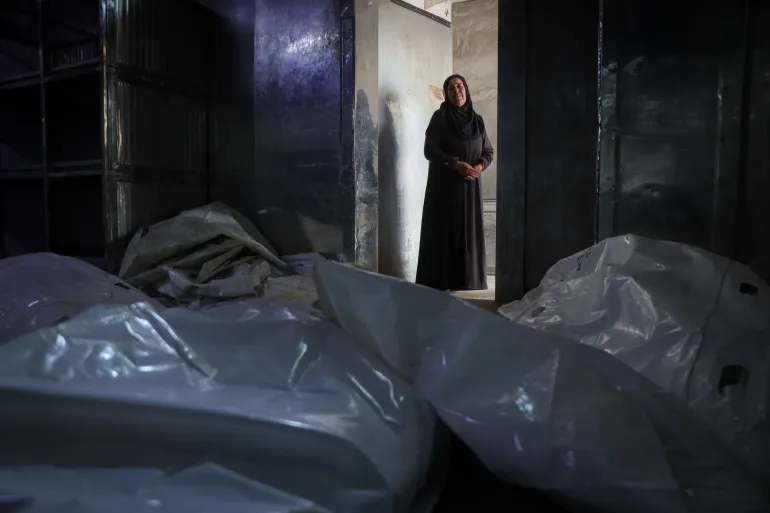
Among the examples examined are the leveling of entire residential neighborhoods, the destruction of farms and agricultural infrastructure, and attacks on public institutions including hospitals, schools, universities, places of worship, and economic facilities. The book also examines the expansion of buffer zones and the repeated displacement of civilians to areas designated as “safe,” which it says often lacked even the minimum conditions necessary for survival.
Weizman also explores the environmental consequences of the destruction, arguing that damage to water and sewage networks, agricultural land, and soil will have long-lasting effects extending well beyond the military campaign itself. Large areas of farmland have been rendered unusable, while thousands of greenhouses, orchards, and livestock facilities have been destroyed, threatening Gaza’s future agricultural recovery.
Toward a Broader Definition of Genocide
Weizman concludes that understanding what happened in Gaza requires looking beyond casualty figures or the scale of physical destruction alone. Instead, he argues, it demands examining how the land, environment, and built landscape were fundamentally transformed, making the destruction of the conditions necessary for human life an integral component of the military campaign itself.
From this perspective, he calls for expanding the legal and conceptual understanding of genocide to encompass not only killing and forced displacement, but also the destruction of the environment, infrastructure, and the essential conditions that make life possible.
According to Foreign Policy, the book offers a detailed documentary and analytical framework grounded in architectural forensics, digital mapping, and visual evidence to reconstruct the events of the war. In doing so, it presents a broader discussion about the nature of Israel’s military campaign in Gaza and its humanitarian and environmental consequences, arguing that the systematic transformation of the territory and the destruction of the foundations of life are essential to understanding what the enclave has experienced during the years of war.