
Gaza Herald _For nearly three years, Gaza laborer Ahmed Al-Shakhrit dreamed of returning home to his eight children. Instead, he found himself imprisoned in Israeli detention facilities after what had begun as a routine work permit to enter Israel turned into a harrowing ordeal. His journey began with the outbreak of Israel’s genocidal war on October 7, 2023, leaving him stranded and unable to return to his family, and ended with a traumatic experience in detention.
Overcome with grief and anguish, Ahmed struggles to recount the details of his brief but painful imprisonment. Every attempt to describe what he endured, from the moment of his arrest until his release, brings back memories intertwined with humiliation and suffering.
Ahmed, 40, is married to two wives and is the father of eight children. Like many Gazans facing severe economic hardship, he sought work inside Israel. He was still at his workplace when the war erupted.
The following morning, Ahmed joined thousands of other Palestinian workers heading toward the occupied West Bank, where they stayed at a Palestinian National Security facility in the city of Jericho. They eventually decided to surrender themselves at an Israeli military checkpoint, hoping they would be allowed to return to Gaza.
Brutal Torture
On July 12, Ahmed and 15 other workers went to the Israeli military checkpoint near Qalqilya.
“When we arrived, we found another 25 workers from Gaza who had already surrendered there,” Ahmed recalled. “We all waited under the scorching sun for three hours.”
He said Israeli soldiers forced all the workers to strip completely naked before conducting thorough body searches. They were then brought before a military judge, who addressed them through a mobile phone before ordering their detention at Ofer Prison.
Ahmed and the other detainees spent their first night at the checkpoint blindfolded, with their hands and feet tightly bound. The following morning, soldiers transferred them to prison, marking what he describes as the beginning of the real suffering. According to Ahmed, soldiers confiscated their mobile phones and personal belongings upon arrival.
First Imprisonment
It was Ahmed’s first experience in prison. His hands and feet were shackled with heavy iron chains, and his eyes remained blindfolded. Searching for words to describe the abuse, he said it reminded him of the torture photographs that emerged from the U.S.-run Abu Ghraib Prison in Iraq after the 2003 invasion.
“We underwent harsh interrogations,” he said. “One soldier forced me to lick the floor of my prison cell with my tongue for about four minutes. I felt like I was suffocating, especially because I only have one functioning lung and already suffer from breathing difficulties.”
He continued:
“They then threw us into an open yard surrounded by barbed wire and left us under the blazing sun for hours without even a sip of water. When I asked for water, one of the soldiers beat me on the head and chest before tightening my restraints so hard that I felt as if my limbs were about to be severed.”
A Cell Like a Tomb
Ahmed said he and the other detainees were eventually pushed into a cramped room measuring no more than 30 square meters after being forced to remove their clothes and wear prison uniforms.
“The uniforms were filthy, torn, and clearly used before,” he said. “They caused severe itching all over our skin.”
The room contained a small, dilapidated toilet and only eight beds for 16 detainees, forcing two prisoners to share each bed.
Ahmed said the beds were engraved with the date October 7, 2023, and topped with extremely thin mattresses that clung to the metal frames and absorbed intense heat.
“The heat coming from the beds was unbearable,” he said. “The space was so narrow that we were forced to sleep on one side all night without being able to move.”
Each day began at 5:00 a.m. with a prisoner count that was repeated four times daily.
“The counting process was never without beatings, insults, and even soldiers spitting in our faces for no reason,” Ahmed said.
Daytime Punishment
Ahmed said prison authorities confiscated the prisoners’ mattresses and blankets throughout the day, forcing them to remain standing or seated on the floor without rest.
“The suffering was relentless,” he said. “During the day, we wished for night to come. At night, we waited desperately for dawn. Either way, we lived through constant physical and psychological torture.”
The abuse, he said, extended to every aspect of daily life—even bathing.
Every seven detainees were forced to shower together in a single bathroom separated only by thin, low wooden partitions that offered virtually no privacy. They were given no soap or hygiene products and had to wash using water alone.
According to Ahmed, a room holding 16 prisoners was allotted just 20 minutes for everyone to shower.
“That meant each person had no more than a minute and a half to bathe, get dressed, stand in the sun, and return to the cell,” he said.
Food was also used as a means of punishment, he added.
“They gave us three meals a day, but they weren’t enough even for a small child,” Ahmed said. “The food was poor quality and often undercooked.”
He recalled one meal consisting of nothing more than a spoonful of labneh accompanied by either half a cucumber or half a tomato.
Torture Before Release
Ahmed described the day of his release as the most brutal of his two-week imprisonment.
“On the night before our release, soldiers came into the cell, tied us up even more tightly, blindfolded us, and forced us to lie face down on our stomachs,” he said. “Then they began beating us. One of the soldiers slammed my head into the wall. We had no idea what was happening or why they were torturing us with such brutality.”
The abuse continued the following morning.
“From seven in the morning until eleven, they never stopped beating and humiliating us, even after informing us that we would be released and transferred to the Kerem Shalom crossing to enter Gaza,” Ahmed said. “The assault continued throughout the roughly four-hour journey.”
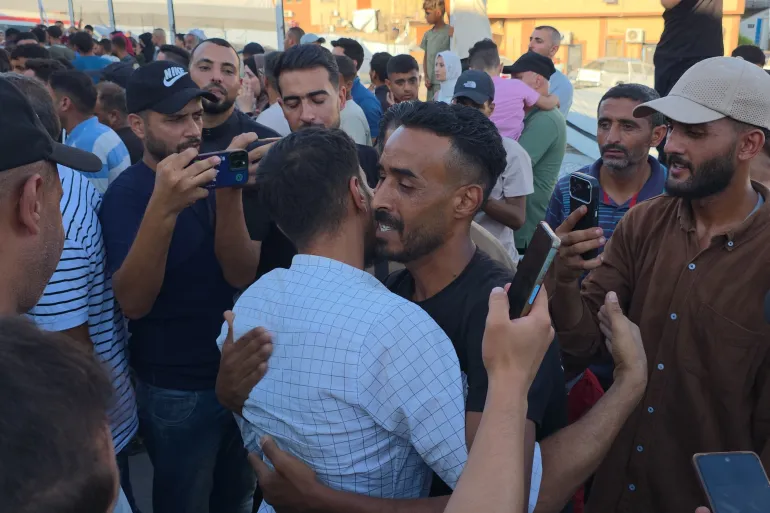
Ahmed was released last Monday alongside 60 Palestinian detainees, most of them laborers. Family members welcomed them upon their arrival at Nasser Medical Complex in Khan Younis, southern Gaza.
 “It Broke My Heart”
Ahmed’s ordeal did not end with his release.
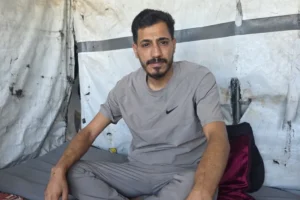
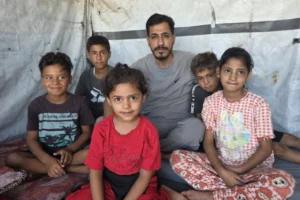
Instead of returning to a home, he reunited with his family in the displacement tent where they have lived since being forcibly displaced from the city of Rafah in May 2024.
Sitting beside her son on an old mattress inside the fragile shelter, his mother, Mervat, 60, described the shock of seeing him again.
“I was devastated by his condition,” she said. “He came out pale, extremely thin, and barely able to stand. He had lost more than ten kilograms because of torture, medical neglect, and malnutrition.”
Her words reflected both relief and heartbreak.
“My only dream was to hold him in my arms and know that he had returned alive,” she said. “I was afraid death would reach me before I ever saw him again.”
She added:
“When I saw the marks of beatings on his body and how emaciated he had become, it broke my heart. But having him back with us after everything he endured is a blessing beyond measure. In every prayer, I ask God to end this suffering for all prisoners and to reunite every detainee with their mother, wife, and children.”
Visits Denied
 Since the outbreak of the war, the International Committee of the Red Cross (ICRC) has been unable to access Palestinian detainees held by Israel.
Speaking to Al Jazeera Net, ICRC spokesperson Amani Al-Nawouq said the organization continues its dialogue with the Israeli authorities in an effort to resume prison and detention-center visits as soon as possible.
“We stress the importance of being informed of the fate and whereabouts of all detainees and of being granted access to visit them,” she said.
Al-Nawouq added that the ICRC stands fully prepared to resume its regular visits to places of detention in order to monitor detainees’ treatment and conditions of confinement.
She said the organization understands the profound anxiety experienced by many Palestinian families waiting for news of their detained loved ones.
“For more than two years, families have been unable to visit or communicate with their relatives in detention,” she said. “Some do not even know where their loved ones are being held.”
Resuming prison visits and restoring communication between detainees and their families remains “a top priority for the International Committee of the Red Cross in Israel and the occupied territories,” she added.
Regarding the ICRC’s role following prisoner releases, Al-Nawouq explained that whenever detainees are freed, the organization transports them from the crossing where they are released to a hospital inside Gaza, where it works to reunite them with their families and facilitate their safe return.
Harrowing Testimonies
Alaa Al-Sakkafi, director of the Al-Dameer Foundation for Human Rights, told Al Jazeera Net that testimonies from recently released detainees point to “an unprecedented deterioration in detention conditions.”
He said torture, ill-treatment, starvation, and denial of medical care have become systematic Israeli policies.
According to Al-Sakkafi, the organization has documented consistent accounts from former detainees describing severe beatings, humiliation, prolonged forced stress positions, extreme overcrowding, inadequate food, restrictions on bathing and personal hygiene, and deprivation of medical treatment.
Addressing Israel’s periodic release of groups of detainees without publicly announced agreements or prisoner exchanges, Al-Sakkafi said these releases are generally unrelated to political deals.
Instead, he explained, they usually occur after interrogation periods have ended, when Israeli authorities determine there is no justification for continued detention, or for logistical and administrative reasons within the prison system.
He noted that most of those released are civilians arrested during military operations or Palestinian laborers who were never formally charged.
“As a result, Israeli authorities release them in small groups under military orders, without court proceedings, prior announcements, or coordination through prisoner-exchange agreements, unlike what occurred during earlier stages of the war,” he said.
Al-Sakkafi stressed that these releases should not be interpreted as an improvement in prison conditions.
“Most detainees leave prison bearing clear signs of torture, malnutrition, and medical neglect,” he said. “Their condition demonstrates that the violations continue and that detention conditions remain in serious decline.”

