
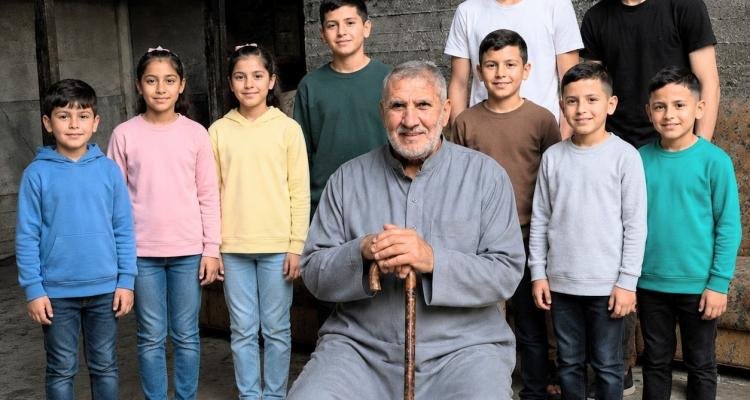
Gaza Herald _Every time Khalil Salem, known as Abu Akram, returns to the Sheikh Radwan neighborhood in Gaza City, he stands for a long time at the spot where, until the morning of December 11, 2023, a home once echoed with the voices of his children and grandchildren.
Within minutes, it was reduced to rubble by an Israeli airstrike that hit the entire residential block without warning. The attack destroyed four homes belonging to Abu Akram and his brothers and killed nearly 80 members of his extended family, including 12 members of his immediate family.
The 85-year-old still remembers every detail of that morning as if it happened yesterday.
Although the neighborhood had endured the war for weeks, no one imagined that decades of family life could vanish so suddenly.
“I didn’t know what had happened when I emerged from beneath the rubble,” Abu Akram told Shehab News Agency. “I had injuries to my head and neck, and all I could think about was finding my children and grandchildren.”
Eighty Family Members Killed
His search did not last long.
News began arriving one after another, each message carrying the name of another relative who had been killed.
“Within hours, I realized that the life I had known for decades had ended that morning,” he said.
Abu Akram lost his wife, three of his four sons, two of his daughters-in-law, several grandchildren, and numerous relatives.
In total, nearly 80 members of his extended family were killed, including 12 from his immediate family.
The pain did not end with recovering the bodies or burying the dead.
Instead, another, even harsher chapter began.
At an age when he never imagined taking on such responsibilities again, Abu Akram suddenly found himself caring for 21 grandchildren who had lost one or both parents.
The elderly grandfather became their closest surviving relative and their primary caregiver amid war, displacement, and the collapse of basic living conditions.
He never imagined that at 85 years old he would begin an entirely new life filled with responsibilities.
Instead of spending his remaining years surrounded by his children and grandchildren, he found himself returning to the routines of raising children once again, making sure they had food and clothes, helping those who could still reach school continue their education, and trying to ease the trauma they carry, even though he knows no one can replace a child’s parents.
He says the hardest moments come when one of his grandchildren asks about their mother or father, or when a child wakes in the middle of the night crying after reliving the horrors they experienced in a nightmare.
“Sometimes I sit alone after they’ve all fallen asleep,” he said. “I don’t want them to see me crying. I try to appear strong in front of them, but no one can ever forget their own children.”
What happened to Abu Akram’s family was not an isolated tragedy.
Since the war began, residential homes across the Gaza Strip have repeatedly been struck while families were inside, burying entire households beneath the rubble.
Only a handful of survivors have emerged from these attacks, often becoming the sole remaining witness to the names and memories of relatives who are no longer alive.
In many cases, a single survivor has been left carrying the memory of an entire family after multiple generations were wiped out in a single airstrike.
Entire Families Wiped Out
Official figures released by Gaza’s Ministry of Health show that what happened to Abu Akram’s family has been repeated on a massive scale since the war began, making the destruction of entire families one of the conflict’s most devastating features.
The attacks have not been limited to individuals. Entire households living under the same roof have been wiped out.
According to the ministry’s latest statistics, 2,276 Palestinian families have been completely exterminated, with every member killed. Those families lost a total of 8,858 people, marking one of the most devastating humanitarian tragedies experienced in the Gaza Strip.
Another 2,348 families were left with only a single surviving member after losing 8,340 relatives.
The devastation extends even further.
The ministry reported that 4,903 Palestinian families suffered massacres in which they lost multiple family members, bringing the death toll within those families to 13,607 people.
These figures illustrate the extent of the destruction inflicted on Gaza’s social fabric.
Loss is no longer measured by the death of one or two family members. In countless cases, nearly every member of a household has been killed, leaving children without parents, parents who have lost all of their children, or a lone survivor carrying the memories of an entire family.
The statistics represent more than numbers.
They document a profound transformation within Palestinian society during the war.
The disappearance of thousands of families means the loss of households that once formed an integral part of daily life in neighborhoods, refugee camps, and villages—families whose bonds stretched across generations, connecting parents, children, grandchildren, uncles, aunts, and neighbors.
In many communities, no one remains to open the doors of those homes or preserve the memory of the families who once lived there after they were all killed beneath the rubble.
A Lost Support System
Social worker Mahmoud Abdul Aziz Mansour said the danger lies not only in the number of people killed but also in the void their deaths leave behind within Palestinian society.
“The family in Palestinian society is not simply a father, mother, and children,” he told Shehab News Agency. “It is a social, economic, and psychological support network. When an entire family is wiped out, the loss goes far beyond the number of people killed. We lose a shared history and generations of relationships that connected families within neighborhoods and the wider community.”
The consequences are perhaps most visible among children who have lost one or both parents during the war.
With every new massacre, more children join the growing number who have lost the family support system that once defined their lives.
Many now live with grandparents, uncles, or other relatives under extremely difficult humanitarian conditions.
According to Gaza’s Ministry of Health, the war has left 60,737 children orphaned across the Gaza Strip.
Of them, 52,095 have lost their fathers, 5,929 have lost their mothers, and 2,713 have lost both parents.
Children who have lost both parents are considered the most vulnerable, often finding themselves without a mother or father, and in many cases without a home, a source of income, or a stable environment to care for them.
These figures reflect a reality now faced by thousands of Palestinian families.
Across Gaza, it has become common to see children living with grandparents or relatives after the war forced elderly family members to assume responsibilities they never expected to carry at this stage of their lives, while children struggle to adapt to life without their parents.
Rebuilding Daily Life
Mansour said social workers across Gaza have found that these cases are no longer exceptional—they have become the norm in much of the Strip.
“These situations have become widespread throughout Gaza,” he said. “Many children are now living with grandparents, uncles, or maternal uncles after losing their parents. The challenge goes beyond providing food or shelter. These children have lost the people who gave them a sense of safety. As a result, many suffer from constant fear, sleep disturbances, and an intense attachment to the family members they have left, along with an ongoing fear of losing them as well.”
According to Mansour, the burden extends beyond the children themselves.
Many elderly relatives who have taken on responsibility for raising their grandchildren are also struggling with the trauma of losing their own children while coping with displacement, worsening living conditions, and the collapse of essential services.
“The suffering of elderly people who have become responsible for raising their grandchildren is no less severe than that of the children themselves,” he said. “They are expected to provide their grandchildren with a sense of security even though they have not yet recovered from the trauma of losing their own sons and daughters.”
He added:
“At the same time, these elderly caregivers are living under enormous pressure. They are trying to comfort their grandchildren while carrying their own grief over the loss of their children. This greatly increases their psychological and social burden, especially amid displacement, the loss of livelihoods, and the shortage of basic services.”
A Future Shaped by Loss
Mansour said children who have lost their parents need stability above all else.
“A child who has lost both parents needs, first and foremost, stability,” he said. “They need someone who remains by their side consistently, and they need, as much as possible, a return to the routines of everyday life through education, play, and social relationships.”
He stressed that caregivers also require psychological, social, and financial support.
“The ability of caregivers to look after these children depends on their own ability to endure and recover.”
Mansour believes the consequences of the war will not end when the fighting stops.
“The reconstruction of homes may take years,” he said, “but rebuilding a family after it has been completely erased is impossible. For many years to come, Palestinian society will continue to live with the consequences of losing thousands of families and entire generations of parents and children.”
His words are reflected in Abu Akram’s own life.
Since that December morning, each day has become an effort to preserve what remains of his family.
Between caring for his 21 grandchildren and keeping alive the memories of the children and grandchildren he lost, the elderly grandfather now lives a reality shared by thousands of Palestinian families whose lives have been permanently shattered by the war.

