
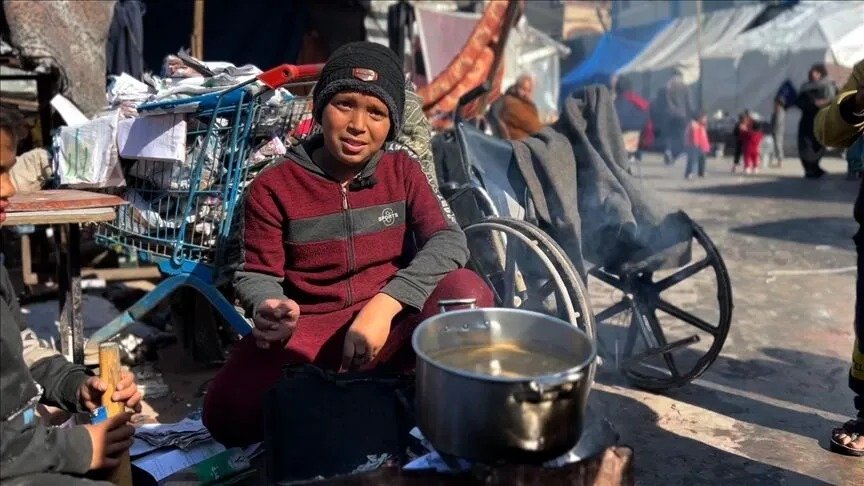
Gaza Herald – Before turning 12, Abdullah Salah should have been carrying a school backpack, not water containers. He should have been searching for his toys, not for firewood or a meal to feed his family.
But the Israeli genocide that has torn apart every aspect of life in the Gaza Strip forced the displaced child from Jabalia refugee camp in northern Gaza into a role he never chose. Instead of enjoying his childhood, Abdullah has become responsible for his family’s daily survival, cleaning their tent, searching for food, and cooking meals, growing up far before his time.
Living in a displacement shelter in Jabalia refugee camp, Abdullah says he is enduring “the hardest days of my life,” surrounded by hunger, thirst, and a lack of even the most basic hygiene, as northern Gaza continues to face a deepening humanitarian catastrophe after months of siege and war.
Instead of enjoying the rights every child deserves, Abdullah now spends his days trying to provide for 20 members of his family, at a time when obtaining food has become increasingly difficult due to severe shortages of essential supplies and the limited arrival of humanitarian aid.
One Pot for Twenty People
Outside the shelter, Abdullah sits with several friends, watching a medium-sized pot slowly boil over a small fire fueled by dry leaves.
Inside the pot is lentil soup, a simple meal that has become his family’s only food for the day. The pot would normally feed no more than ten members, yet it must now be divided among twenty hungry relatives waiting for him to return.
For more than two hours, the young boy has struggled to cook the meal. With no firewood, cooking gas, or fuel available, he burns dried leaves, which ignite quickly but fade just as fast.
As he repeatedly feeds the fire, thick smoke surrounds the children gathered nearby. Some cough and struggle to breathe, but Abdullah continues until the food is finally ready.
“I wake up early every morning,” he says. “I clean the tent, then I go looking for food and cook it.”
“There Is Nothing Here”
Abdullah now relies on dry leaves because firewood has become scarce and unaffordable, while cooking gas and fuel have almost completely disappeared.
“There is no firewood, no timber, no gas, no food, no flour,” he says quietly. “There is nothing here.”
He explains that families across northern Gaza are trying to survive with whatever little remains, facing increasingly harsh conditions that have turned meeting basic daily needs into a constant struggle.
Water presents another daily hardship. Abdullah and his family must walk long distances carrying heavy jerry cans just to bring drinking water back to their tent.
“We carry jerrycans full of water for long distances until we reach our shelter,” he says.
Life in displacement is made even harder by the collapse of sanitation services. Sewage water regularly floods shelters and surrounding streets, creating especially dire conditions during winter, when rainwater mixes with overflowing sewage and seeps into tents.
Abdullah says these conditions have contributed to the spread of illness among displaced families, particularly children and the elderly.
A Child Waiting to Go Home
Since the Israeli genocide on Gaza began in October 2023, the Strip’s population has faced severe shortages of water, food, medicine, electricity, and fuel, while the United Nations and humanitarian organizations continue to warn of worsening hunger and disease.
Despite everything, Abdullah says there is only one thing he hopes for.
“We want to return home with dignity,” he says. “We want aid, food, drinking water, and the basic necessities of life.”

