
Gaza Herald _For many young Palestinians in Gaza, earning a university degree no longer guarantees a path to employment. Instead, thousands of graduates now face a harsh reality in which years of education have been overshadowed by war, economic collapse, and the disappearance of career opportunities.
Rawan Al-Jabali knows that reality all too well. Sitting inside a displacement camp in central Gaza, she repeatedly refreshes a slow internet connection while searching online for job openings. Since being forced to flee northern Gaza with her family, the search has become even more difficult, but she refuses to stop trying.
Al-Jabali graduated from the Islamic University of Gaza two years ago with a degree in English language and literature, specializing in translation. She had hoped her qualifications would lead to a professional career, but she says Israel’s ongoing war has devastated the institutions where translators once found employment.
“I chose translation because I believed it would offer good career opportunities,” she said. “After the war, most of those workplaces no longer exist.”
According to Gaza’s Government Media Office, roughly 80 percent of Palestinians are now unemployed, while poverty has climbed above 93 percent, reflecting the unprecedented economic devastation across the Strip.
Despite daily power outages, unstable internet service, and the challenges of displacement, Al-Jabali continues to search for work, determined to support her family.
Mohammed Al-Khudari, another graduate of the Islamic University of Gaza, faces a similar struggle. Trained as an engineer, he expected to begin his professional career after graduation. Instead, months of war, widespread destruction, border closures, and food insecurity have brought Gaza’s labor market to a near standstill.
Most days, Al-Khudari scrolls through job listings on his phone whenever electricity and internet access are available.
“I spend hours looking for work,” he said. “Sometimes it’s difficult just to charge my phone or stay connected, but I keep searching.”
Like many other graduates, he has lowered his expectations. Rather than limiting himself to engineering positions, he now applies for any available work, including jobs in restaurants, cafés, and cleaning services, in hopes of earning enough to support himself and his family.
“Right now, having any source of income matters more than finding work in my field,” he said, adding that many university graduates have been forced to make the same difficult choice.
Economy in freefall
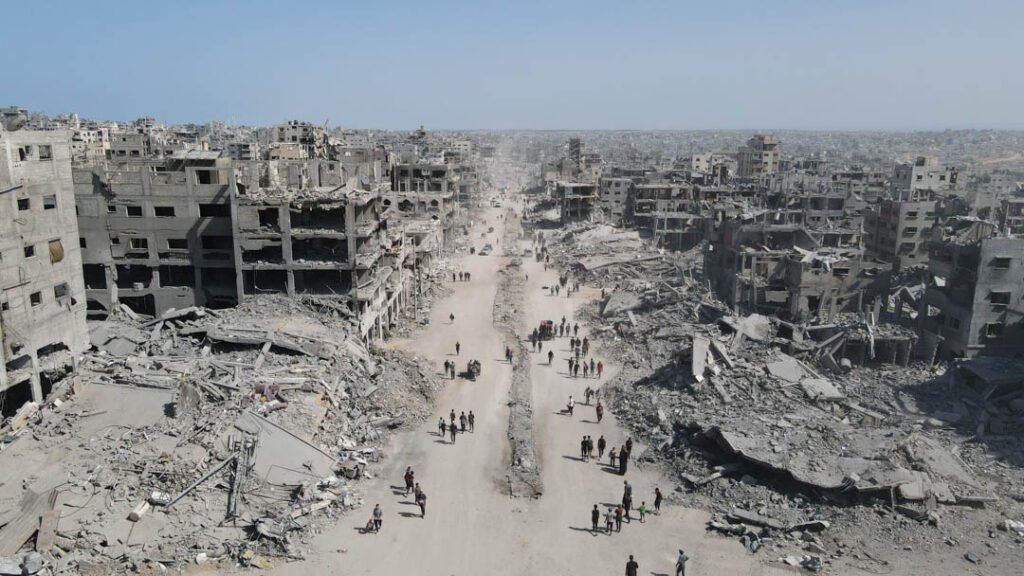
Gaza’s unemployment crisis is closely tied to the broader collapse of its economy. Since the start of Israel’s military campaign in October 2023, the territory’s gross domestic product has contracted by more than 82 percent, leaving businesses shuttered and employment opportunities nearly nonexistent.
The destruction caused by the war, combined with Israel’s long-standing blockade of Gaza, has pushed most of the population into dependence on humanitarian aid while eliminating many traditional sources of income.
Palestinian economist Mohammed Abu Jeiab said Gaza’s labor market had already been under severe pressure before the war because of the blockade imposed since 2007. The current conflict, he said, has dramatically accelerated that decline.
According to Abu Jeiab, prolonged unemployment has weakened Gaza’s skilled workforce, increased dependence on humanitarian assistance, deepened poverty, delayed economic recovery, and raised concerns that many educated Palestinians may leave if opportunities arise elsewhere.
He argued that reversing the crisis will require a comprehensive reconstruction strategy centered on rebuilding infrastructure, creating jobs, supporting small businesses, encouraging entrepreneurship, investing in technology and remote employment, expanding paid training opportunities for graduates, and aligning higher education with labor market demands. He also stressed the importance of creating a stable economic environment capable of attracting both local and international investment.
For Gaza’s young graduates, however, rebuilding careers remains inseparable from rebuilding the territory itself. Until meaningful economic recovery begins, many say their degrees represent not a gateway to opportunity, but a reminder of ambitions placed on hold by war and displacement.
Community initiatives offer a lifeline
With Gaza still lacking a fully functioning governing system, reconstruction efforts largely stalled, and Israeli attacks continuing despite the ceasefire announced last October, employment opportunities remain extremely limited for much of the population.
Even so, local initiatives are working to ease some of the burden by creating spaces where students and graduates can continue studying, search for jobs, and work remotely despite the difficult conditions.
One example is Peace Work Space in Deir al-Balah, a community hub established to provide young Palestinians with dependable internet access, electricity, and a quiet environment for work and learning.
Founder Mohammed Al-Buheisi said he launched the initiative in February 2024 after recognizing the urgent needs of thousands of displaced Palestinians who had fled to central Gaza following repeated Israeli displacement orders.
Operating the center has presented significant financial challenges, particularly as the cost of essential equipment, including solar energy systems, has more than doubled. Despite these obstacles, the project has steadily expanded its capacity.
“What began as a small workspace for around 10 people has grown into a center that now serves nearly 80 students, graduates, and freelancers,” Al-Buheisi said, describing the project as an effort to preserve educational and professional opportunities despite the ongoing humanitarian crisis.
Al-Buheisi said the initiative was created to give students and university graduates the resources they need to continue learning, working, and pursuing opportunities despite Gaza’s ongoing hardships.
“Our mission has always been to create a supportive environment where young people can continue their education and careers using the best resources available,” he said.
He noted that reliable electricity and internet access have become indispensable not only for job seekers but also for remote workers, freelancers, and students taking online exams, all of whom depend on stable connectivity that is difficult to find elsewhere in Gaza.
As employment opportunities continue to disappear, the economy remains in decline, and the gap between higher education and the labor market widens, many Palestinian graduates are finding themselves in prolonged uncertainty. Increasingly, they are adapting by accepting jobs outside their fields of study, pursuing freelance work, or relying on community-led initiatives that provide access to remote employment.
Al-Buheisi believes digital skills will play a critical role in Gaza’s future economic recovery.
“Developing technical and digital skills is one of the most sustainable ways to create employment,” he said. “Giving young people the tools to earn an income online is essential, especially when local job opportunities remain extremely limited.”
For many graduates, these initiatives have become more than shared workspaces; they represent one of the few remaining pathways to maintaining hope, developing professional skills, and building a future amid the ongoing challenges of war and displacement.

