
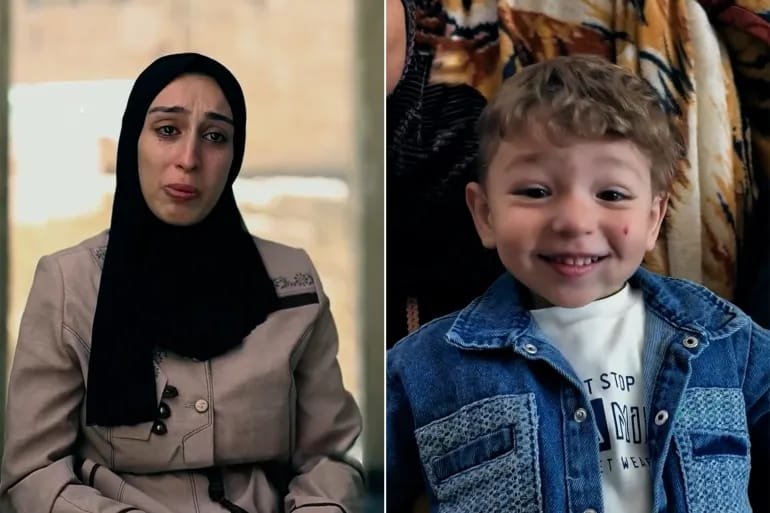
Gaza Herald – In a story that reflects the suffering of thousands of Palestinian families torn apart by Israeli genocide, an emotional scene unfolds between two places divided by war: a displacement tent in the Gaza Strip and a hospital room in the occupied West Bank city of Hebron.
In Gaza, a mother and father cling to a mobile phone screen to catch a glimpse of their son. In Hebron, Jamil Ghoneim, now 32 months old, runs into his grandmother’s arms, laughing and playing like any other toddler, unaware that the distance separating him from his parents is not measured in kilometers, but by war, siege, and closed crossings.
A Medical Journey That Became Years of Separation
Jamil’s story began two years and eight months ago, when he left Gaza at just 10 days old to receive treatment for a congenital blockage in the pulmonary artery of his heart.
His grandmother accompanied him to the occupied West Bank after his mother was unable to travel due to her own health condition.
The family expected the treatment to last only a few weeks before the infant returned home. But the outbreak of Israeli genocide in Gaza changed everything.
Border crossings closed, travel became impossible, and Jamil was stranded in the occupied West Bank while his parents remained trapped inside Gaza.
He has grown up in Hebron, knowing his parents only through phone screens. Likewise, they have watched his childhood unfold through photographs and video calls.
A Family United by a Phone, Divided by War
In footage aired by Al Jazeera, the camera shifts between the walls of the hospital in Hebron and the fabric of a displacement tent in Gaza, capturing the family’s painful reality.
Their repeated meetings through a small screen attempt to replace the hugs and affection they have been denied, but they cannot bridge the emotional distance created by years of forced separation.
The story reflects the broader reality of forced family separation experienced by many Palestinian families since the genocide began.
In Hebron, Jamil’s grandmother continues to appeal for permission to return him to Gaza, while his parents follow every milestone of his growth from inside a displacement camp, watching his features change year after year without ever holding him.
“I Want to Go Home to Gaza”
In a soft child’s voice, Jamil expresses a simple wish:
“I want to go home to Gaza.”
His mother’s response comes immediately during their video call:
“Do you want to come back to Gaza, my love? How are you, Jammoul? Come home, sweetheart. We’ll take you out, play with you, and buy you everything you want.”
His father joins the call, saying warmly:
“Welcome home, son. Come back.”
Holding back tears, Jamil’s mother says:
“Hearing his voice makes me happy, but my heart is burning because he’s far away from me. I just want him back in my arms so I can play with him.”
She explains that she never imagined his absence would last longer than a few weeks after what was supposed to be a routine medical trip, especially since he is her first son.
His father describes the pain of watching his child grow up from afar:
“I’ve watched my son’s childhood from behind a screen. I see him growing through photos and videos.”
Fear of the First Reunion
The years of separation have left emotional scars beyond the physical distance.
Jamil’s father says the boy has become shy during video calls because he has never experienced his parents’ presence or affection in person.
His mother shares the same fear as she folds clothes she bought in anticipation of his return.
“I’m afraid he won’t recognize me,” she says quietly. “I’m afraid that when we finally meet, he won’t know who I am.”
The pain becomes especially overwhelming during holidays and family celebrations, when she watches other mothers embrace their children while her own son remains beyond reach.
A Grandmother Carrying the Burden Alone
Jamil’s grandmother has also endured years of separation.
For nearly three years, she has been away from her own children and her husband, who remains ill in Gaza.
“I’ve been away from my children and my sick husband for three years,” she says. “Sometimes he falls into a coma. He needs me.”
She explains that long internet outages during the genocide often prevented Jamil from even seeing his parents online.
“I’m exhausted from carrying this responsibility,” she says. “The place isn’t suitable. There are 42 of us living here, unable to leave. We all want to return to Gaza.”
A Childhood Suspended Between Gaza and Hebron
Jamil’s father says his son is becoming more aware with each passing day, yet continues to grow up without his parents by his side.
For nearly three years, the hospital residence has become the child’s only home, a life shaped not by choice, but by prolonged separation and circumstances beyond his family’s control.

