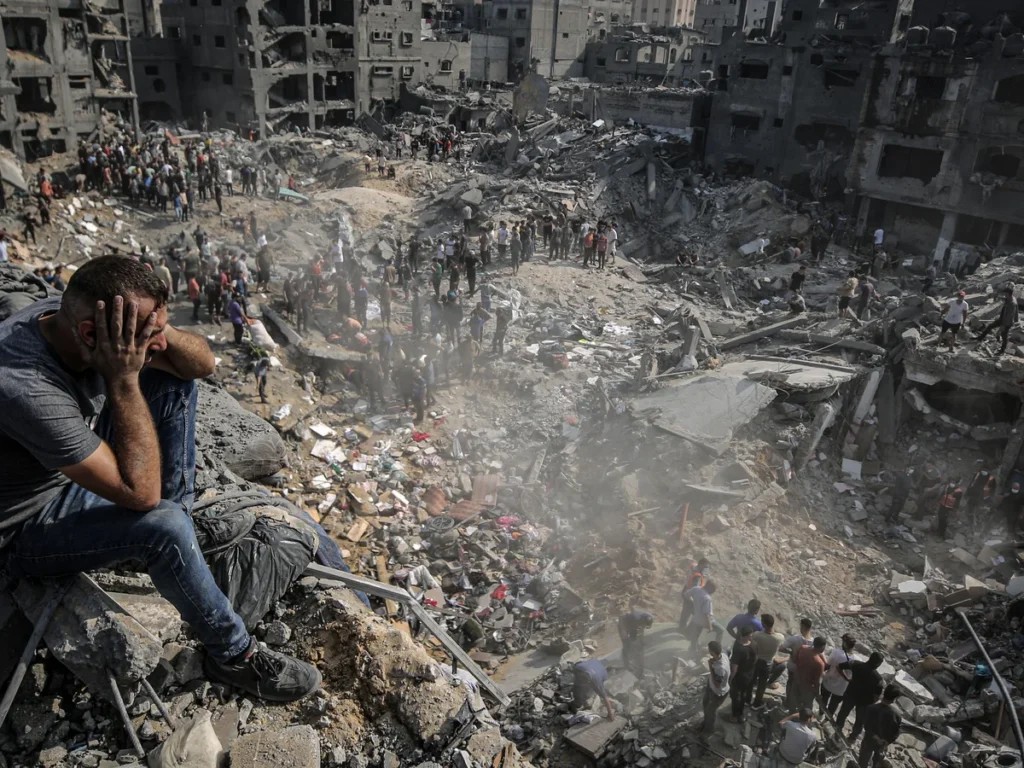
Gaza Herald — The Israeli strike on Nasser Medical Complex in Khan Younis early Thursday, November 12, 2026, was the latest in a series of attacks that have devastated Gaza’s healthcare system since October 7, 2023.
Over three years of war, Israeli military operations have damaged hospitals, healthcare centers, ambulances, and other medical infrastructure, while hundreds of healthcare workers have been killed, injured, or detained. The destruction has forced major medical facilities to suspend services, leaving Palestinians with increasingly limited access to lifesaving treatment.
The crisis extends beyond direct bombardment. Military sieges, ground incursions, forced evacuations, detention of medical personnel, and restrictions on the entry of medicine, equipment, and fuel have severely weakened Gaza’s healthcare system.
As a result, hospitals that remain partially operational face overwhelming numbers of patients, shortages of essential supplies, and the loss of specialized medical staff.
2023: Al-Ahli and Al-Shifa Become Early Symbols of Gaza’s Healthcare Crisis
On October 17, 2023, an explosion devastated the courtyard of Al-Ahli Arab Hospital in Gaza City, where large numbers of displaced Palestinians had sought shelter.
Gaza’s Ministry of Health reported that 471 people were killed and 342 injured. The cause of the explosion was disputed, with Palestinian authorities blaming an Israeli strike and Israel denying responsibility.
Weeks later, on November 3, an Israeli strike hit an ambulance convoy near the main entrance of Al-Shifa Medical Complex as wounded Palestinians were being transported from the hospital. Palestinian health authorities reported that 12 people were killed and dozens injured, including medical personnel.
Israeli forces surrounded Al-Shifa in mid-November before entering the facility on November 15. The military operation severely disrupted healthcare services and endangered patients, medical workers, and displaced civilians sheltering inside.
On November 18, thousands of people left the complex amid the military operation and deteriorating conditions. Medical departments, including intensive care and cardiac services, had been severely affected, while shortages of electricity, water, oxygen, and essential supplies threatened patients’ lives.
Other major hospitals, including Al-Awda, the Indonesian Hospital, and Kamal Adwan Hospital, also experienced Israeli military operations, shelling, access restrictions, and shortages of medicine, food, and fuel.
The resulting disruptions made it increasingly difficult to transfer critically ill and wounded patients to functioning medical facilities.
2024: Nasser and Al-Amal Besieged as Al-Shifa Suffers Further Destruction
As Israeli military operations expanded into Khan Younis in early 2024, Nasser Medical Complex and Al-Amal Hospital, operated by the Palestine Red Crescent Society, came under intense pressure.
In January, Israeli forces surrounded Al-Amal Hospital and restricted access to the facility, disrupting medical services and threatening patients and displaced families.
Further military operations, raids, and arrests during February and March severely damaged the hospital and contributed to its closure in April.
Meanwhile, on March 18, Israeli forces launched a second major operation at Al-Shifa Medical Complex in Gaza City.
The operation continued until April 1, leaving extensive destruction across the hospital and surrounding buildings.
The Office of the United Nations High Commissioner for Human Rights (OHCHR) documented serious violations during Israeli military operations at Gaza’s hospitals, including civilian deaths, attacks affecting medical personnel, and conditions that placed patients at grave risk.
Following the Israeli withdrawal from Al-Shifa, Palestinian authorities reported the discovery of bodies and burial sites in and around the hospital grounds, raising further demands for independent investigations.
Later that year, Israeli strikes hit the grounds of Al-Aqsa Martyrs Hospital in Deir al-Balah.
In October 2024, one such attack ignited fires among tents sheltering displaced families in the hospital courtyard. Palestinian authorities reported five deaths and 65 injuries.
On December 27, Israeli forces raided Kamal Adwan Hospital in northern Gaza and detained its director, Dr. Hussam Abu Safiya, during the operation.
The raid forced the hospital out of service, further reducing access to medical care in northern Gaza, where functioning healthcare facilities had already become scarce.
2025: Renewed Strikes Hit Surgical Departments and Emergency Responders
Following the resumption of large-scale Israeli military operations on March 18, 2025, Gaza’s healthcare facilities faced renewed attacks and severe disruptions.
On March 23, an Israeli strike hit a surgical department at Nasser Medical Complex in Khan Younis, killing two patients and injuring eight others, according to Palestinian reports.
The attack reportedly damaged 35 hospital beds and forced the affected department to suspend operations.
That same day, 15 Palestinian emergency responders and humanitarian workers were killed during a rescue mission in the Tal al-Sultan area of Rafah.
Video recovered from the phone of one of the victims showed clearly marked emergency vehicles and responders carrying out their duties before the fatal shooting, contradicting aspects of Israel’s initial account of the incident.
The killings prompted international calls for accountability and an independent investigation.
In May 2025, Israeli airstrikes also struck the European Hospital and its surroundings in Khan Younis, severely disrupting medical services in southern Gaza.
By that month, the World Health Organization (WHO) reported that only 19 of Gaza’s 36 hospitals remained operational, all at partial capacity.
The remaining facilities faced acute shortages of fuel, medicines, medical equipment, and specialized healthcare workers.
The Scale of Destruction: Hundreds of Attacks and Hospitals Operating at Partial Capacity
The cumulative impact of Israeli military operations has left Gaza’s healthcare system struggling to meet even basic medical needs.
According to WHO data cited in a March 2026 UNICEF assessment, more than 931 attacks on healthcare were recorded across Gaza between October 2023 and February 9, 2026, including 216 during 2025.
The assessment also indicated that approximately 95% of Gaza’s hospitals had sustained damage.
On September 24, 2026, the WHO director-general reported that only 19 of Gaza’s 36 hospitals were partially operational, with none functioning at full capacity.
He warned of severe shortages of essential medicines, diagnostic equipment, generator fuel, and specialized medical personnel.
These shortages have had particularly serious consequences for patients requiring continuous treatment.
Cancer patients face interruptions in lifesaving care, people with kidney disease struggle to access regular dialysis, and thousands of amputees remain without adequate rehabilitation services.
The destruction of hospitals has therefore produced a crisis extending well beyond the immediate casualties of military attacks.
November 2026: Israeli Strike on Nasser Hospital Kills Six Palestinians
Despite the ceasefire agreement that took effect on October 10, 2025, Israeli military attacks affecting Gaza’s healthcare system have continued to be reported.
Early Thursday, November 12, 2026, an Israeli strike hit the Al-Yassin Building inside Nasser Medical Complex in Khan Younis, killing six Palestinians and injuring more than 20 others, according to local authorities.
Among those killed was Dr. Rizq Abu Shaeera, a physician working at the hospital.
The bombardment struck the building’s second floor, damaging the recovery unit, surgical departments, and internal medicine wards.
The attack caused panic among patients, their families, and medical personnel, further disrupting services at one of southern Gaza’s most important hospitals.
Nasser Medical Complex serves as a major referral center for critically ill and wounded Palestinians, making any interruption to its operations especially consequential for patients across southern Gaza.
The latest strike also renewed concerns over the ability of Gaza’s remaining medical facilities to operate safely under the ceasefire.
International Law, Accountability, and the Long-Term Healthcare Crisis
Hospitals, ambulances, patients, and medical personnel are protected under international humanitarian law.
These protections are central to the Fourth Geneva Convention and the rules governing the conduct of hostilities.
Medical facilities may lose their specific protection against attack only under narrowly defined circumstances, including when they are used to commit acts harmful to the enemy outside their humanitarian function. Even then, strict legal requirements continue to apply, including applicable warning, proportionality, and precaution obligations.
In a report published on December 31, 2024, OHCHR documented a pattern of Israeli attacks on and around Gaza’s hospitals that had pushed the territory’s healthcare system toward collapse.
The UN office raised serious concerns about compliance with international humanitarian law and called for independent investigations and accountability.
The consequences of Gaza’s healthcare crisis extend far beyond the physical destruction of hospital buildings.
Every hospital forced to close reduces access to emergency surgery, intensive care, maternity services, diagnostic imaging, and treatment for chronic illnesses.
Restrictions on the entry of medical equipment, spare parts, and fuel have compounded these losses, leaving medical teams unable to restore essential services even where buildings remain standing.
For patients requiring dialysis, cancer treatment, emergency surgery, or long-term rehabilitation, the loss of functioning healthcare facilities can be life-threatening.
More than three years after the war began, Gaza’s healthcare system remains severely damaged, understaffed, and overwhelmed.
The November 12 strike on Nasser Medical Complex illustrates the continuing vulnerability of patients and healthcare workers in a territory where access to medical treatment has become increasingly uncertain and the need for protection, reconstruction, and accountability remains urgent.