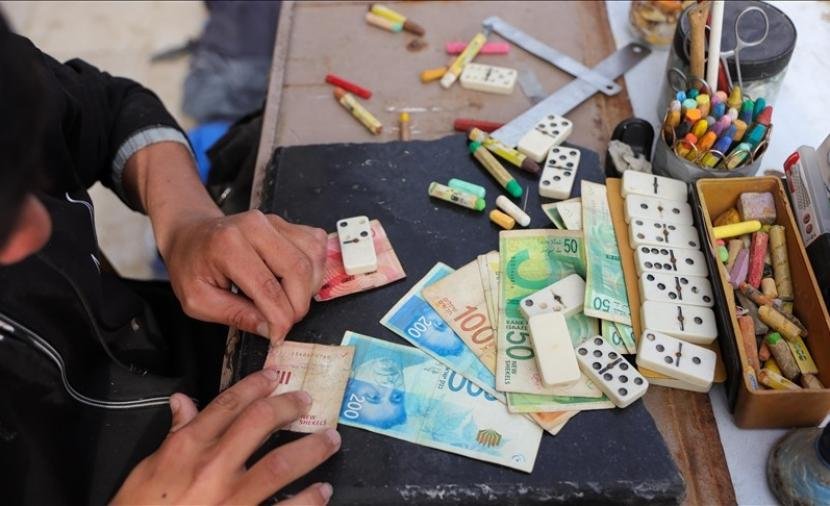
Gaza Herald — Gaza’s financial market is undergoing a dramatic reversal as physical cash, once so scarce that Palestinians paid steep commissions to obtain it, increasingly becomes a burden that some holders are now paying to convert into digital balances, economic analyst Ahmed Abu Qamar said.
Abu Qamar said the shift reflects a fundamental change in the role of money in Gaza’s battered economy. The value of cash, he explained, depends not only on its face value but also on how easily it can be accepted, exchanged and used to settle transactions.
During Gaza’s severe liquidity crisis, the scarcity of physical currency gave banknotes significant bargaining power. At one point, commissions for obtaining cash reportedly became so high that Palestinians could lose as much as half the value of the money they were withdrawing.
Now, the situation is reversing. As electronic payments expand and merchants become increasingly selective about which banknotes they accept, some Palestinians are paying commissions simply to convert physical cash into more usable digital balances.
Abu Qamar said commissions for converting cash into digital funds currently range from 3% to 10%, depending partly on the condition and quality of the banknotes. Worn or damaged notes can therefore become less valuable in practice because they are harder to spend or exchange.
The result, he said, is a market in which liquidity is effectively priced according to its quality and usability. The harder a banknote is to circulate, the more its holder may have to pay to convert it into a form that merchants will readily accept.
Cash itself does not disappear from the economy. Instead, Abu Qamar explained, it moves from individuals to currency traders and larger merchants before eventually circulating back into the market.
Meanwhile, digital payments are becoming increasingly important because they are more readily accepted by major merchants and make transactions easier amid shortages of small-denomination notes and difficulties providing change.
Abu Qamar stressed that the underlying problem is neither cash nor electronic payment itself, but the growing cost of moving between the two. As that gap widens, ordinary Palestinians are forced to absorb an increasing share of the cost of circulating and accessing their own money.
The shift illustrates another distortion in Gaza’s war-ravaged economy: physical cash has moved from being a scarce and highly sought-after asset to something that can itself carry an additional cost simply to use or exchange.
This report was produced in the Gaza Herald newsroom.