Gaza Herald — For thousands of Palestinian families trapped in Gaza, securing shelter has devolved into an agonizing choice between competing lethality rather than a pursuit of safety. While some endure daily life inside structurally compromised buildings on the verge of sudden collapse, others are forced into fragile canvas tents that flood with every downpour. Families attempting to escape both hazards are confronted by an extortionate real estate market where rents have skyrocketed while the stock of habitable apartments has been completely obliterated.
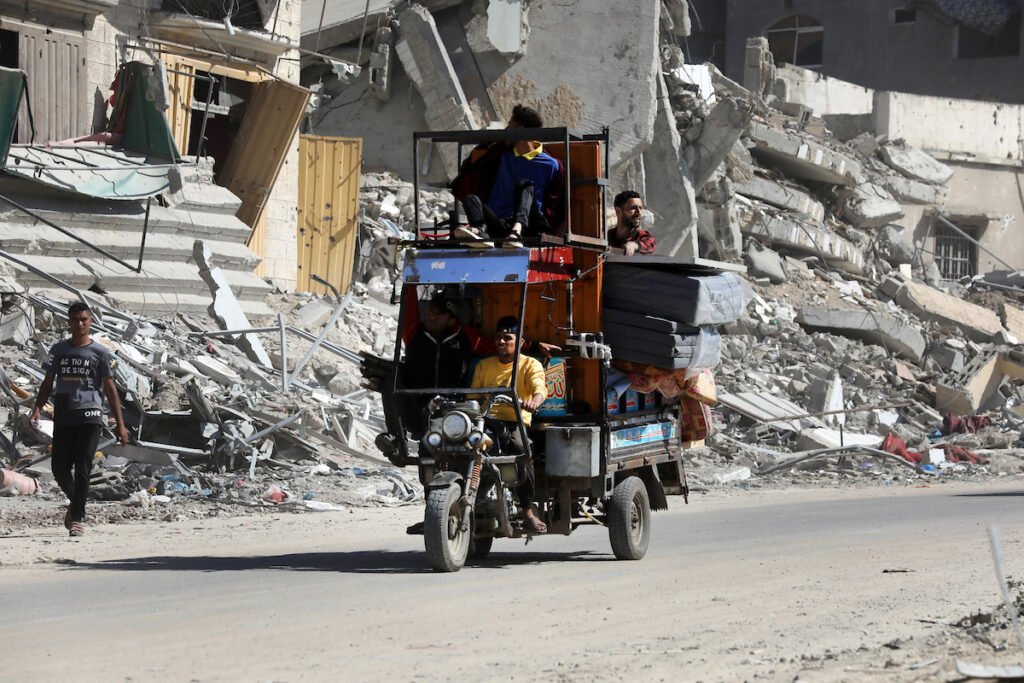
In the Sabra neighborhood of southern Gaza City, the Hamad building stands precariously among surrounding fields of concrete rubble. Having barely survived repeated Israeli bombardment, its floors tilt visibly, deep structural cracks line its facade, and load-bearing columns are severely fractured. Civil defense authorities and municipal engineers have formally designated the structure as a death trap that must be immediately evacuated and demolished.
Yet laundry hanging across the fractured balconies reveals a grim truth: families remain inside. Within one apartment, Hanan Hamad, known as Umm Yasser, resides with her four adult children and their families, a total of 15 people living in constant jeopardy. They are fully aware that the ceiling above them could give way at any moment and have received repeated warnings to leave, but they face an unyielding reality: there is nowhere else left to go.
When Evacuation Means Total Homelessness
Following the catastrophic collapse of the nearby Al-Saada residential building—which martyred 21 displaced Palestinians—the Hamad family made desperate attempts to reinforce their cracked living space. Umm Yasser’s eldest son borrowed $1,000 to purchase 30 metal jack posts, hoping the steel supports might hold up the compromised ceilings for a little while longer.
The makeshift props have done nothing to alleviate the constant fear. A massive chunk of concrete ceiling recently sheared off and crashed down just feet from her sleeping grandson, reducing the family’s daily existence to a terrifying calculus of risk: remain indoors and risk being buried alive, or step outside without a single safe alternative.
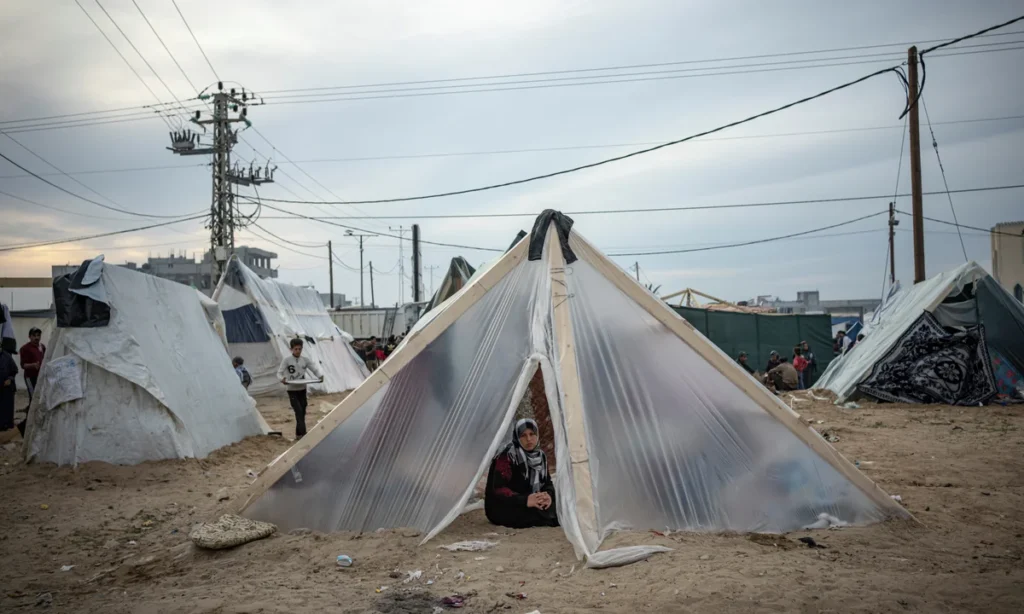
The question that dictates their existence is simple: where can they possibly go? The family cannot afford the exorbitant cost of a rental apartment, and returning to a displacement camp is a nightmare they refuse to repeat after suffering through more than a year in a makeshift tent in southern Gaza. Umm Yasser vividly recalls the suffocating heat, rodent infestations, overflowing sewage pits, and uncollected waste surrounding the camp enclosures. With winter setting in, she fears heavy rains will soak into the building’s fractured concrete and cause the remaining columns to buckle under storm pressure.
For families like hers, an official evacuation order is only half a directive. Civil defense officials can issue warnings about an unsafe building, but a piece of paper does not build a replacement home.
From Shattered Concrete to Flooded Camps
Across the Strip, this housing tragedy manifests in equally brutal ways. Nearby, Abu Ismail Hamad works to dismantle the worn tarpaulins of his makeshift tent to move them to slightly higher ground before winter storms arrive. His presence at the location is deeply personal; he erected the shelter directly over the ruins of the home where his wife and six children were killed by an Israeli airstrike in December 2023.
Because the plot lies in a low-elevation pocket, previous rains quickly transformed his shelter into a swamp. Floodwaters pooled around the perimeter and soaked through the floor where he sleeps. Now he is forced to move again, desperately searching for a few square meters of elevated ground that might protect him from being flooded out during the coming months.
The choices available to Gaza’s displaced population have shrunk to a horrifying minimum: a shattered apartment that could collapse without warning, a makeshift tent exposed to torrential rains and disease, or a rental home whose price tag is entirely out of reach.
Palestinian Civil Defense data indicates that at least 2,000 occupied structures across Gaza are at immediate risk of structural failure. Emergency crews are continually dispatched to rescue residents from previously damaged buildings that remain packed with families due to the absolute lack of shelter alternatives. In one recent operation, rescuers barely managed to extract five children trapped on an upper floor after an internal staircase collapsed inside a bombed house. In another incident, multiple families had to be evacuated from the Al-Najma building in Sheikh Radwan after whole sections of exterior wall crumbled into the street.
Hundreds of Thousands of Homes Destroyed Under Siege
Naji Sarhan, an infrastructure and reconstruction expert at Gaza’s Ministry of Public Works, estimates that the Israeli military offensive has destroyed roughly 330,000 housing units. An additional 80,000 homes have sustained severe structural damage, rendering them entirely uninhabitable, while approximately 90,000 units have suffered partial damage.
This immense scale of destruction means that basic repairs alone cannot solve the crisis. Gaza urgently requires a massive influx of raw construction supplies to enable families to build minimal, dignified shelters, even basic brick enclosures covered by corrugated metal roofs, paired with water storage tanks and proper sanitation systems.
However, the ongoing blockade keeps these critical materials strictly barred from entering the Strip. Sarhan highlights that essential items like water tanks, piping, sanitary fixtures, and plumbing hoses are virtually non-existent, rendering long-term reliance on crumbling tents both inhumane and unsustainable.
He estimates that 77% of Gaza’s total population is currently displaced, with roughly 66% surviving inside makeshift tents. The small remaining percentage survives in overcrowded rented rooms or crammed inside the partially damaged homes of relatives. More than half of all existing tents have degraded so severely from heat, wind, and rain that they fail to provide even basic shelter.
The crisis extends far beyond the physical shelters themselves. Most displacement zones lack functioning sewage lines, access to clean drinking water, electricity, or basic sanitation infrastructure. At the same time, available land suitable for setting up new camps is rapidly disappearing. With over two million Palestinians forcibly squeezed into an ever-shrinking perimeter while vast swathes of the Strip remain designated as unsafe or off-limits, the Ministry of Public Works faces severe spatial constraints in locating ground for new shelters.
Sarhan calculates that Gaza’s total housing deficit now exceeds 400,000 units. This structural deficit has forced families back into compromised ruins and driven the remaining rental market into extreme exploitation.
A Rental Market Exploited by Catastrophe
Gaza-based real estate broker Fadel Abdel Aal explains that the rental market has been drastically distorted by two simultaneous shocks: the near-total destruction of physical housing stock coupled with an unprecedented surge in desperate demand.
He estimates that average rental prices have surged by 300% to 800% compared to pre-war rates. For example, a basic apartment in Gaza City’s Rimal neighborhood that rented for approximately 700 shekels per month before the war now commands upwards of 3,200 shekels, an astronomical sum for a population stripped of its livelihoods.
Demand is heavily concentrated in areas that residents perceive as relatively safer, particularly specific pockets of central and western Gaza City, despite the heavy destruction that has impacted those districts. The majority of those searching for shelter are families whose homes were leveled by airstrikes, along with hundreds of thousands forcibly expelled from northern Gaza.
Unable to afford these prices, many families are forced to return to structural ruins. Others pay exorbitant rates to move into unfinished concrete shells that lack basic plumbing, wiring, windows, or doors. The result is a predatory housing market where even an uninhabitable or hazardous structure commands prices far beyond what ordinary families can pay.
A Crisis With No Safe Escape
Gaza’s housing catastrophe is no longer simply a matter of future post-war reconstruction. It is an immediate human crisis of daily survival while rebuilding remains blocked.
A family can be ordered out of a dangerous building by civil defense crews, only to find themselves standing on the street with nowhere to go. They can flee to a displacement camp, only to encounter flooding, disease, rodents, and raw sewage. They can search for an apartment, only to discover that price gouging has placed basic shelter completely out of reach.
The systemic destruction of Gaza’s housing infrastructure has transformed shelter into an unobtainable luxury, forcing Palestinian families to navigate a daily minefield of deadly hazards.
For those surviving amid the rubble, the onset of winter is not merely a seasonal change; it is an existential threat. It tests whether fractured concrete will hold, whether worn canvas tents will withstand heavy rain, and whether millions of Palestinians who have been displaced over and over will have anywhere left to survive.
Until building supplies, humanitarian shelter kits, and structural materials are allowed into Gaza at a scale matching the destruction, this housing crisis will continue to push innocent families into life-threatening conditions.
For thousands of Palestinians, the question is no longer when they will be allowed to return to their homes. It is whether a single safe home will be left standing for them to return to.