
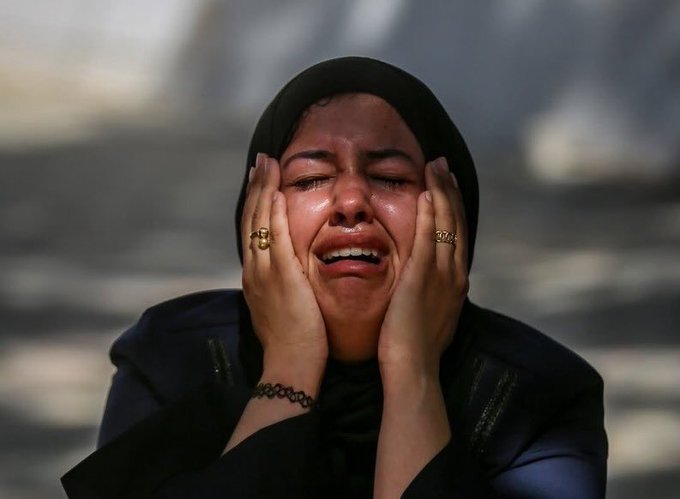
Gaza Herald — Across the devastated landscape of the Gaza Strip, the formal cessation of heavy, continuous bombardment has offered no respite to thousands of Palestinian families whose missing loved ones remain buried beneath millions of tons of pulverized concrete and mangled rebar. For these families, the passage of time brings no closure, only the agonizing realization that their homes, schools, and neighborhoods have been transformed into physical mass graves holding the silence of those lost.
Operating under a crippling, punitive siege that systematically blocks the entry of heavy machinery, fuel, and specialized excavation equipment, rescue crews from the Palestinian Civil Defence have been forced to dig through destroyed structures using bare hands, shovels, and primitive tools. Despite these immense constraints, emergency teams have pulled over 630 martyrs and fragmented human remains from beneath the ruins across Gaza since November 2025. Local authorities and human rights organizations estimate that more than 8,000 to 9,500 Palestinians remain unaccounted for, buried under an estimated 61 million tons of war debris.
The scale of this horror is acutely felt beneath the ruins of the Engineers’ Tower in the Nuseirat refugee camp. Targeted by Israeli warplanes on October 31, 2023, while housing residents across 22 apartments, the attack martyred over 250 Palestinians in one of the most horrific crimes of the two-year genocidal war. Today, more than half of those victims remain under the rubble, their bodies turned to remains mingled with the tower’s wreckage. At the time, grieving families were completely unable to retrieve their loved ones due to the absence of heavy machinery and excavators, a denial of basic dignity that compounded loss with the cruel deprivation of a proper burial.
For survivors, the passage of time offers no relief, only compounding anxieties. Islam Darwish (25), who lost her husband and two young children when their home collapsed, fears their remains will be permanently lost after more than two years beneath the rubble. Beyond the inability to reach them due to the occupation’s ban on heavy equipment, she dreads that their remains might be cleared along with the debris, dumped into the sea, or processed through concrete recycling initiatives. “Every day that passes makes the wound grow,” she told Al Jazeera Net. “They are under the rubble, turned into bones and decomposed remains after all this time. Is there anything left of their remains that we can bury? Can I retrieve what is left of them to say a proper final goodbye? I do not want them to remain a memory suspended under the rubble, or for their memory to fade with the debris, leaving their fate unknown with no graves and no farewell.”
Shaher Abu Ouda (35) endured a similar compound tragedy in the Swedish Village near the Philadelphi Corridor in Rafah. On June 6, 2024, an Israeli strike destroyed his home, burying 14 members of his family. Shaher was the sole survivor, forced to flee as occupation forces invaded and bulldozed the entire neighborhood, hauling the debris and the human remains within it—to unknown locations. “What happened is a compound crime: bombing the house over the heads of its residents, leaving the bodies under the rubble, and finally bulldozing the debris with the remains inside without giving us a chance to retrieve them or know their fate,” Abu Ouda said, calling for international accountability and answers regarding where his family’s remains were taken.
According to data from the Palestinian Civil Defence General Directorate, thousands of martyrs remain unaccounted for across specific sectors:
• Gaza City: 4,210 martyrs beneath 589 destroyed homes
• North Gaza: 2,341 martyrs beneath 387 destroyed homes
• Central Governorate: 890 martyrs beneath 130 destroyed homes
• Khan Younis: 580 martyrs beneath 109 destroyed homes
• Rafah: 189 martyrs beneath 30 destroyed homes
Mohamed Al-Mughayyir, Director of Humanitarian Support and International Cooperation for the Civil Defence in Gaza, confirmed that during a recent project supported by the International Committee of the Red Cross aimed at retrieving roughly 1,000 martyrs, rescue teams found no physical trace of nearly 50 percent of the victims. Officials attribute this horrifying reality to advanced biological decomposition and the intense chemical and thermobaric effects of the specialized weaponry deployed in civilian areas.
The continuous unearthing of victims, the vast majority of whom are women, children, and the elderly, has drawn severe warnings from international rights monitoring bodies. UN High Commissioner for Human Rights Volker Türk emphasized that the physical evidence emerging from residential areas highlights potential war crimes and systemic breaches of international humanitarian law, particularly regarding the use of heavy explosive weapons in densely populated civilian areas.
For surviving Palestinian families, the manual clearance of concrete is both an act of defiance and a desperate search for human dignity. Documenting biological samples, blast trajectories, and structural destruction before Israeli military bulldozers scrape away the ruins is critical to preserving immutable physical proof of war crimes. Human rights advocates continue to demand urgent global pressure to force open the borders for heavy excavation equipment and grant independent international investigators immediate access, ensuring that the stories and lives of Gaza’s martyrs are not permanently erased beneath the dust.

