
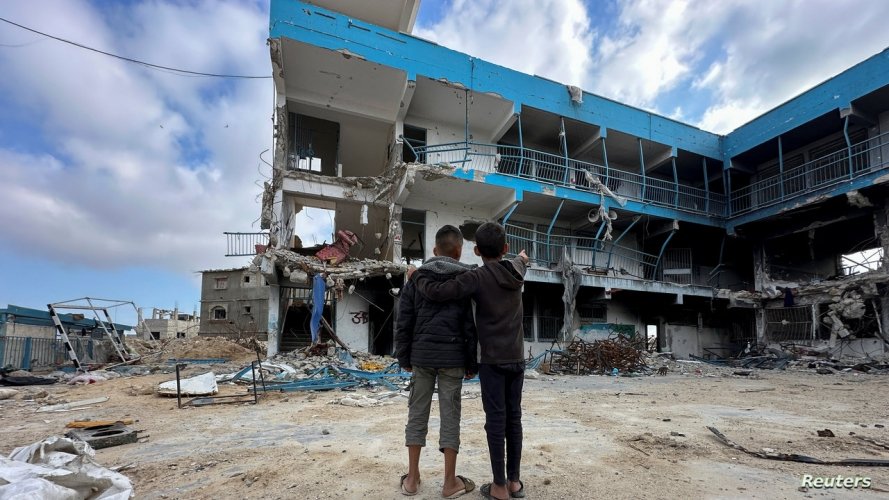
Gaza Herald — In Gaza, the start of a new school year once brought a familiar sense of excitement. Children would crowd around stationery shelves choosing colorful notebooks, pens, and school bags, while parents prepared to cover the expenses of another academic year. Shops would become busier, traders would anticipate one of the year’s most important commercial seasons, and families would try to give their children the feeling of a fresh start.
This year, however, the back-to-school season has become a reflection of Gaza’s economic collapse. Markets remain largely stagnant as families struggle to afford even the most basic school supplies. Parents move from one shop to another searching for the cheapest options, compare prices before making even small purchases, and often leave essential items such as school bags, clothing, or additional stationery until they can somehow afford them. For many households, the question is no longer what their children need for school but what the family can sacrifice to provide.
The transformation is particularly visible in the experience of children. Before the war, choosing a school bag or a new set of notebooks could be a small but meaningful part of preparing for the academic year. Today, many children begin school with bags from previous years, reused stationery and only a limited number of notebooks. Families are increasingly forced to reuse whatever remains available, while some postpone purchases or rely on charitable initiatives to provide basic supplies. The back-to-school season has therefore become less about choosing new belongings and more about calculating what can be left out.
What appears to be a simple shortage of school supplies is, in reality, a deeper crisis of purchasing power. Gaza’s families still need the same notebooks, uniforms, bags and stationery they needed before, but many no longer have the income required to buy them. The quietness of the markets is not evidence that demand has disappeared. It is evidence that the ability to pay has collapsed.
A Season That Lost Its Meaning
On Omar al-Mukhtar Street, vendor Hussein Muhammad stands among school bags and clothing that would once have attracted families preparing for the new academic year. Yet the activity around his stall bears little resemblance to the busy commercial season he remembers.
Seasonal periods traditionally offered traders an opportunity to increase sales and recover financially. Families would save money for school supplies, while shopkeepers prepared their inventories in anticipation of increased demand. That cycle has largely disappeared.
“Every year we used to wait for the seasons and count the days to welcome them,” Muhammad says. “Today, seasons are no longer a source of livelihood. They pass like ordinary days because people’s purchasing power is so weak.”
The crisis affects both sides of the market. Families cannot purchase what they need because their incomes have been severely reduced, while traders face weak demand, fluctuating prices, and repeated losses. Muhammad says school clothing prices rose significantly at the beginning of the season before falling somewhat, but they remain well above their previous levels, further limiting sales.
School bags have become particularly difficult for families to afford. Their prices are now roughly twice what they were before the war, making a new bag an unrealistic expense for many households. Some parents have begun waiting for charitable initiatives to distribute bags, while others rely on old ones or start the academic year without being able to provide all of their children’s requirements.
The result is an unusual situation in which a major commercial season arrives without generating the economic activity normally associated with it. The need remains, but the purchasing power required to transform that need into actual demand has disappeared.
The Economy Behind the Empty Shops
The crisis in school markets cannot be separated from the wider destruction of Gaza’s economy. Since October 2023, extensive damage to homes, infrastructure and economic facilities has disrupted production, trade and transportation while eliminating hundreds of thousands of employment opportunities. Widespread displacement has further destabilized household incomes, while the destruction of workplaces and restrictions on movement have made it increasingly difficult for people to earn a living.
Economic analyst Dr. Maher al-Tabba places the current situation within one of the deepest economic, humanitarian, and social crises Gaza has experienced in decades. The latest Gaza Rapid Damage and Needs Assessment estimates direct physical damage at approximately $35.2 billion, while economic and social losses have reached around $22.7 billion. Reconstruction and recovery needs are estimated at approximately $71.4 billion over the next decade.
The labor market has suffered an unprecedented collapse. Around three-quarters of Gaza’s working population before the war lost their jobs, while the employment-to-population ratio fell to approximately 9.3 percent. More than 80 percent of workers have been unable to work because workplaces were destroyed, roads were closed, transportation was disrupted, electricity became unreliable, and essential supplies became increasingly difficult to obtain.
For al-Tabba, these figures represent much more than an unemployment crisis. They demonstrate the collapse of household income and local demand, making purchasing power one of the clearest indicators of the economic devastation facing Gaza. A family may desperately need school supplies, but if its income has disappeared, that need cannot translate into a purchase.
This is why the price of a school bag has become economically significant. The problem is not simply that the bag costs more than it did before the war. The deeper problem is that the income that once allowed parents to buy it has largely disappeared.
When Education Competes With Survival
For many families, school expenses now compete directly with the basic costs of survival. Food, water, fuel, medicine, and shelter consume the limited resources available to households, leaving little room for expenses that were once considered routine.
A family that has to decide between purchasing several notebooks and paying for food is no longer making an ordinary household budgeting decision. It is making a choice imposed by economic collapse.
That pressure is gradually changing the meaning of the back-to-school season for children. A new bag, uniform, or set of colored pencils may appear insignificant compared with the destruction surrounding Gaza, but these small items are part of what once made childhood feel normal. Their absence shows how deeply the economic crisis has entered everyday life.
Parents are now forced to prioritize. A child may receive a new notebook but continue using an old bag. Another may have enough stationery for only part of the academic year. Families with several children may divide available supplies among them or postpone purchases until they receive assistance.
The consequences are also being felt by traders. Weak household demand means fewer sales, while unstable prices make it difficult for shopkeepers to plan, replenish their stock, or recover previous losses. The commercial cycle that once connected seasonal demand with household spending and business income has been severely disrupted.
The longer that cycle remains broken, the harder it becomes for families and businesses to recover. Families cannot spend because they lack stable incomes, while traders cannot recover because customers cannot afford to spend.
A Childhood Defined by Scarcity
For Gaza’s children, the most painful part of the transformation may be how ordinary expectations have changed. Preparing for school once meant choosing something new and looking forward to returning to classmates. Today, many children have to accept whatever their families can provide.
An old school bag is no longer simply an old school bag. It can represent a family’s lost income, a parent’s difficult choice, or a household that has already exhausted its resources on necessities. A smaller stack of notebooks can reveal the same reality.
The war has already changed where Gaza’s children live, how they study, and what they experience every day. The economic crisis is now changing what they expect from childhood itself. Even modest things that once brought excitement are becoming luxuries.
Yet the continued demand for school supplies also reveals something important. Families have not abandoned education. They remain determined to send their children to school and provide whatever they can, even when their ability to pay has been dramatically reduced.
That determination is visible in every reused school bag and every carefully counted notebook. It shows that the desire to educate children remains intact even as the economic system that once supported that education has been devastated.
The School Bag as a Measure of Gaza’s Crisis
The quiet back-to-school markets therefore tell a much larger story than the decline in seasonal sales. They show what happens when an economy loses its ability to generate income and when families are forced to redirect their limited resources toward immediate survival.
The school bag has become a symbol of that transformation. Before the war, it was part of a child’s excitement about starting a new academic year. Today, for many families, it is a financial calculation that must be weighed against food, water, medicine and shelter.
This is why the back-to-school season in Gaza cannot be measured simply by how many children return to classrooms or how many bags are sold in the markets. It must also be measured by what families had to sacrifice to make that return possible.
Behind every reused bag and every missing notebook is a household trying to preserve its children’s education despite an economy that has stripped away much of its ability to provide for them.
For Gaza’s children, going back to school should be a symbol of hope and continuity. Instead, the price of that simple return is exposing the depth of an economic crisis that has reached into the smallest details of everyday childhood.
And when a school bag becomes a luxury, the real story is no longer about what the market is selling. It is about what an entire society can no longer afford to give its children.

