
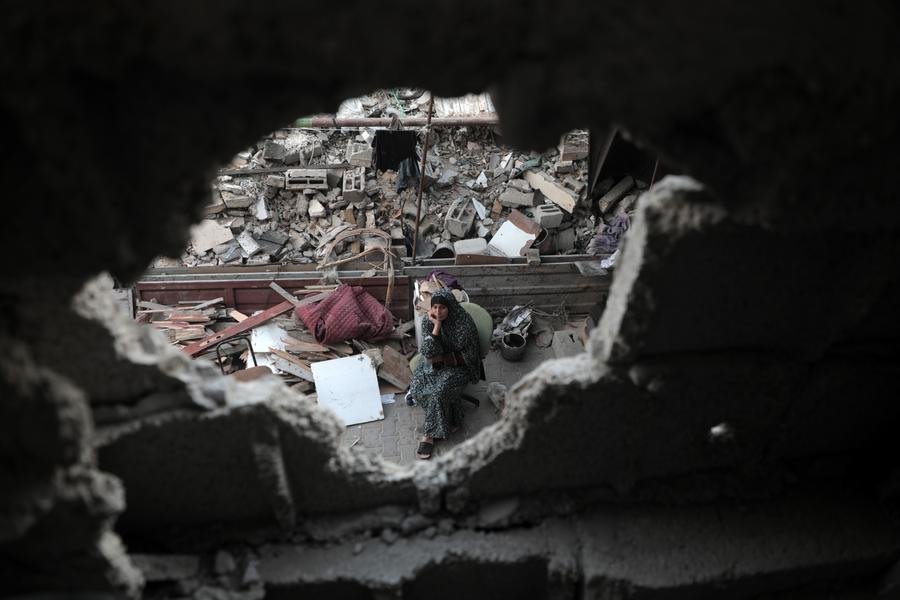
Gaza Herald _For Palestinians across the Gaza Strip, survival is no longer only about finding safety from airstrikes. The challenges of displacement now extend into every aspect of daily life, from securing a bed to sleep on and a place to store clothing to creating basic sanitation facilities that preserve a measure of dignity inside overcrowded tents.
As the war continues, destruction spreads, and essential goods remain scarce, thousands of displaced families have been forced to develop creative solutions using the remnants of destroyed homes and whatever materials can be found nearby. In Gaza’s displacement camps, resilience has become a daily necessity.
Building Furniture from Shipping Pallets
Outside a modest tent in the al-Mawasi area of Khan Younis, 32-year-old Tamer Hamdan proudly examines a simple wooden bed he spent three days constructing after months of sleeping on a worn mattress placed directly on damp ground.
“I never expected displacement to last this long,” Hamdan said. “At first, we thought we would return home within days. But as time passed, we realized we needed basic things to make life inside the tent bearable.”
Using wooden shipping pallets, known locally as “mashateeh,” Hamdan built the bed himself. He hopes to make beds for his children as well, though rising prices and limited supplies make that difficult.
Across Gaza’s displacement camps, pallet wood has become one of the most valuable materials available. Families use it to construct beds, tables, chairs, shelves, and makeshift wardrobes, replacing furniture that has either been destroyed or become impossible to obtain.
Workshops Reborn Beneath Plastic Sheets
Along Gaza’s coastal al-Rashid Road west of Khan Younis, carpenter Nahed Abu Azab has reopened his business beneath a collection of plastic tarps after losing his original workshop in Abasan.
“Before the war, I built doors, windows, and bedroom furniture,” he explained. “Today everything is different. We work with whatever materials we can find and recycle simple pieces of wood to meet people’s most urgent needs.”
According to Abu Azab, demand now centers on basic necessities rather than luxury items. Families are seeking chairs, tables, storage units, and raised platforms to help them cope with life inside tents.
“The shortage of materials has made recycling part of our daily work,” he said.
Turning Debris into Sanitation Solutions
The need for alternatives extends beyond furniture.
In western Khan Younis, 25-year-old Youssef Saud has begun producing makeshift toilets from marble and ceramic fragments salvaged from damaged homes and buildings.
“People need practical solutions,” he said. “Ready-made toilets are either unavailable or far too expensive, so families have started looking for alternatives.”
He also creates washing stations from old metal containers mounted on wooden frames, helping displaced families manage daily chores despite severe shortages.
Old Clothing Finds New Purpose
Inside many tents, worn-out clothes and damaged blankets have taken on entirely new functions.
Umm Mohammed al-Najjar, a displaced mother living in al-Mawasi, says nearly every piece of fabric is reused.
“Nothing goes to waste anymore,” she explained. “Old blankets and damaged clothing have become curtains that separate sleeping areas and provide privacy for our children.”
She added that discarded fabrics are often sewn into storage covers for clothing, food, and household items, helping families organize cramped living spaces.
Plastic Containers Become Essential Resources
As Gaza’s water crisis deepens, empty plastic bottles and containers have become indispensable tools for survival.
Salem Abu Shamala, a resident of a displacement camp west of Khan Younis, says families now save every container they can find.
“Plastic bottles have become extremely valuable,” he said. “We use them to store drinking water for days because access to water is so unpredictable.”
Smaller containers are commonly repurposed to store cooking oil, flour, and other essential supplies that would otherwise be difficult to preserve.
Palm Fronds Replace Scarce Building Materials
In some areas, residents have turned to palm fronds as a substitute for expensive and hard-to-find wood.
Forty-two-year-old Mustafa al-Agha said the material was initially used to provide shade from the sun but soon found additional uses.
“People started making simple storage units and partitions inside tents,” he explained. “Wood is scarce and costly, but palm fronds remain available in some agricultural areas.”
The lightweight structures help families protect clothing and bedding from sand, moisture, and overcrowded conditions.
Debris Becomes a Tool for Survival
Throughout Gaza’s camps, the remnants of destroyed homes have become building materials for a new reality.
Mahmoud Baraka, displaced from eastern Khan Younis, said concrete fragments and stones are routinely used to secure tents against strong winds.
“We also reuse metal sheets and scrap materials to build temporary doors and barriers,” he said. “None of us imagined we would one day be creating our necessities from the ruins of our own homes.”
A War-Driven Economy of Survival
Economists describe what is happening in Gaza as a form of forced circular economy, where discarded materials are continuously repurposed into new products.
Unlike planned environmental or development initiatives, however, this system has emerged out of necessity. The collapse of markets, restrictions on imports, widespread poverty, and soaring unemployment have left residents with little choice but to recycle and reuse whatever remains available.
Today, across Gaza’s displacement camps, rubble is no longer simply a symbol of destruction. It has become a resource for survival, helping families rebuild fragments of daily life while enduring one of the most devastating humanitarian crises in the territory’s history.
For many Palestinians, every bed assembled from pallet wood, every curtain sewn from old fabric, and every shelter reinforced with salvaged debris represents an act of resilience and determination to endure despite the immense hardships surrounding them.

