
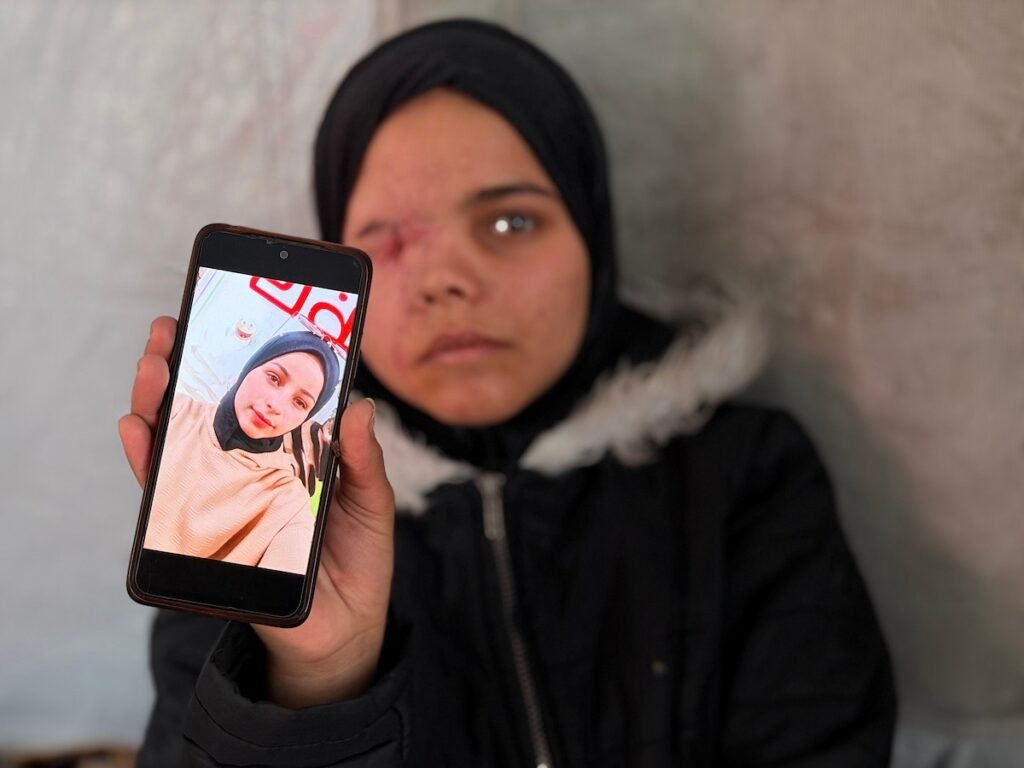
Gaza Herald – Known for her academic excellence and quiet ambitions, she is now battling a severe injury that has changed her facial features and threatens her future, after an Israeli strike targeted the area near her family’s tent in Sheikh Radwan neighborhood, north of Gaza City.
 The 15-year-old Nada Abdel Rahman Arhouma’s life was completely altered when an Israeli shrapnel penetrated her right eye, stripping her of the childhood features she once had and placing her in a harsh medical and psychological reality.
On September 10, 2025, while she was inside her family’s tent with her sisters, an Israeli bombardment suddenly hit the area. A fragment struck Nada’s face, causing her to lose her right eye in a moment that shifted her life from relative stability into ongoing suffering.
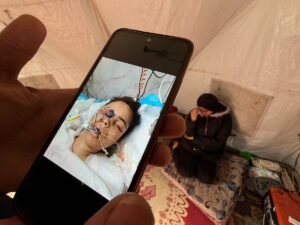
Her father recalls that day, saying they were preparing food outside the tent when one of his daughters suddenly screamed that Nada was killed. He rushed in and found her motionless. She was taken to Al-Shifa Hospital and initially placed among the dead before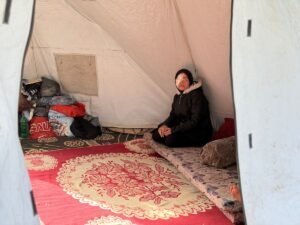 doctors discovered she was still breathing.
Her injuries were severe and complex. She lost her right eye completely and suffered extensive damage to her face, jaw, and teeth, along with complicated fractures in her nose that required a tracheostomy tube in her neck. Fluid leakage from the eye socket also posed a direct threat to her life.
Beyond that, she is now unable to speak or move properly and suffers partial memory loss, alongside damage to a nerve in her right hand. Her left eye is also at risk of gradual vision loss.
Doctors performed several emergency interventions, but confirmed that her condition exceeds the medical capacity available inside Gaza. She has been granted two urgent medical referrals abroad: one for advanced reconstructive surgery of the face and jaw and bone grafting, and another for an artificial eye implant and facial reconstruction.
However, these treatments depend on her ability to travel outside the Gaza Strip, which has not yet been possible.
In addition to her physical condition, Nada is facing severe psychological distress. She struggles to accept the changes in her appearance and daily life, tends to withdraw and cry, and shows significant behavioral fluctuations, increasing her family’s concern as treatment continues to be delayed.
Her father says she was top of her school and dreamed of succeeding and making her family proud. Today, he says, she cannot accept her appearance and is in a very difficult psychological state, adding that every passing day without treatment increases their fear for her.
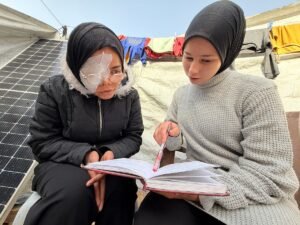 The family’s suffering has worsened after being displaced from Jabalia refugee camp and losing their home, forcing them to live in a tent lacking basic living conditions. With the father’s income cut off, the family struggles to provide daily necessities such as medication, medical gauze, and scarce treatment supplies.
He adds that she breathes through an opening in her neck and suffers repeated episodes of suffocation every day, saying that each time they fear they might lose her.
Despite receiving official medical referrals, she remains trapped inside the Gaza Strip due to travel restrictions and closed crossings, depriving her of potentially life-saving treatment.
Her father appeals for help, saying their request is simple: for their daughter to travel for treatment. He stresses that many people travel without serious injuries, while his daughter urgently needs the opportunity to live like other children.
Nada is one of thousands of patients and wounded people in Gaza who require treatment outside the Strip. According to Gaza’s Ministry of Health, more than 21,000 patients urgently need medical care abroad, including 4,500 children.
The continued closure of the Rafah crossing by Israel has worsened patients’ conditions to a critical level, while shortages of medicines, medical supplies, and the collapse of specialized services and hospital infrastructure have significantly increased waiting lists for treatment abroad.

