
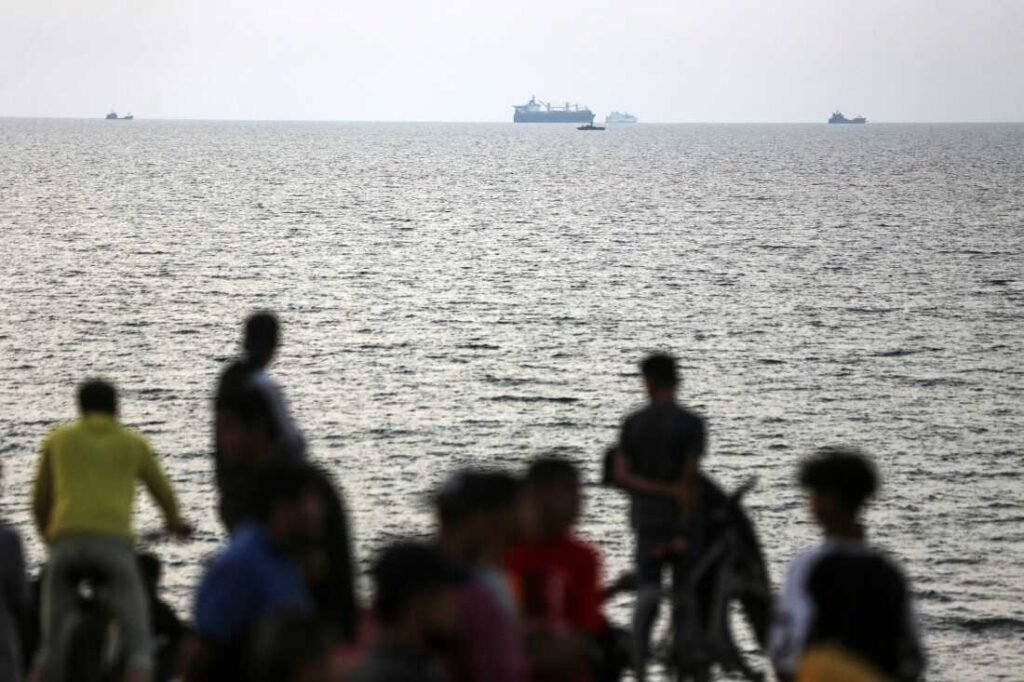
Gaza Herald_ Even after Israeli attacks destroyed his fishing boat and equipment, Ismail Farhat felt compelled to return to the sea. Fishing was not a livelihood he could abandon; it was his only means of feeding his family.
On the morning of 8 October, Farhat left the coast of Deir al-Balah in central Gaza aboard a small, makeshift boat he had constructed himself. Not long after setting out, an Israeli naval vessel approached and ordered him to surrender.
Farhat was detained, abused, and threatened with arrest should he ever fish again. He was released more than two months later, on a Tuesday.
“I was fishing with another man when an Israeli naval vessel suddenly approached us,” Farhat told Middle East Eye the day after his release. “They ordered us to remove our clothes, jump into the sea, and swim toward their ship.”
Once aboard, the soldiers interrogated the fishermen, asking about their residences, displacement history, and personal details such as identification numbers, ages, and phone numbers. One soldier photographed Farhat using his personal phone.
A second naval vessel later arrived, and Farhat was transferred to it for further questioning. After the interrogation ended, both fishermen were initially released and instructed to return to shore.
Minutes later, the naval vessel intercepted them again.
“One soldier called me by name and ordered me to jump into the water and swim toward him, while telling the other fisherman to go back to shore,” Farhat said. “They arrested me, blindfolded me, and handcuffed me.”
He described being verbally abused and beaten, adding that soldiers repeatedly accused him of belonging to Hamas. “They said I was pretending to be a fisherman. Every time I spoke or lifted my head, they beat me and insulted me with obscene language.”
At that moment, Farhat realized he was being detained indefinitely. He later reflected that he was fortunate to survive, noting that many other fishermen had been shot and killed at sea.
Detention and Torture
Since the beginning of Israel’s war on Gaza on 7 October 2023, at least 230 Palestinian fishermen have been killed, according to the Palestinian Fishermen Syndicate.
Farhat was first taken to an unidentified port before being transferred to Sde Teiman, an Israeli detention facility notorious for the mistreatment and torture of Palestinian detainees.
“Throughout this entire time, I was kept wearing only shorts, despite the freezing cold,” he said. “I wasn’t allowed to speak.”
Upon arrival at Sde Teiman, guards forced him to remove his clothes, searched him, and issued prison garments. He said approximately 150 Palestinian detainees were held at the facility, including fishermen and truck drivers who had transported aid and goods.
For the first 50 days of his detention, Farhat remained handcuffed around the clock.
“You live with your hands bound 24 hours a day,” he said. “We were forbidden from talking, forbidden from leaning, and forbidden from sleeping. There were no mattresses. I slept on iron mesh.”
He added that if exhaustion caused him to fall asleep or shift position, guards would immediately punish him by forcing him to stand for hours.
Over more than two months in detention, Farhat said he and other fishermen were treated as criminals despite never being formally charged.
He encountered many fishermen imprisoned under similar circumstances. Many had been detained simply for fishing amid Israel’s imposed starvation of Gaza since March.
“At night, a unit they called the ‘commando’ would storm the prison and throw stun and smoke grenades at us,” he said. “Often, they forced us to remain kneeling for long periods.”
Medical care was almost entirely denied. “When we were sick or in pain, they refused to give us even basic medication. Sometimes they photographed us and put us through long procedures just to give a single painkiller.”
Destroyed Livelihoods
According to Farhat, new fishermen were brought into the prison every few days. The youngest detainees were 16 years old, while the oldest were in their mid-50s. None of them, he said, have been released.
“Before my arrest, we were constantly harassed and attacked,” Farhat explained. “But the conditions during the war forced us back to the sea again and again.”
“We risked our lives simply to provide food. We know this profession often ends in detention, injury, or death.”
Farhat was released on 16 December as part of a ceasefire agreement between Israel and Palestinian factions.
According to Zakaria Bakr, head of the Fishermen Union Committees in Gaza, more than 95 percent of Gaza’s fishing sector has been destroyed.
This includes the killing of fishermen, the destruction of boats and equipment, and the targeting of essential infrastructure such as Gaza Port, storage facilities, the ice factory, and the fish market.
“Since the first day of the war, the permitted fishing area has been reduced to zero,” Bakr told Middle East Eye. “A total naval blockade remains in place, even after the ceasefire.”
Under the 1993 Oslo Accords, Palestinian fishermen were theoretically allowed to fish up to 20 nautical miles from Gaza’s shore, a provision that has never been fully implemented.
A Forced Return to the Sea
Over the past three decades, Israel has repeatedly reduced fishing limits, at times allowing access to only three to twelve nautical miles before the war.
“During the war, the navy’s main response was shooting and killing,” Bakr said. “Sixty-five fishermen were killed while working at sea.”
Following the ceasefire, arrests and boat destruction intensified. At least 28 fishermen were detained after the truce, with only one later released.
Even before the war, Gaza’s fishermen were among the poorest communities, with nearly 90 percent living below the poverty line.
“Under these conditions, fishermen are forced to risk their lives to obtain food for themselves and their communities,” Bakr said.
Before October 2023, around 4,500 fishermen were officially registered in Gaza, alongside thousands more working under temporary permits or connected to the fishing industry. Today, only 400 to 500 individuals remain involved in fishing.
“They now rely on makeshift platforms, rebuilt from destroyed boats, leisure rafts, or even refrigerator doors,” Bakr explained. “Fishing nets are often recovered from beneath rubble.”
Current fish production amounts to no more than two percent of pre-war levels. “All fishermen operating from Gaza Port together catch only about 16 kilograms of fish per day,” Bakr said. “Before the war, daily catches could reach 15 tonnes.”
“No one is allowed to enter the sea,” he added. “This is collective punishment.”

