
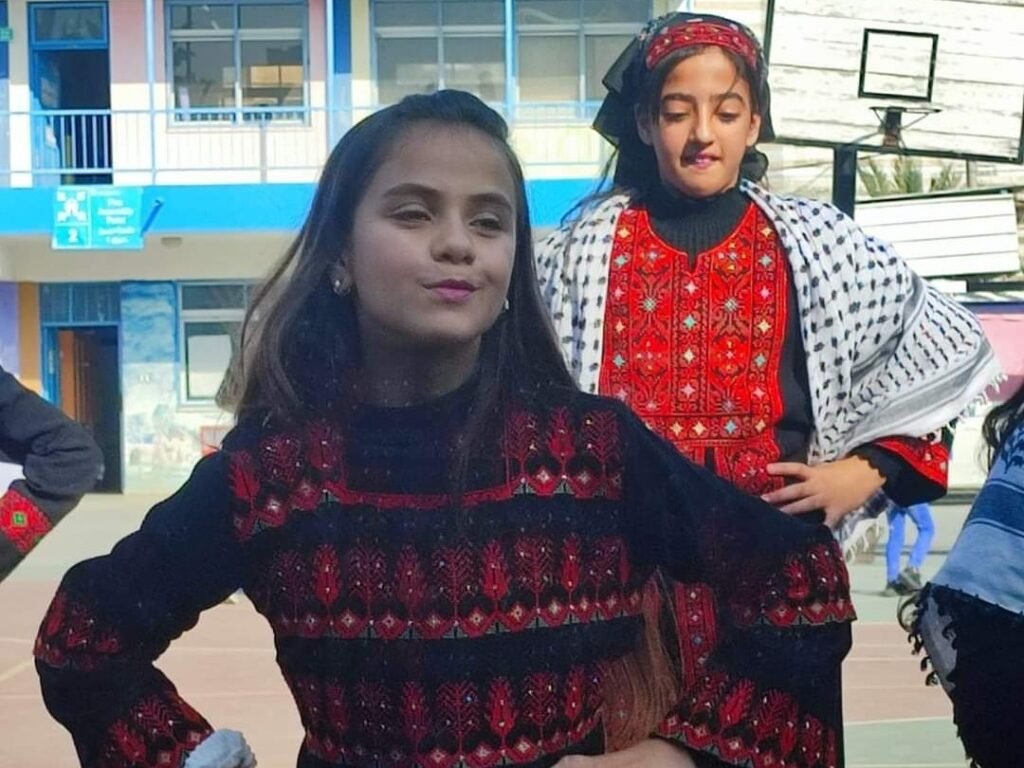
Gaza Herald- Noor is 14 years old, and she is the sole survivor of her family after an Israeli airstrike tore their lives apart. She wants the world to remember her mother, father, and sisters not as nameless figures in a death toll, but as people whose lives were stolen in an instant.
In the early hours of August 6, at around 3:00 a.m., Israeli warplanes bombed the apartment where Noor lived with her mother, Somaiya, 35, her father, Anas, 35, and her sisters, Hoor, 13, and Sham, 9. The strike killed them instantly. Noor survived, but her arm was shattered so badly it required urgent surgery. Two days later, as she was wheeled into the operating room, she called out for her parents. She already knew they were gone, but in her pain and fear, she cried for the comfort of voices she would never hear again.
Now she carries a title no child should bear: “the wounded child with no surviving family.” She often speaks of wanting to be reunited with her parents and sisters, unable to imagine a future without them.
The reason Noor survived was a small quarrel with Hoor the night before. The two had always been inseparable sharing a bed, going to school together, buying ice cream from their favorite shop. But that night, after their disagreement, Noor chose to sleep on the opposite side of the room, near the curtain. When the missile struck, it hit the spot where the rest of her family slept. The blast hurled her mattress across the room into the bathroom wall. She lived, but her arm was broken in multiple places.
Somaiya was the heart of her family warm, generous, and deeply involved in her community. Trained as a journalist, she never worked in the field formally, but during the genocide she created a safe haven for neighborhood children, teaching them language and mathematics to give them something to hold on to beyond war and grief.
Once, she sent a photograph of herself standing in front of a whiteboard with the word “HOPE” written in bold letters. Even in the darkest moments, she believed hope could be passed on. In her final message to a relative, she wrote: “We are still in this world, hoping to get some good news.” The good news never came.
From childhood, Somaiya had been adventurous and daring climbing olive trees in her grandparents’ yard, trying to open the door of a moving car. She passed that fearless spirit to her daughters, dressing them in matching outfits, taking them to amusement parks, filling their days with joy.
In 2013, a relative returning from New Zealand gave her a book about the Māori haka dance. Just last July, that same relative attended a haka performance in Rotorua and thought about telling the Māori chief how Hoor once pored over that book, her eyes bright with curiosity. But a month later, Hoor’s life, along with the rest of her family’s, was cut short.
With Gaza’s cemeteries overflowing, Anas was buried in an aunt’s grave, with Hoor beside him. Somaiya and Sham were buried in another family grave, alongside an aunt who had died in 2007 during Israel’s siege. Perhaps being laid to rest beside loved ones brought them the peace they never knew in life. Noor often wishes she could go back to the days when she and Hoor argued over toys or ice cream flavors, or when her father drove fast so the wind could tangle their hair.
But the world stood by as the genocide unfolded. Noor’s family did not want streets or schools named after them; they wanted to live. Hoor and Sham wanted to grow into the women they dreamed of becoming. Somaiya wanted to see Gaza free. Noor wanted the simple joy of family.
One day, she hopes to visit their graves in a free Gaza if they are not destroyed, like so many others. She wants the world to know their names, faces, and dreams. That, she believes, is the least anyone can do, after the world failed to protect them.
In her mind, Noor imagines her parents and sisters in a place where Palestinians live without fear, taking long drives and sharing ice cream. She sees her mother teaching children about hope, just as she once did. And she dreams of a day when she can live not to escape her grief, but to honor their memory in a world where justice and freedom have finally reached Gaza.

