
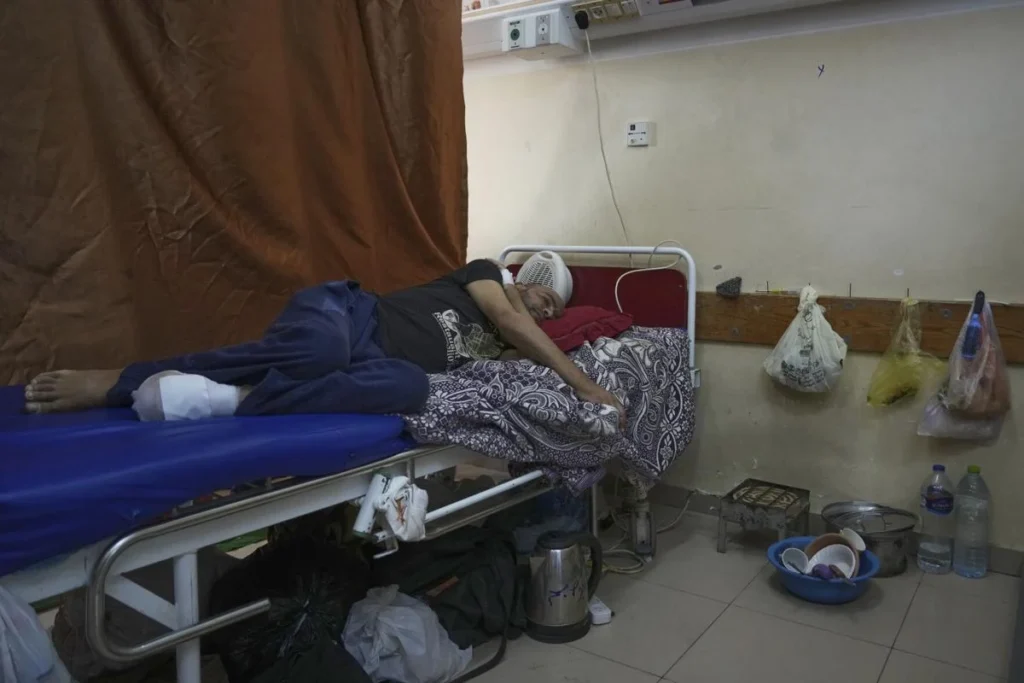
Gaza Herald- Dozens of kidney failure patients in Gaza became severely swollen, shortly before they died due to the lack of dialysis sessions.
Since October 2023, four in every ten kidney patients in the Gaza Strip have died, according to the Palestinian Ministry of Health.
Shifa Hospital raid
The collapse of the healthcare system has been driven by Israeli military assaults on hospitals, ongoing blockades on essential medicines, and the cutting off of electricity, food, and water.
But the deadliest blow for kidney patients came when Israeli forces stormed al-Shifa Hospital, Gaza’s largest medical complex.
Since then, the hospital’s dialysis ward has been struggling to maintain its operations.
Though the hospital has been raided three times since the war began, it was the March 2024 assault that proved most catastrophic for kidney patients, who, according to a nurse from the dialysis ward, began “dying one by one,” both in the hospital and at home.
Faroug Akkila, a 73-year-old kidney patient whose health had sharply deteriorated during the war, passed away in the early days of the Israeli military’s assault on the hospital.
His son, Khaled, could not be with him in his final moments, as he was forced to leave the hospital and abandon him when Israeli forces stormed the complex.
“A week before the Israeli army stormed the hospital, we took my father there because, during the war, his health deteriorated rapidly as he mainly relied on thyme and canned food, none of which were suitable for kidney patients. But there were no alternatives,” Khaled told Gaza Herald.
“His kidney function worsened significantly, and his blood levels dropped drastically, so we had to take him to the hospital.”
When Israeli forces stormed the hospital, they searched all medical professionals, patients, their companions, and those displaced inside before ordering the vast majority to evacuate.
But Khaled was unable to take his father with him.
“I had to leave my father behind,” Khaled recalled. “He couldn’t walk, stand, or even move. He needed urgent treatment.”
Once outside, Khaled tried to reach his father. But the power outage and the Israeli-imposed telecom blackout made communication impossible.
“There was no way to contact him. Everyone whose phone numbers I had taken to check on him either had their phones switched off due to the power outage or were unreachable because of the network blackout at that time,” Khaled said.
“For several days, we had no way of knowing my father’s fate, whether he was alive or dead, or if he had been forced to leave or was still trapped inside the hospital.”
Days later, the family received devastating news.
“A doctor told us my father had died. They said it was due to the lack of food, water, and medicine. His body gave up,” Khaled continued.
“Kidney patients need special food and mineral water. Without those, even dialysis doesn’t help.”
Under siege, al-Shifa’s staff couldn’t transfer the bodies of the deceased for burial in regular cemeteries.
To contain the spread of disease, they had no choice but to dig a mass grave within the hospital yard and bury the bodies there.
“The doctors at the hospital had dug a grave themselves and buried my father along with about eight other people, both men and women,” Khaled added.
“When we went to retrieve the body from the grave after the Israeli forces withdrew, we found that his face and feet had begun to decompose. We recognised him because he was not shrouded but buried in his blanket and clothes.”
But Khaled noticed something deeply disturbing.
“There was a wound on his head, like he’d been struck with the butt of a rifle. My father was too weak to move. Yet it seems Israeli soldiers had hit him.”
‘Too late for many’
Faroug Akkila was just one among what doctors describe as an “uncountable number” of kidney patients who died, particularly during al-Shifa’s repeated shutdowns, the only hospital in northern Gaza offering dialysis at the time.
“Every time Israeli forces stormed al-Shifa, it stopped functioning for nearly two weeks,” said Dr Muhammad Abuhassira, a specialist in internal medicine and nephrology at the complex, told MEE.
“Machines were damaged, and part of the dialysis ward was burned. When dialysis stopped, it was a catastrophe. Patients knew they had days, maybe a week, left. And then they started dying. One by one.”
Once Israeli forces withdrew, doctors immediately worked to resume dialysis treatments. But it “was too late for many,” Dr Abuassira said.
“Some patients had already suffered irreversible damage. There were only two or three machines left. We provided just two-hour sessions per patient, just enough to keep them alive.” He told Gaza Herald.
According to doctors at al-Shifa Hospital, the death of around 40% of kidney patients did not alleviate the pressure on the dialysis units, as the number of residents suffering from kidney failure has increased during the war, due to the lack of access to healthy food and clean drinking water.
Normally, patients require 12 hours of dialysis per week. However, even under the best circumstances since the last Israeli raid, the hospital is only able to provide four to six hours of dialysis per patient.
Today, around 30 dialysis machines are available at al-Shifa Hospital, serving over 350 kidney patients in northern Gaza.
Despite the availability of some dialysis machines, patients are facing a new challenge that frequently disrupts or cancels their sessions.
By July 2024, Gaza City had lost nearly all of its water production capacity, with approximately 88% of its water wells and 100% of its desalination plants damaged or destroyed, according to Oxfam International.
This destruction of water infrastructure has left medical staff struggling to secure the clean water required to operate dialysis machines.
Even after the ceasefire and partial rebuilding of al-Shifa’s dialysis ward, the water shortage remains critical, continuing to threaten the lives of patients who cannot survive without regular, uninterrupted care.
On numerous occasions, dialysis sessions have been canceled due to the lack of water.
A drinking water distribution vehicle driver, who requested to remain anonymous and be identified as Abu Ahmed, told Gaza Herald that he undertook several “death journeys,” risking his life to reach al-Shifa Hospital and supply the dialysis unit with water amid Israel’s intensive attacks on Gaza.
“On one of those days, Israeli tanks were only a few hundred meters away. I had no obligation to work at that time, especially since I work for my own profit. But knowing that no one else would be able to reach the hospital or provide it with water, I had to find a way to get there,” he said.
“On the days when no water distribution vehicles could reach the hospital, the dialysis ward couldn’t operate, and patients had to wait until the next day for their sessions. So I would take side roads, trying not to be seen by Israeli tanks and drones.
“To be honest, I believed I would be killed someday during one of those journeys.”

