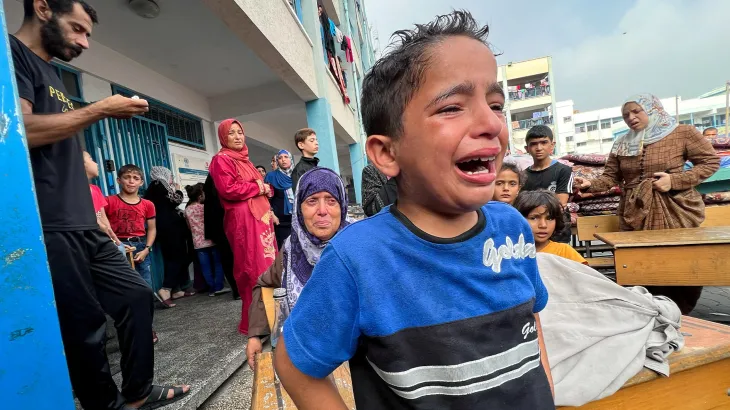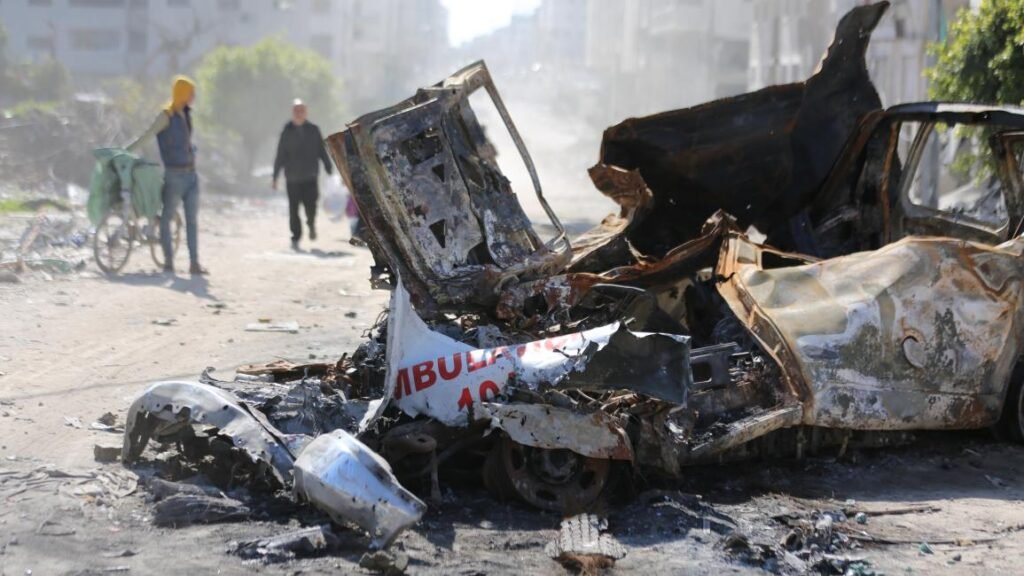
Gaza Herald — The strike by Israeli occupation forces on Nasser Medical Complex in Khan Younis on November 12, 2026, which killed six Palestinians and wounded dozens, including patients and medical personnel, raises urgent questions under international humanitarian law regarding the protection of medical facilities during armed conflict and the legal duties of those carrying out and enabling military operations.
Among those killed were Saif Abu Hatab, who was awaiting surgery, and Dr. Rizq Abu Shaeira, a surgeon working at the hospital. The strike hit a building housing the surgical department, inflicting heavy damage and disrupting medical services at one of Gaza’s principal healthcare facilities.
Israeli military officials stated that forces targeted a senior Hamas commander and alleged that armed members used the hospital complex for military purposes. Such assertions, however, do not automatically strip a hospital of protected status or establish that a strike against it was lawful.
Under international humanitarian law, medical facilities, patients, the wounded, and medical personnel receive special protection, requiring strict compliance with legal rules in any military operation affecting them. The core question is therefore not merely whom Israeli forces say they sought to target, but whether the strike complied with rules governing hospital protection and the conduct of hostilities, while drawing fresh scrutiny to states’ broader legal duties to prevent violations, investigate alleged crimes, and ensure respect for international humanitarian law.
Nasser Hospital and Legal Protection of Medical Facilities
Hospitals and medical units enjoy special protection under the Geneva Conventions and customary international humanitarian law, requiring them to be respected and protected in all circumstances and spared from attack while performing humanitarian functions. That protection does not vanish simply because wounded or sick combatants receive care inside a hospital, nor does the presence of medical staff carrying light weapons for self-defense, armed guards, or weapons taken from wounded patients automatically convert a medical facility into a military objective.
International humanitarian law recognizes a narrow exception where a medical facility is used, outside its humanitarian functions, to commit acts harmful to the enemy. Even then, protection cannot be withdrawn immediately: applicable rules require an effective warning, a reasonable time limit where appropriate, and an opportunity for harmful activity to cease before any withdrawal of protection, while keeping wounded and sick patients protected.
Even where a military objective is alleged inside or near a hospital, an attack must still satisfy fundamental rules on the conduct of hostilities, including distinction between civilians and combatants and between civilian objects and military objectives, proportionality prohibiting attacks expected to cause excessive civilian harm relative to anticipated concrete and direct military advantage, and precautions requiring all feasible measures to avoid or minimize civilian casualties and damage to protected facilities.
Claiming a military commander was inside a hospital does not by itself prove legality; investigators must examine the nature of alleged military use, intelligence available to attackers, weapon choice, expected civilian presence, warning steps, and anticipated harm. Where evidence shows a hospital was intentionally attacked while retaining protected status, such conduct can constitute a war crime under the Rome Statute of the International Criminal Court, making an independent investigation into the November 12 strike essential.
A Ceasefire Does Not Suspend International Legal Obligations
The October 2025 ceasefire did not erase legal protections for civilians or grant any party unrestricted license to use force. International humanitarian law continues to bind parties whenever armed-conflict conditions persist, regardless of political agreements or declarations that fighting has ended.
More than 1,600 Palestinians have been killed and 5,833 wounded since the ceasefire took effect—figures that, alongside ongoing strikes and restrictions, raise serious questions about adherence to ceasefire commitments and civilian protection. United Nations Security Council Resolution 2803, adopted in November 2025, endorsed the Comprehensive Plan to End the Gaza Conflict and called on all parties to implement it in full, including upholding the ceasefire in good faith without delay.
Continuing strikes must therefore be evaluated against both ceasefire obligations and independent rules of international humanitarian law, as breaching a ceasefire does not automatically prove a war crime, just as observing a political accord cannot excuse unlawful acts. Humanitarian restrictions, including limits on tents, blankets, medicines, medical equipment, and essential supplies, must also be judged against humanitarian relief rules and occupying-power duties where applicable, including the prohibition on using starvation of civilians as a method of warfare and the duty to allow and facilitate rapid, unimpeded passage of impartial humanitarian relief. Where restrictions are arbitrary or relief is unlawfully obstructed, further legal violations may arise depending on the restrictions’ nature, stated rationale, civilian impact, and compliance with humanitarian safeguards.
Individual Criminal Liability and International Courts
Legal fallout from strikes on hospitals reaches beyond state responsibility into individual criminal liability where elements of an international crime are established. Under the Rome Statute, individuals face criminal responsibility for war crimes, including intentionally directing attacks against protected hospitals and medical facilities, extending not only to those who execute an attack but also to those who order, plan, facilitate, or contribute to it under applicable legal standards, as well as through command responsibility where commanders knew or should have known forces under their effective command were committing or about to commit crimes and failed to take necessary and reasonable measures to prevent, repress, or refer them.
The International Criminal Court holds jurisdiction over alleged crimes in the occupied Palestinian territory, including Gaza, and in November 2024 issued arrest warrants for Israeli Prime Minister Benjamin Netanyahu and former Defense Minister Yoav Gallant over alleged war crimes and crimes against humanity, warrants that do not constitute convictions but show senior officials can face individual criminal proceedings under international law.
Meanwhile, the International Court of Justice has issued provisional measures in South Africa’s case against Israel under the Genocide Convention, imposing binding obligations regarding prevention of acts under the Convention, urgently needed humanitarian aid, and evidence preservation, measures that are not a final finding of genocide but establish central legal duties for global response.
Duties of States Supporting Israeli Operations
International responsibility does not stop at the borders of the state whose forces conduct a strike. Other states also carry legal obligations under international humanitarian law, including Common Article 1 of the Geneva Conventions, which obligates states to respect and ensure respect for the Conventions in all circumstances, a duty the International Committee of the Red Cross notes requires using influence to prevent and end violations and refraining from encouraging violations by other parties.
This obligation carries direct weight for governments supplying military aid, weapons, ammunition, equipment, or other support to parties in armed conflict.
States must evaluate the risk that transfers or assistance could contribute to international humanitarian law violations, alongside obligations under the Arms Trade Treaty, including prohibitions and risk-assessment rules on arms transfers, and must refrain from transferring weapons where a clear risk of contributing to such violations exists, basing assessments on facts and evidence rather than political ties or general assurances.
A supporting state’s precise legal responsibility turns on applicable rules and evidence, including knowledge, type of assistance, and connection to wrongful conduct, where political backing alone does not automatically establish war-crime complicity, yet absence of direct combat participation does not erase duties to prevent harm and avoid contributing to grave violations. That framework places diplomatic pressure, arms-transfer choices, investigation cooperation, and prevention measures squarely under legal scrutiny.
Moving From Condemnation to Legal Accountability
Repeated expressions of concern and condemnations have not alone protected civilians in Gaza. International law provides enforcement tools beyond political statements, including criminal probes, state-responsibility proceedings, arms-transfer limits, lawful sanctions, and evidence preservation, mechanisms requiring political and institutional action to prevent further harm, establish facts, identify perpetrators, and open paths to justice and reparation.
Investigating alleged crimes requires preserving physical evidence, documenting victims’ identities and circumstances, recording medical and forensic findings, and securing records on targeting decisions and operations, making access for independent investigators and humanitarian agencies vital. International obligations cannot be measured by the volume of statements after each strike, but by concrete actions governments take to prevent violations, uphold international humanitarian law, and back credible accountability.
For Palestinians in Gaza, legal inaction translates into lives lost, inoperable hospitals, slain medical workers, and civilians denied medical care and safe shelter, making independent investigation, transparent legal review of the November 12 strike on Nasser Hospital, and consistent enforcement of international law before, during, and after military operations an urgent test for the international community.