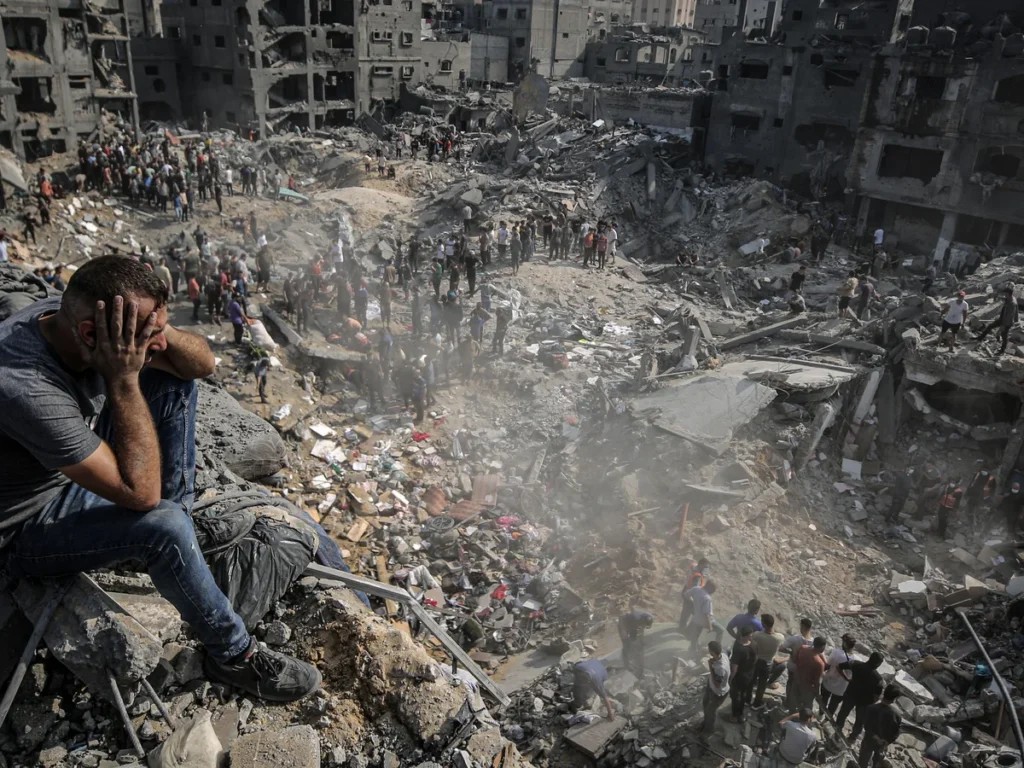
Gaza Herald — For thousands of Palestinians in Gaza, the danger of death no longer comes only from Israeli bombardment. Cracked walls, weakened concrete pillars, and damaged roofs now threaten families who have sought refuge in buildings that could collapse under the weight of winter rains.
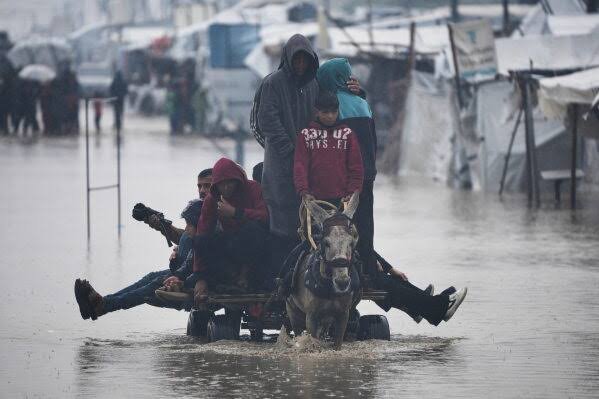
As storms sweep across the devastated Gaza Strip, displaced families face an agonizing choice: remain inside homes severely damaged by Israeli airstrikes and artillery fire, or return to makeshift tents that offer little protection against heavy rain, freezing temperatures, and powerful winds.
For many, neither option provides safety.
Repeated storms have flooded displacement camps, torn through fragile tents, and soaked children’s mattresses, blankets, and clothing. Meanwhile, rainwater seeping into damaged buildings has raised fears of sudden structural collapses.
With homes and infrastructure destroyed across Gaza and severe shortages of temporary housing, construction materials, and reinforcement equipment, thousands of families continue living in buildings they know could collapse.
Their decision to stay is not a reflection of confidence in the structures around them, but of the desperate shortage of alternatives.
Civil Defense Warns of Buildings at Risk of Collapse
Gaza’s Civil Defense Directorate has issued urgent warnings to residents living in buildings damaged during Israel’s military offensive, urging them to evacuate structures at risk of collapse.
The agency warned that rainwater penetrating cracked walls, damaged foundations, and weakened structural supports could worsen existing damage and trigger partial or complete collapses.
It urged residents not to return to damaged buildings until specialized engineering teams have inspected them and confirmed they are safe.
Civil Defense also called for children, women, and older residents to be kept away from unstable structures and surrounding areas.
However, the agency acknowledged that many families remain in dangerous buildings because they lack safe alternatives.
It appealed to international humanitarian and human rights organizations to provide emergency housing for families facing the threat of structural collapse.
Last Thursday, Gaza’s Ministry of Public Works and Housing announced that residents of four severely damaged buildings in Gaza City had been given until November 10 to evacuate voluntarily.
The buildings were identified as the Foura Building, Siam Building, Al-Bayadh Building, and Al-Najma Building.
Following engineering assessments, the ministry warned that the structures posed an immediate threat to residents and neighboring properties. It said compulsory evacuation measures could follow if occupants failed to leave by the deadline.
‘I Will Not Return to Life in a Tent’
For 42-year-old Mohammad Abdel Aal, the warnings have brought another painful decision.
He lives with his wife and five children in a badly damaged home, fully aware that its cracked walls and weakened roof could collapse.
“I know my house is no longer safe. I know the walls are cracked and the roof is nothing like it was before the war,” Abdel Aal told the Palestinian newspaper Felesteen.
“Sometimes, when I hear a loud noise or feel the building shaking, I am overwhelmed by the fear that this could be the moment the house collapses over our heads.”
Yet leaving the building would mean exposing his family to another winter in a tent.
“But what am I supposed to do? Where can I take my wife and five children? Should I take them out onto the streets and leave them exposed to the cold and rain?” he asked.
Abdel Aal has already experienced the harsh conditions of displacement camps, where families struggle with overcrowding, a lack of privacy, and inadequate protection from severe weather.
He recalled waking one night to find rainwater pouring into his family’s tent.
“Once, we woke up to find water pouring into our tent. Our blankets, clothes, and mattresses were soaked, and we spent hours trying to save whatever we could,” he said.
“My children were shivering from the cold, and I had nothing I could do for them.”
His refusal to evacuate, he explained, is driven by the absence of safe housing.
“We are not refusing to evacuate because we enjoy risking our lives. We are refusing because we have nowhere else to go.”
Abdel Aal said his family urgently needs a prefabricated housing unit or another form of temporary shelter capable of protecting his children from winter weather.
More than a year after the October 2025 ceasefire took effect, restrictions on the entry of prefabricated housing units, shelter materials, and reconstruction supplies continue to hamper efforts to provide safe accommodation for displaced families.
Paying $300 a Month to Live in a Building That Could Collapse
The housing crisis has also forced displaced Palestinians to pay high rents for buildings that are structurally unsafe.
Among them is 38-year-old Khaled Issa, who lives with his family in a rented house in Gaza City despite serious damage to the building.
Issa pays $300 a month for accommodation he knows could collapse.
“I pay $300 a month for this house, and I know perfectly well that it is unsafe,” he told Felesteen.
“There are visible cracks in the walls and damaged sections of the ceiling. But whenever I look for another place, I cannot find one. Even when I do find somewhere suitable, the rent is so expensive that I cannot afford it.”
The shortage of housing has left families like Issa’s choosing between unaffordable rents, damaged buildings, and exposed displacement camps.
“We did not choose this house because it is safe. We chose it because we have no other option,” he said.
For Issa, even a damaged building provides some protection from the weather that a tent cannot offer.
“Having four walls to sit between, a wall to lean against, and a roof over our heads to protect us from the rain is far better than living in a tent that floods and tears apart whenever it rains or the wind blows.”
He said people who have never spent a night in a flooded tent cannot fully understand the experience of watching their children shiver in the cold while searching desperately for somewhere dry to sleep.
Despite receiving an evacuation warning from a local emergency committee, Issa has remained in the building because no alternative accommodation has been provided.
Each approaching storm brings renewed anxiety.
As the rain intensifies, his family stays awake, watching the damaged walls and fearing that the building could give way.
Civil Defense: 2,000 Buildings at Risk, 20,000 Residents in Danger
Mahmoud Basal, spokesperson for Gaza’s Civil Defense Directorate, warned that approximately 2,000 buildings across the Gaza Strip are at immediate risk of collapse.
According to Basal, nearly 20,000 Palestinians continue living in damaged buildings and residential units despite the danger, largely because they have no access to safer housing.
He warned that winter rainfall could further weaken already damaged structures, increasing the risk of sudden collapses.
Water infiltration can worsen cracks, weaken damaged concrete, and undermine structural stability, particularly in buildings that have already sustained extensive damage from bombardment.
Basal stressed that the danger is compounded by Gaza’s severely limited emergency response capacity.
Civil Defense teams face major shortages of rescue equipment and heavy machinery needed to remove debris, reach trapped residents, and respond to building collapses.
Much of the equipment has been damaged or destroyed during the war, while restrictions on the entry of replacement machinery have further constrained rescue operations.
The shortages mean that even when dangerous buildings are identified, authorities often lack the resources needed to secure them or provide residents with safe alternatives.
Winter Deepens Gaza’s Shelter Emergency
For thousands of Palestinian families, the arrival of winter has intensified a housing crisis already shaped by widespread destruction, repeated displacement, and restrictions on reconstruction supplies.
Families are being warned to evacuate buildings that could collapse, yet many have no safe place to relocate.
Those who leave may find themselves in tents vulnerable to flooding, strong winds, and falling temperatures. Those who remain face the possibility of being buried beneath weakened concrete.
The shortage of prefabricated housing, structural reinforcement materials, and emergency shelter supplies has left residents exposed to dangers that grow more severe with each storm.
For Abdel Aal, Issa, and thousands of others, the choice is not between a safe home and a dangerous one.
It is between a roof that could collapse over their children and a tent that cannot keep out the rain.