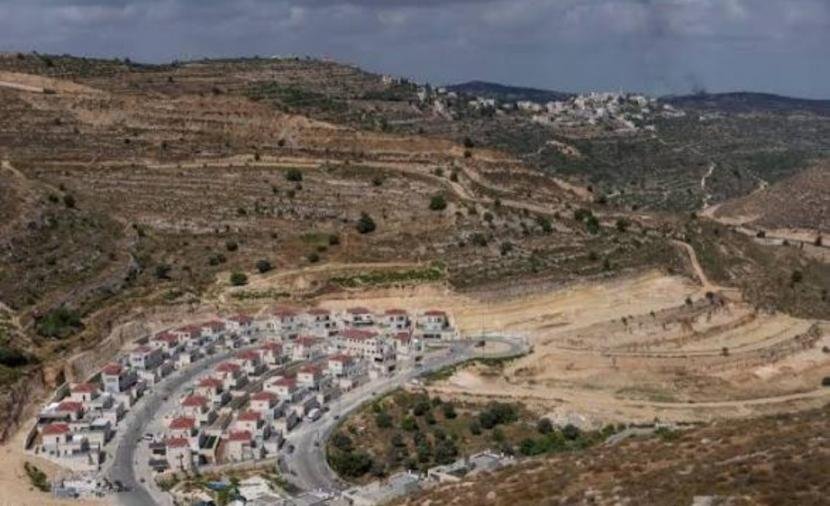
Gaza Herald – The Israeli military occupation in the occupied West Bank has expanded its use of military orders beyond land confiscation to target agricultural details and plant cover. These orders aim to uproot olive trees and remove crops under security and military pretexts. Authorities have recently intensified issuing such orders alongside placing thousands of dunams under seizure for various purposes, opening the door for settlement expansion.
Since the 1967 occupation, military orders have served as a primary tool for controlling vast Palestinian land areas through multiple legal paths. According to the Wall and Settlement Resistance Authority, the current right-wing government has confiscated approximately 109,141 dunams since late 2022 using parallel military, administrative, and legal instruments that altered land status and restricted usage.
The authority specified that 69,084 dunams were designated under natural reserve boundary modification orders via ten decisions. Additionally, 29,131 dunams were declared state lands through twenty-two measures, while 5,829 dunams were subject to seizure orders across 239 documents. Another 5,572 dunams were affected by seventeen expropriation orders.
Data reveals that confiscation peaked during the first two years of the current government. In 2023, 50,525 dunams were seized, followed by 46,597 dunams in 2024. This totals 97,122 dunams, representing roughly 89 percent of the overall figure collected under these measures during this period.
Amir Dawood, Director of Documentation and Publishing at the resistance authority, stated that tree removal orders differ from land confiscation or ownership deprivation. He explained that these orders target only the plant cover on a specific plot, often citing security risks for settlers or construction sites. Dawood emphasized that these do not constitute land confiscation.
Dawood clarified that “state land” declarations differ significantly, aiming to transfer ownership to the Custodian of Government Property. This entity then holds the authority to allocate these lands for future settlements. He distinguished between temporary military measures like seizure orders and permanent planning measures aimed at enduring control and land transfer.
According to Dawood, tree removal orders surged notably after October 7, 2023. Records show four such orders in 2023, rising to nineteen in 2024, forty-nine in 2025, and fifty-three by September 2026. This upward curve reflects an expanded use of security justifications to impose facts on the ground.
Regarding area sizes, the fifty-three recent orders targeted 2,287 dunams of tree cover. In contrast, broader confiscation orders affected 6,817 dunams in 2026 and 5,572 dunams in 2025. Previous years saw higher volumes, with approximately 46,000 dunams in 2024 and 50,000 dunams in 2023.
Jamal Jumaa, a specialist in settlement affairs, asserted that these military orders aim to seize land under the guise of establishing military camps before converting them into settlements. He warned that these mechanisms remain a key instrument for the Civil Administration to expand infrastructure and secure zones around settlements.
This report was produced in the Gaza Herald newsroom.