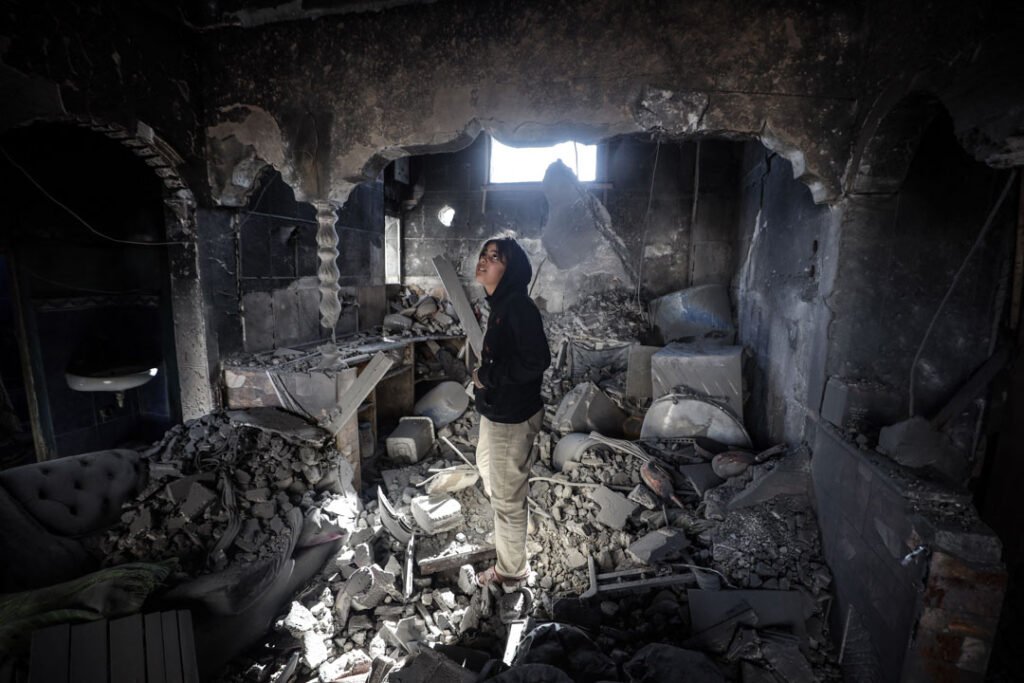
Gaza Herald _Long before the war turned much of Gaza into rubble, its streets, churches, mosques, mosaics, and ancient artifacts told the story of civilizations that had flourished there for thousands of years.
Today, as bombs continue to erase landmarks and bury history beneath the debris, a group of Palestinian volunteers is working against time to preserve what remains—not only to protect priceless artifacts, but to ensure that Gaza’s history survives even as much of its present is being destroyed.
As Gaza’s historic landmarks continue to suffer extensive damage during the ongoing war, a group of Palestinian volunteers is racing to rescue what remains of the territory’s cultural heritage. Working inside a large tent in Khan Younis with limited resources, they are carefully cleaning, documenting, and preserving ancient artifacts and historical records in an effort to protect Gaza’s history for future generations.
According to the United Nations, more than 160 historical and cultural sites across Gaza have been damaged since the war began, with many dating back thousands of years.
Mohammed Abu Lahia, a Palestinian visual artist involved in the initiative, said several ancient mosaics have already been destroyed or severely damaged during the conflict.
He stressed that preserving what remains is not only about protecting archaeological treasures but also about safeguarding Palestinian identity and ensuring future generations remain connected to their cultural heritage.
Protecting Centuries of History
Over thousands of years, Gaza has been shaped by numerous civilizations—including the Persians, Greeks, Romans, Byzantines, and Ottomans—leaving behind a rich collection of churches, mosques, ports, mosaics, and other archaeological treasures.
Muhannad Abu Lahia, a cultural heritage guide with the Mayasem Association for Culture and Arts, said volunteers are working to preserve artifacts spanning thousands of years.
Among the items being protected is a 5,000-year-old stone mortar once used for grinding grains and herbs.
Inside the preservation tent, cleaned and cataloged artifacts are carefully stored on shelves while volunteers continue documenting additional discoveries.
Saving History Without Specialized Equipment
With severe restrictions limiting the entry of conservation supplies into Gaza, volunteers have been forced to improvise.
Instead of professional restoration tools, they use ordinary paintbrushes to remove dust from fragile mosaics. They have also built a simple scanning station using a camera mounted above a box lined with black paper to digitally preserve old photographs, maps, and paper documents.
The digitized materials are then archived electronically to reduce the risk of permanent loss.
More Than Ancient Artifacts
The preservation effort extends beyond archaeological objects.
Many families displaced by the war have entrusted volunteers with documents and personal collections dating to the late Ottoman era, the British Mandate, the Egyptian administration, and the early years of the Palestinian Authority.
Volunteer Taghreed Hajjari said one collection includes historical maps of Khan Younis produced during the British Mandate.
Elsewhere in the tent, volunteers painstakingly reconstruct damaged contemporary mosaics by matching hundreds of broken stone fragments with photographs of the original artwork.
A Race Against Time
Despite these efforts, many historical artifacts remain inaccessible inside areas currently under Israeli military control, making recovery operations extremely difficult.
Even so, volunteers say they remain committed to preserving everything they can reach, including historical newspapers, official records, photographs, and oral testimonies collected from elderly Palestinians.
Hajjari said these firsthand accounts have been carefully documented alongside written archives to ensure Gaza’s history is preserved for future generations.
She said the project is about protecting not only physical artifacts, but also the collective memory of a people determined to keep their history alive despite the destruction of war.